

- Updated: July 2, 2026
- 8 min read
Structural Distinguishability of Static and Adaptive Policy Regimes in Agent-Based Regulatory Simulation
Direct Answer
The paper introduces a controlled simulation benchmark that isolates the effects of static versus adaptive policy regimes in an emissions‑regulation agent‑based model (ABM). By systematically comparing four policy‑agent configurations, it shows that average outcomes can mask fundamentally different regulatory dynamics, urging practitioners to evaluate “regime distinguishability” rather than just mean performance.
Background: Why This Problem Is Hard
Agent‑based models are the go‑to tool for exploring how complex socio‑technical systems respond to policy levers such as carbon caps, traffic pricing, or financial regulations. Yet most policy‑oriented ABMs treat regulation as a fixed scenario parameter—essentially a static rule that never changes during a simulation run. This simplification creates two intertwined blind spots:
- Agent adaptation hidden: Real‑world firms, households, or autonomous systems continuously learn and adjust their behavior in response to observed outcomes. A static policy cannot reveal whether a policy’s success stems from agents’ willingness to adapt or from the policy’s inherent robustness.
- Policy adaptation ignored: Modern regulators increasingly employ feedback‑driven mechanisms (e.g., dynamic emissions caps, safety‑margin adjustments). Ignoring policy dynamics prevents us from understanding the interaction between a learning regulator and learning agents.
Existing ABM studies either (a) keep both policy and agents static, or (b) let agents adapt while the policy remains fixed. Few works explore the full combinatorial space of static vs. adaptive policies and agents, leaving a methodological gap that hampers reliable policy inference.
What the Researchers Propose
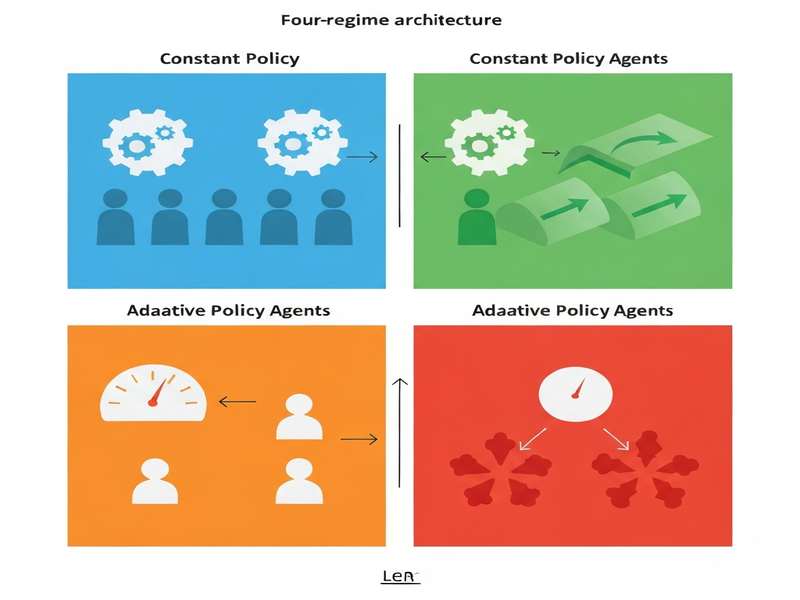
Building on a previously defined four‑regime architecture, the authors propose a benchmark that explicitly separates the four possible configurations:
- Constant policy / Constant agents (C‑C): Both the regulator’s rule and the agents’ strategies remain unchanged throughout the run.
- Constant policy / Adaptive agents (C‑A): The regulator sticks to a fixed rule while agents learn from the environment.
- Adaptive policy / Constant agents (A‑C): The regulator updates its rule based on observed outcomes, but agents follow a static strategy.
- Adaptive policy / Adaptive agents (A‑A): Both sides continuously adjust, creating a co‑evolutionary loop.
To populate the “adaptive policy” slot, the study implements three well‑known controller archetypes drawn from control theory:
- Setpoint control: The regulator aims to keep emissions exactly at the cap, correcting any deviation immediately.
- Safety‑margin control: The regulator adds a conservative buffer to the cap, reducing the likelihood of violations at the cost of stricter limits.
- One‑sided control: The regulator only reacts when emissions exceed the cap, otherwise leaving the rule unchanged, which can lead to “ratcheting” toward over‑conservatism when agents also adapt.
How It Works in Practice
The benchmark uses a single, highly configurable emissions‑regulation ABM. The core components are:
- Environment: A synthetic economy where firms emit a quantifiable pollutant each period.
- Agents (firms): Each firm decides production levels based on profit motives, cost of emissions, and any learned policy feedback.
- Policy controller: Implements one of the three adaptive strategies or a fixed cap.
- Metrics collector: Tracks scalar indicators (average emissions, violation frequency), cap‑relative diagnostics (how far the system drifts from the target), and trajectory motifs (patterns such as oscillations or monotonic drift).
During a simulation run, the following workflow repeats each time step:
- The policy controller announces the current emissions cap (static or adjusted).
- Agents observe the cap, their own past emissions, and any market signals, then choose production levels. Adaptive agents update their internal strategy using a simple reinforcement‑learning rule.
- The environment aggregates emissions, checks for cap violations, and feeds the result back to the controller.
- The controller updates its rule according to its archetype (setpoint, safety‑margin, or one‑sided).
- Metrics are logged for later analysis.
What distinguishes this approach from prior work is the deliberate isolation of each regime under identical stochastic seeds and parameter settings, allowing a clean attribution of observed dynamics to the policy‑agent interaction rather than to random variation.
Evaluation & Results
The authors run extensive Monte‑Carlo experiments across the four regimes, each with three adaptive controllers and a baseline fixed‑policy scenario. Key evaluation dimensions include:
- Violation frequency: How often emissions exceed the legal cap.
- Boundary crossing intensity: Magnitude of overshoot when violations occur.
- Policy conservatism index: Average distance between the announced cap and the theoretical optimum.
- Trajectory motifs: Visual patterns such as “chasing” (policy constantly lags behind emissions) or “ratcheting” (progressive tightening of caps).
Findings can be summarized as follows:
| Regime | Controller Type | Typical Violation Pattern | Interpretation |
|---|---|---|---|
| C‑C | Fixed | Steady‑state overshoot or compliance depending on cap level | Baseline; no learning dynamics to mitigate or exacerbate violations. |
| C‑A | Fixed | Reduced overshoot as agents learn to stay under the cap | Agent adaptation alone can improve compliance, but only up to a limit. |
| A‑C (Setpoint) | Setpoint | Frequent boundary crossings; policy constantly chases emissions | Pure tracking leads to instability when agents are static. |
| A‑C (Safety‑margin) | Safety‑margin | Few violations; caps are conservatively lower than optimum | Conservatism trades off economic efficiency for reliability. |
| A‑C (One‑sided) | One‑sided | Initial compliance, then gradual tightening (ratcheting) | Policy reacts only to excess, leading to over‑conservatism over time. |
| A‑A (Setpoint) | Setpoint | Oscillatory dynamics; agents and policy chase each other | Co‑evolution amplifies instability without damping mechanisms. |
| A‑A (Safety‑margin) | Safety‑margin | Low violation frequency, but higher average emissions cost | Combined conservatism and learning yields stable yet sub‑optimal outcomes. |
| A‑A (One‑sided) | One‑sided | Rapid ratcheting; caps become overly strict as agents adapt | Adaptive agents accelerate the policy’s drift toward over‑conservatism. |
Crucially, the benchmark recovers the expected archetype behavior while also exposing subtle cross‑effects: for example, safety‑margin control remains effective in the A‑A regime, but the one‑sided controller’s ratcheting is dramatically amplified when agents also adapt. These insights would be invisible if one only examined average emissions across runs.
For readers who want to dive deeper into the raw data, the full experimental suite is available in the original arXiv paper.
Why This Matters for AI Systems and Agents
Regulatory simulation is no longer a niche academic exercise; enterprises are embedding ABMs into digital twins, compliance dashboards, and autonomous decision‑making pipelines. The benchmark’s emphasis on “regime distinguishability” has three immediate practical implications:
- Design of adaptive compliance engines: Companies building AI‑driven compliance tools can now justify the inclusion of safety‑margin logic to avoid costly oscillations, especially when their downstream agents (e.g., supply‑chain bots) also learn.
- Evaluation standards for policy‑aware agents: Instead of reporting a single average KPI, developers should surface trajectory motifs and violation patterns, enabling stakeholders to see whether a policy is merely “averaging out” risk or truly stabilizing the system.
- Integration with orchestration platforms: Modern AI orchestration stacks (such as the UBOS platform overview) can ingest the benchmark’s scalar indicators to trigger automated policy adjustments, creating a feedback loop that mirrors the A‑A regime without the unintended ratcheting.
In short, the research equips AI architects with a diagnostic toolkit that separates the “what” (average emissions) from the “how” (dynamic interaction patterns), a distinction that is essential for building trustworthy, resilient AI‑enabled regulatory systems.
What Comes Next
While the benchmark clarifies many dynamics, several open challenges remain:
- Scalability to multi‑policy environments: Real‑world regulation often involves overlapping caps (e.g., CO₂, NOx, water usage). Extending the four‑regime framework to multi‑dimensional policy spaces is an active research frontier.
- Rich agent heterogeneity: The current agents share a common learning rule. Future work should explore heterogeneous learning rates, risk preferences, and network effects.
- Human‑in‑the‑loop validation: Translating simulation insights into actionable policy requires stakeholder engagement. Embedding the benchmark into decision‑support dashboards could bridge that gap.
Practitioners interested in applying these concepts can start by prototyping on the UBOS for startups environment, which offers ready‑made ABM templates and a low‑code workflow studio. For larger enterprises, the Enterprise AI platform by UBOS provides scalable compute, versioned model registries, and integrated policy‑engine services.
Pricing details and a comparison of feature tiers are available on the UBOS pricing plans page, helping organizations align investment with their regulatory simulation maturity.
Visual Insight
The diagram below visualizes the four policy‑agent regimes and the three adaptive controllers evaluated in the study.
Call to Action
Ready to bring rigorous, regime‑aware simulation into your compliance workflow? Visit the UBOS homepage to explore consulting services, or reach out directly through our About UBOS contact page. Empower your organization with AI‑driven policy design that knows the difference between static rules and adaptive intelligence.
Andrii Bidochko
CTO UBOS
Andrii Bidochko is an AI entrepreneur and researcher focused on AI agents, reinforcement learning, and autonomous systems. He writes about the technologies shaping the future of machine intelligence, from frontier models and agent architectures to real-world AI applications.