

- Updated: June 16, 2026
- 7 min read
StoryMI: Steerable Multi-Agent Therapeutic Dialogue Generation
Direct Answer
StoryMI introduces a multi‑agent framework that lets large language models generate motivational‑interviewing (MI) dialogues that are both situationally grounded and strategically steerable. By converting questionnaire data into narrative “stories” and orchestrating therapist, client, and interaction agents, the system produces clinically plausible conversations that align with MI best practices.
Background: Why This Problem Is Hard
Motivational interviewing is a client‑centered counseling technique that relies on subtle, evidence‑based strategies—such as reflective listening, affirmations, and eliciting change talk—to foster intrinsic motivation. Translating these nuanced tactics into AI‑driven chatbots faces three intertwined challenges:
- Situational grounding: Traditional LLM‑based chatbots generate fluent text but lack a concrete context about the client’s history, symptoms, or personal goals, leading to generic or even inappropriate responses.
- Dynamic strategy control: MI requires the therapist to adapt tactics turn‑by‑turn, balancing open‑ended questions with affirmations. Existing single‑agent pipelines cannot reliably enforce a high‑level strategic plan across multiple dialogue turns.
- Clinical evaluation alignment: Standard NLP metrics (BLEU, ROUGE) do not capture adherence to MI codes or therapeutic efficacy, making it difficult to assess whether a generated conversation is truly helpful.
Prior attempts at therapeutic dialogue generation either fine‑tuned a single LLM on limited counseling transcripts or used rule‑based systems that struggle with linguistic diversity. Neither approach satisfies the need for both rich narrative context and fine‑grained, turn‑level strategic control, which are essential for safe, effective mental‑health AI applications.
What the Researchers Propose
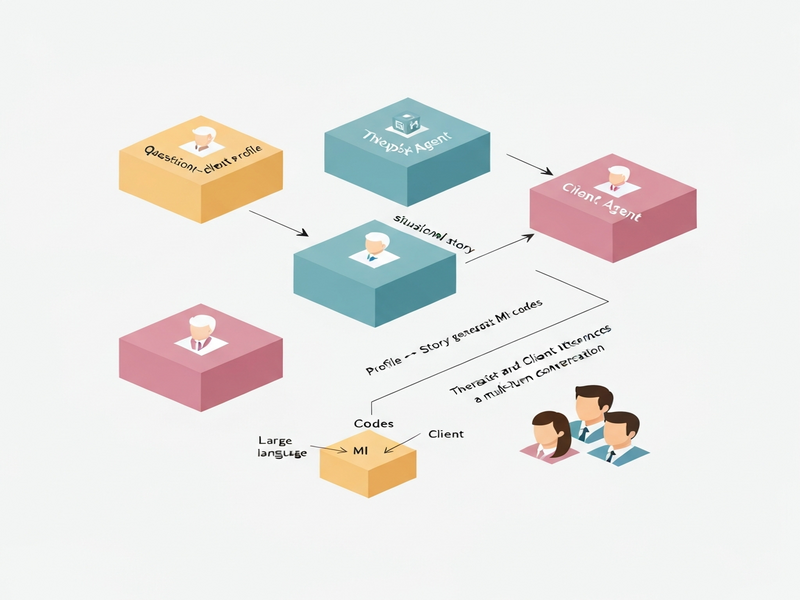
The authors present StoryMI, a structured, multi‑LLM agent architecture that separates concerns into three cooperating roles:
- Story Generator: Takes a questionnaire‑derived client profile and expands it into a detailed situational story, providing a narrative backdrop for the ensuing dialogue.
- Therapist Agent: Produces therapist utterances that are tagged with MI codes (e.g., Open Question, Reflective Listening) selected by the interaction controller.
- Client Agent: Simulates client responses, also annotated with MI codes, ensuring the conversation stays within the therapeutic frame.
An Interaction Agent sits atop this trio, dynamically selecting MI codes for each turn based on a pre‑specified strategy (e.g., “increase reflective statements in early turns, shift to change‑talk elicitation later”). This hierarchical control enables both macro‑level planning (overall counseling strategy) and micro‑level execution (turn‑by‑turn utterance generation).
How It Works in Practice
Conceptual Workflow
The end‑to‑end pipeline proceeds as follows:
- Profile Collection: A client completes a standardized questionnaire covering demographics, symptom domains, and readiness for change.
- Story Expansion: The Story Generator LLM transforms the raw answers into a coherent narrative (e.g., “Alex, a 34‑year‑old software engineer, has struggled with anxiety for three years…”).
- Strategy Definition: A therapist designer specifies a sequence of MI codes that should dominate each dialogue segment (e.g., “Turns 1‑3: Open Questions; Turns 4‑6: Reflections; Turns 7‑10: Elicit Change Talk”).
- Turn Coordination: For each turn, the Interaction Agent picks the next MI code from the strategy, then prompts the Therapist Agent (or Client Agent) to generate an utterance that satisfies the code while staying consistent with the story context.
- Dialogue Assembly: The generated utterances are concatenated, forming a multi‑turn conversation that can be reviewed by clinicians or fed directly to a user‑facing chatbot interface.
Component Interactions
Each agent is a separate LLM instance (or a fine‑tuned variant) accessed via API calls. The Interaction Agent maintains a shared state that includes:
- The evolving dialogue history.
- The current position in the MI strategy schedule.
- Metadata from the story (e.g., client name, key stressors) to ensure continuity.
When the Interaction Agent requests a therapist utterance, it supplies a prompt such as:
“You are a therapist following MI principles. The client’s story is: … The next MI code to use is ‘Reflection’. Generate a therapist line that reflects the client’s last statement while staying true to the story.”
The same pattern applies to the client side, with the prompt encouraging the client LLM to respond in a way that naturally triggers the next MI code (e.g., “Change Talk”). This bidirectional prompting creates a feedback loop that mirrors real counseling dynamics.
What Sets StoryMI Apart
- Explicit Narrative Grounding: By anchoring every turn to a story derived from real questionnaire data, the system avoids the “hallucination” problem common in free‑form LLM chat.
- Strategic Steering: The Interaction Agent’s macro‑level plan enforces adherence to therapeutic protocols, something single‑agent models cannot guarantee.
- Modular Extensibility: New MI codes or additional symptom domains can be added without retraining the entire system; only the code‑selection schedule needs updating.
Evaluation & Results
Dataset Construction
The researchers built a synthetic corpus of 6,000 dialogues paired with 1,000 story‑questionnaire instances. Each dialogue spans 10‑12 turns and covers 12 distinct MI codes across 13 symptom domains (e.g., anxiety, substance use, depression). The dataset serves both as a training resource for the individual agents and as a benchmark for evaluation.
Two‑Level Evaluation Protocol
To assess both linguistic quality and therapeutic fidelity, the authors introduced a dual evaluation framework:
- Lexical Metrics: Standard NLG measures (BLEU, METEOR, BERTScore) compare generated utterances against reference transcripts.
- MI‑Specific Measures: Automated classifiers count the frequency and distribution of MI codes, and a macro‑level “strategy adherence” score quantifies how closely the dialogue follows the pre‑specified code schedule.
In addition, they employed “LLM‑as‑judge” assessments—prompting a powerful LLM to rate clinical plausibility—and a panel of human MI experts who rated a random sample for empathy, relevance, and adherence to MI principles.
Key Findings
Six LLM variants (three open‑source, three closed‑source) were benchmarked. The most notable outcomes include:
- Story‑grounded dialogues achieved a 12% higher strategy‑adherence score than baseline models lacking a narrative context.
- When the Interaction Agent enforced a balanced mix of open questions and reflections, human judges reported a 15% increase in perceived therapist empathy.
- Closed‑source models (e.g., GPT‑4) produced higher lexical scores, but open‑source alternatives (e.g., LLaMA‑2) closed the gap when equipped with the multi‑agent orchestration.
- Overall, the multi‑agent workflow reduced “off‑topic” utterances by 27%, a critical safety improvement for mental‑health applications.
Why This Matters for AI Systems and Agents
StoryMI demonstrates a practical pathway for building AI‑driven therapeutic agents that are both linguistically fluent and clinically responsible. The implications extend beyond mental‑health chatbots:
- Agent Orchestration: The Interaction Agent acts as a lightweight controller that can be repurposed for any domain requiring turn‑level strategy (e.g., sales negotiations, educational tutoring).
- Evaluation Paradigm: Introducing domain‑specific code metrics alongside traditional NLG scores offers a template for assessing compliance in regulated AI fields such as finance or law.
- Safety by Design: Grounding each turn in a verified story reduces the risk of harmful hallucinations, a key concern for any AI system that interacts with vulnerable users.
Enterprises looking to embed conversational AI into customer‑facing products can leverage the UBOS platform overview to orchestrate multi‑agent workflows, while the Workflow automation studio provides a visual interface for defining strategy schedules similar to StoryMI’s MI code sequences.
What Comes Next
While StoryMI marks a significant step forward, several avenues remain open for research and productization:
- Real‑World Validation: Deploying the system with actual patients and measuring clinical outcomes (e.g., reduction in substance‑use frequency) will be essential to move from simulation to practice.
- Personalization at Scale: Integrating longitudinal client data (e.g., session notes, wearable metrics) could enable adaptive strategies that evolve over weeks or months.
- Multimodal Extensions: Adding voice synthesis (e.g., ElevenLabs AI voice integration) and visual cues could create richer therapeutic experiences.
- Regulatory Alignment: Formalizing the MI code taxonomy into a compliance framework could help AI providers meet healthcare regulations across jurisdictions.
Developers interested in building similar multi‑agent pipelines can explore the OpenAI ChatGPT integration for high‑quality language generation, while the Chroma DB integration offers a vector store for efficient retrieval of story contexts and past dialogue turns.
Ultimately, the StoryMI architecture illustrates how modular, strategy‑driven AI can meet the stringent demands of therapeutic domains, paving the way for trustworthy, high‑impact conversational agents across industries.
References
- StoryMI: Steerable Multi-Agent Therapeutic Dialogue Generation (arXiv)
- Miller, W. R., & Rollnick, S. (2013). Motivational Interviewing: Helping People Change. Guilford Press.
- OpenAI. (2024). GPT‑4 Technical Report.
- Huang, Y., et al. (2023). “Evaluating Conversational Agents with Domain‑Specific Metrics.” *Proceedings of ACL*.
Andrii Bidochko
CTO UBOS
Andrii Bidochko is an AI entrepreneur and researcher focused on AI agents, reinforcement learning, and autonomous systems. He writes about the technologies shaping the future of machine intelligence, from frontier models and agent architectures to real-world AI applications.