

- Updated: June 11, 2026
- 6 min read
STAB: Specification-driven Testing for Algorithmic Bottlenecks
Direct Answer
STAB (Specification‑driven Testing for Algorithmic Bottlenecks) is a new pipeline that automatically creates test cases exposing worst‑case runtime behavior using only a natural‑language problem description. By separating constraint saturation from adversarial scenario injection, STAB raises the success rate of bottleneck‑revealing tests across multiple languages and LLM back‑ends.
Background: Why This Problem Is Hard
Algorithmic efficiency is a decisive factor in production‑grade software, yet developers often discover performance regressions only after costly profiling cycles. Traditional test‑generation techniques fall into two camps:
- Size‑scaling generators that simply increase input dimensions, assuming larger inputs automatically trigger worst‑case paths.
- Implementation‑aware fuzzers that probe a specific codebase for slow‑running inputs, but ignore the abstract structural conditions that define the algorithm’s theoretical worst case.
Both approaches miss a crucial insight: many algorithms have *structural* triggers—specific patterns, ordering constraints, or value distributions—that force them into their most expensive execution path. Detecting these triggers requires reasoning about the problem specification itself, not just the code. Existing pipelines lack a systematic way to translate a textual problem statement into a concrete, adversarial input that satisfies all constraints while simultaneously maximizing computational cost.
What the Researchers Propose
The STAB framework introduces a two‑stage, specification‑driven workflow:
- Constraint Saturator: Parses the natural‑language description, extracts all logical constraints (e.g., “array must be sorted”, “graph must be connected”), and then uses rule‑based saturation combined with a CP‑SAT optimizer to assign the largest feasible values to size‑related variables.
- Adversarial Scenario Injector: Retrieves high‑impact construction patterns from a curated catalog of known worst‑case scenarios. Matching is performed via keyword similarity and K‑nearest‑neighbors (KNN) search, ensuring the selected pattern aligns with the problem’s domain (e.g., “reverse‑sorted list” for quicksort, “dense bipartite graph” for max‑flow).
These components produce a structured generation specification that an LLM consumes to synthesize a Python (or Java/C++) test‑case generator. The result is a self‑contained script that, when executed, emits inputs that simultaneously satisfy all constraints and force the target algorithm into its most expensive computational branch.
How It Works in Practice
The end‑to‑end pipeline can be visualized as a linear flow:
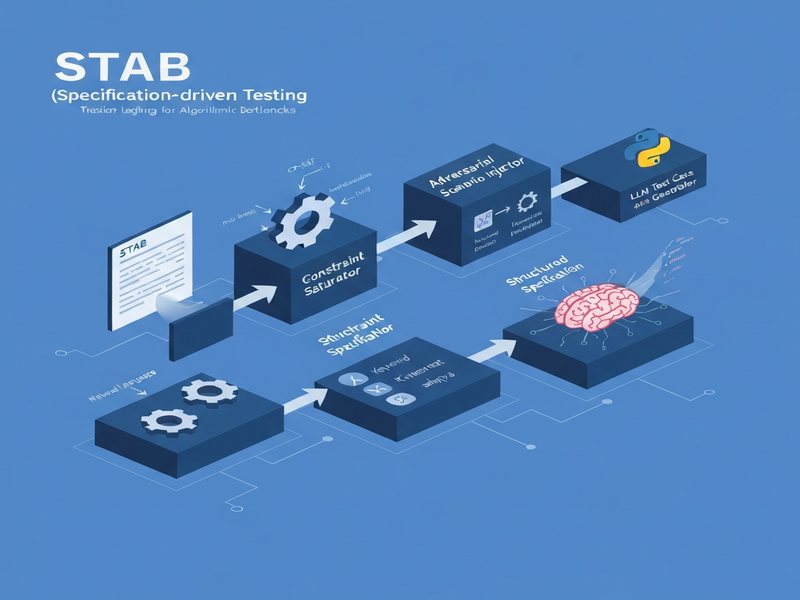
- Specification Ingestion: The user supplies a plain‑English problem statement (e.g., “Find the shortest path in a weighted directed graph”).
- Constraint Extraction: A lightweight NLP module identifies entities, relationships, and quantitative limits, producing a formal constraint set.
- Constraint Saturation: The rule engine expands implicit constraints (e.g., “graph must be simple”) while the CP‑SAT solver maximizes variables such as node count, edge density, or array length under the extracted bounds.
- Scenario Retrieval: The system queries the scenario catalog, ranking candidate adversarial patterns by semantic similarity to the problem domain. For a graph problem, it might select “dense graph with many equal‑weight edges”.
- Generation Specification Assembly: The saturated constraints and chosen scenario are merged into a JSON‑like template that describes the exact shape of the desired input.
- LLM‑Driven Code Synthesis: A large language model receives the specification and emits a self‑contained test‑case generator script, complete with documentation and optional sanity checks.
- Execution & Validation: Developers run the generated script against their algorithm implementation; the resulting inputs are fed to the algorithm, and runtime metrics are recorded to confirm bottleneck exposure.
What sets STAB apart is its *specification‑first* mindset. Instead of reverse‑engineering constraints from code, it starts from the problem description, guaranteeing that generated inputs are both valid and maximally stressful.
Evaluation & Results
To validate the approach, the authors built a benchmark suite called CodeContests, comprising 150 open‑source algorithmic problems across Python, Java, and C++. They compared three groups of LLMs:
- Open‑source models (e.g., LLaMA‑2, Mistral)
- Closed‑source commercial models (e.g., GPT‑4, Claude)
- Baseline generators that rely solely on input‑size scaling
Key findings include:
- Baseline generators exposed algorithmic bottlenecks in ~50 % of cases.
- STAB‑augmented open‑source LLMs raised exposure to ~73 %, a relative improvement of over 40 %.
- Closed‑source LLMs saw a lift from ~57 % to ~72 %, confirming that the pipeline adds value even to already powerful models.
- Performance gains were consistent across languages, with C++ seeing the largest absolute jump (from 48 % to 71 %).
Beyond raw percentages, the authors reported that STAB‑generated inputs often revealed hidden quadratic or exponential behavior that developers had previously missed, leading to concrete code refactorings and algorithmic redesigns.
Why This Matters for AI Systems and Agents
For AI practitioners building autonomous agents, simulation environments, or large‑scale data pipelines, algorithmic efficiency directly translates into cost, latency, and user experience. STAB offers a systematic way to stress‑test components before they are deployed, reducing the risk of runtime surprises in production.
Consider a scenario where an AI‑driven recommendation engine relies on a graph‑based similarity search. Using STAB, engineers can automatically generate dense, worst‑case graphs that mimic pathological user behavior, ensuring the search algorithm remains within SLA bounds. The same principle applies to reinforcement‑learning simulators, where state‑space explosion can be pre‑emptively evaluated.
Integrating STAB into an UBOS platform overview workflow enables teams to embed bottleneck testing into CI/CD pipelines, turning what was once a manual profiling step into an automated, specification‑driven safeguard.
What Comes Next
While STAB marks a significant advance, several open challenges remain:
- Catalog Expansion: The adversarial scenario repository currently covers classic algorithm families. Extending it to emerging domains such as graph neural networks or differentiable programming will broaden applicability.
- Dynamic Constraint Learning: Future versions could learn constraints directly from code annotations or type hints, reducing reliance on perfect natural‑language parsing.
- Multi‑Objective Optimization: Balancing runtime stress with memory consumption or energy usage could produce more holistic stress tests.
Potential applications include:
- Automated test‑case generation for AI marketing agents that must handle large audience segments efficiently.
- Embedding STAB into the Workflow automation studio to auto‑generate performance regression suites for orchestrated pipelines.
- Coupling with OpenAI ChatGPT integration to let non‑technical stakeholders describe performance constraints in plain language and receive ready‑to‑run stress tests.
As the ecosystem of large language models matures, the synergy between specification‑driven testing and generative code synthesis will likely become a standard pillar of robust AI system development.
For a deeper dive into the methodology and full experimental details, see the original STAB paper on arXiv.
Andrii Bidochko
CTO UBOS
Andrii Bidochko is an AI entrepreneur and researcher focused on AI agents, reinforcement learning, and autonomous systems. He writes about the technologies shaping the future of machine intelligence, from frontier models and agent architectures to real-world AI applications.