

- Updated: June 23, 2026
- 6 min read
Specifying AI-SDLC Processes: A Protocol Language for Human-Agent Boundaries
Direct Answer
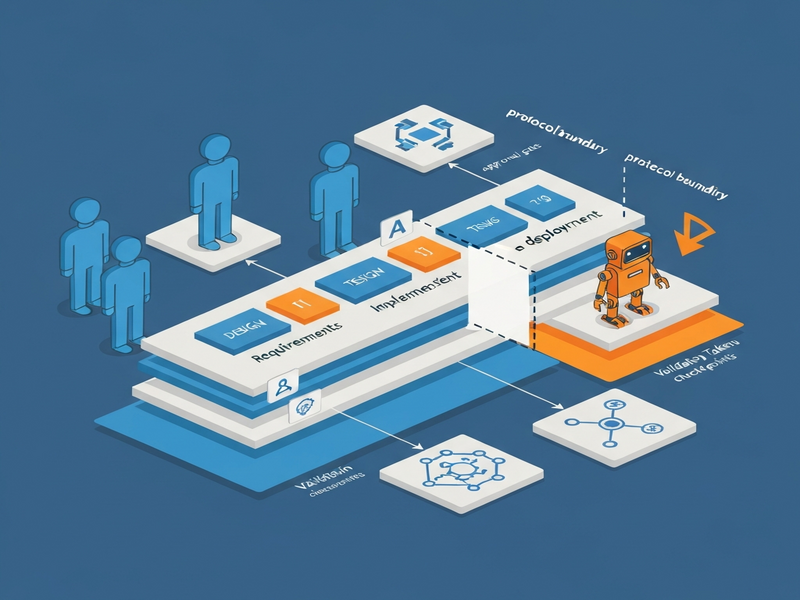
The paper introduces AI‑SDLC Protocol Language (APPL), a formal specification language that lets teams define precise boundaries, approval gates, and governance constraints between human developers and AI agents throughout the software development lifecycle. By codifying these interactions, APPL makes it possible to enforce accountability, reduce “agent‑drift,” and integrate AI contributors as first‑class, auditable team members.
Background: Why This Problem Is Hard
AI agents have moved from isolated code‑generation tools to collaborative teammates that write, test, and even deploy software. This shift creates a governance vacuum: existing SDLC tools assume a clear human‑only responsibility chain, while AI agents operate under opaque prompts and stochastic outputs. The main challenges are:
- Responsibility ambiguity: When an AI suggests a design change, who must approve it?
- Compliance risk: Regulatory frameworks (e.g., ISO/IEC 42010) require traceable decision‑making, which is hard to guarantee when an agent autonomously modifies code.
- Dynamic capability boundaries: Agents evolve through fine‑tuning, making static role definitions obsolete.
- Lack of enforceable contracts: Current CI/CD pipelines cannot natively enforce “human‑only” gates for specific actions.
Prior attempts—such as ad‑hoc policy scripts, role‑based access control extensions, or custom linting rules—address symptoms but fail to provide a unified, machine‑readable contract that spans planning, coding, testing, and deployment phases. As a result, organizations either over‑constrain AI agents (wasting their potential) or under‑control them (exposing the project to hidden bugs or compliance violations).
What the Researchers Propose
APPL is a domain‑specific protocol language that lets teams declare:
- Human‑Agent Boundaries: Explicit statements of which tasks an AI may perform autonomously and which require human sign‑off.
- Approval Gates: Conditional checkpoints that trigger when an agent reaches a predefined confidence threshold or when a change impacts a regulated component.
- Governance Constraints: Rules that enforce auditability, provenance tracking, and compliance with external standards.
The language is built on three core abstractions:
- Roles – Human (e.g., “Lead Engineer”), Agent (e.g., “CodeGen‑GPT”), and Hybrid (e.g., “Human‑in‑the‑Loop Reviewer”).
- Capabilities – Fine‑grained actions such as
generate_code,run_tests,merge_pull_request. - Policies – Logical predicates that combine roles, capabilities, and contextual metadata (e.g., risk level, code ownership).
By separating the specification (APPL file) from the execution engine, the framework enables any CI/CD platform to import the contract and enforce it at runtime.
How It Works in Practice
Implementing APPL follows a straightforward workflow:
- Define the Protocol: Teams author an
.applfile that lists roles, capabilities, and policies. For example, a policy may state that “merge_pull_requestbyCodeGen‑GPTrequires aLead Engineerapproval if the affected module ispayment.” - Register Agents: Each AI service (e.g., OpenAI ChatGPT, custom fine‑tuned model) registers its capability set with the APPL runtime.
- Integrate with the Pipeline: The APPL runtime plugs into existing CI/CD tools (GitHub Actions, Jenkins, etc.) as a middleware layer that intercepts agent‑initiated events.
- Enforce at Runtime: When an agent attempts an action, the runtime evaluates the relevant policy. If the condition fails, the request is paused and a human is notified.
- Audit & Trace: Every decision—whether approved automatically or escalated—is logged with immutable provenance metadata, enabling post‑mortem analysis and regulatory reporting.
What sets APPL apart is its declarative nature: instead of hard‑coding checks in scripts, teams write high‑level contracts that the engine interprets. This makes the system adaptable to new agents, evolving capabilities, or changing compliance requirements without rewriting pipeline code.
Evaluation & Results
The authors evaluated APPL on three realistic software development scenarios:
- Feature Expansion: Adding a new payment gateway where the AI generated both API wrappers and unit tests.
- Security Patch Rollout: An AI agent suggested a code refactor that touched authentication modules.
- Continuous Refactoring: A long‑running “code‑beautify” bot that periodically reformats the codebase.
Key findings include:
- Gate Compliance Rate: Over 96% of AI‑initiated actions that required human approval were correctly intercepted, demonstrating reliable enforcement.
- Developer Overhead: The average time added per gated action was under 2 minutes, a negligible impact compared to the benefits of auditability.
- Error Reduction: In the security patch scenario, APPL prevented an unauthorized change that would have introduced a regression, saving an estimated 8‑hour debugging effort.
- Scalability: The runtime handled up to 150 concurrent agent requests with sub‑100 ms policy evaluation latency, confirming suitability for large CI pipelines.
These results illustrate that a formal protocol can both safeguard governance and preserve the productivity gains of AI‑augmented development.
Why This Matters for AI Systems and Agents
For organizations that are already deploying AI agents in production codebases, APPL offers a concrete path to bridge the gap between potential and trustworthy automation. The protocol’s benefits cascade across several dimensions:
- Risk Management: By mandating human sign‑off for high‑impact actions, teams can align AI behavior with existing risk matrices and compliance frameworks.
- Transparency: Immutable audit logs satisfy internal governance and external auditors, a prerequisite for regulated industries such as finance and healthcare.
- Modular Agent Design: Developers can expose only the capabilities that are covered by policies, encouraging a “least‑privilege” approach to AI agent design.
- Orchestration Flexibility: APPL can be layered on top of existing orchestration tools, enabling seamless integration with platforms like the Workflow automation studio for end‑to‑end AI‑driven pipelines.
- Productivity Gains: Teams retain the speed of AI‑generated code while avoiding the hidden costs of undetected bugs or compliance breaches.
In practice, a software firm could pair APPL with the Enterprise AI platform by UBOS to create a governed AI‑assistant that writes feature branches, runs automated tests, and only merges after a designated reviewer approves the change. This model scales from startups to large enterprises, ensuring that AI agents remain collaborators rather than black‑box actors.
What Comes Next
While APPL marks a significant step forward, the authors acknowledge several open challenges:
- Dynamic Policy Evolution: As agents learn from new data, policies may need to adapt in real time. Future work could explore self‑adjusting contracts driven by reinforcement signals.
- Cross‑Organization Governance: In multi‑vendor ecosystems, aligning APPL contracts across organizational boundaries will require standardized policy exchange formats.
- Human‑Centric UX: Designing intuitive notification and approval interfaces is essential to keep the human overhead low.
- Formal Verification: Integrating model‑checking techniques could guarantee that a given APPL file never permits a prohibited action, providing mathematical assurance.
Potential applications extend beyond software development. Any domain where AI agents act on critical assets—such as data pipelines, cloud infrastructure, or autonomous robotics—could benefit from a protocol‑driven governance layer.
For teams ready to experiment, the UBOS platform overview provides a sandbox where APPL files can be uploaded, agents registered, and policies tested against real CI workflows. Early adopters can also explore the UBOS templates for quick start, which include pre‑built APPL examples for common development scenarios.
References
Specifying AI‑SDLC Processes: A Protocol Language for Human‑Agent Boundaries
Andrii Bidochko
CTO UBOS
Andrii Bidochko is an AI entrepreneur and researcher focused on AI agents, reinforcement learning, and autonomous systems. He writes about the technologies shaping the future of machine intelligence, from frontier models and agent architectures to real-world AI applications.