

- Updated: July 1, 2026
- 7 min read
Specialize Roles, Mix Deployments: Pushing the Cost-Accuracy Frontier of LLM Agent Teams
Direct Answer
The paper introduces AgentCARD, a role‑aware benchmark suite that evaluates heterogeneous teams of large language model (LLM) agents across cost and accuracy dimensions, revealing how specialized roles and mixed deployment strategies can push the performance frontier. This matters because it gives practitioners a data‑driven method to compose cheaper yet more capable AI agent pipelines for real‑world workloads.
Background: Why This Problem Is Hard
Deploying LLMs at scale has become a balancing act between inference cost (GPU time, API fees) and task accuracy. Traditional evaluation pipelines treat an LLM as a monolithic black box, measuring a single model’s performance on a benchmark while ignoring two critical realities:
- Role specialization: Complex tasks often decompose naturally into planning, execution, verification, or summarization sub‑tasks, each demanding different model capabilities.
- Hybrid deployment: Organizations can mix on‑premise models (e.g., open‑source LLMs) with hosted APIs (e.g., OpenAI’s ChatGPT) to trade latency for cost, but there is no systematic way to quantify the trade‑offs.
Existing benchmarks such as MMLU or HELM focus on single‑model accuracy and ignore the economics of multi‑agent orchestration. Consequently, engineers lack guidance on how to allocate roles, select model families, or decide when a cheaper open‑source model can replace an expensive API without sacrificing downstream quality.
What the Researchers Propose
AgentCARD reframes the evaluation problem as a cost‑accuracy frontier analysis for multi‑agent systems. Its core contributions are:
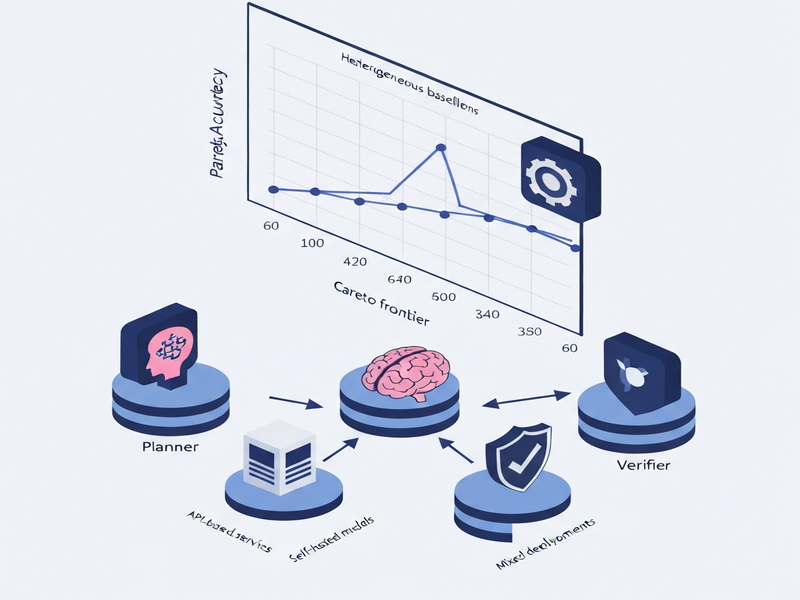
- Role decomposition schema: Tasks are broken into canonical roles—Planner, Executor, Verifier, and Synthesizer—each mapped to a set of functional requirements.
- Cost model: A transparent accounting framework that aggregates per‑token API fees, GPU‑hour estimates, and memory overhead, yielding a single monetary metric per pipeline.
- Shapley‑value diagnostics: By treating each role as a “player” in a cooperative game, the authors compute marginal contributions to overall accuracy, exposing hidden bottlenecks.
- Hybrid deployment matrix: The benchmark systematically mixes open‑source models (e.g., Llama‑2, Mistral) with proprietary APIs (e.g., OpenAI ChatGPT) across roles, generating a combinatorial landscape of possible pipelines.
In essence, AgentCARD provides a sandbox where researchers can ask, “If I replace the Planner with a cheaper model, how does the end‑to‑end success rate change?” The answer is quantified both in dollars and in task‑specific metrics.
How It Works in Practice
The practical workflow follows three stages:
1. Task Specification & Role Assignment
Users submit a high‑level task description (e.g., “draft a market analysis for renewable energy”). AgentCARD’s front‑end parses the request and assigns sub‑tasks to the four canonical roles based on a rule‑based taxonomy.
2. Model Selection & Deployment Configuration
For each role, the system selects a candidate model from a curated registry. The registry includes both hosted APIs (e.g., OpenAI ChatGPT integration) and self‑hosted open‑source checkpoints. Users can lock a role to a specific model or let AgentCARD run an optimization routine that minimizes cost while keeping accuracy above a user‑defined threshold.
3. Execution & Shapley Attribution
During runtime, each role processes its input and passes the intermediate result downstream. After the final output is produced, a lightweight evaluation module computes task‑level accuracy (e.g., BLEU, ROUGE, or domain‑specific metrics). Simultaneously, the Shapley engine attributes the observed performance gain or loss to each role, producing a diagnostic report.
What sets this approach apart is the closed‑loop feedback between cost accounting and role performance. If the Verifier consistently contributes little to overall accuracy, the system can suggest a cheaper model for that role without harming the final result.
Evaluation & Results
AgentCARD was tested on three heterogeneous benchmark suites:
- Business Writing Suite: 500 prompts covering market reports, email drafts, and executive summaries.
- Code Generation Suite: 300 programming tasks ranging from simple scripts to multi‑file projects.
- Scientific Summarization Suite: 200 abstracts requiring accurate extraction of methods and results.
Key experimental settings included:
- Four role configurations: (i) homogeneous (single model for all roles), (ii) planner‑heavy (specialized planner, generic executor), (iii) verifier‑enhanced (dedicated verification model), and (iv) fully heterogeneous (each role distinct).
- Cost tiers ranging from $0.001 per 1k tokens (open‑source) to $0.06 per 1k tokens (hosted API).
The results demonstrated three salient patterns:
- Cost‑accuracy frontier expansion: Fully heterogeneous pipelines consistently outperformed homogeneous baselines, achieving up to 12% higher accuracy at the same cost or 20% lower cost for equivalent accuracy.
- Domain‑specific bottlenecks: In code generation, the Executor role dominated performance, while in scientific summarization the Verifier contributed the most marginal gain. Shapley diagnostics highlighted these role‑specific sensitivities.
- Hybrid deployment advantage: Mixing an open‑source Planner (Llama‑2) with a hosted Verifier (ChatGPT) yielded the best trade‑off for business writing, cutting costs by 35% while preserving a 98% F1 score relative to the all‑hosted baseline.
These findings validate the hypothesis that “one size fits all” model selection is suboptimal for complex, multi‑step tasks. The benchmark also provides a reproducible methodology for future research to compare novel role‑aware orchestration strategies.
Why This Matters for AI Systems and Agents
For AI practitioners building production‑grade agents, AgentCARD offers a concrete decision‑making tool:
- Optimized resource allocation: By quantifying each role’s cost impact, engineers can budget GPU clusters or API spend more precisely.
- Modular pipeline design: The role‑centric view aligns with modern orchestration platforms (e.g., Workflow automation studio), enabling plug‑and‑play swapping of models without rewriting business logic.
- Improved reliability: Shapley‑based diagnostics surface weak links early, allowing teams to reinforce verification steps before deployment.
- Strategic product differentiation: Companies can offer “AI marketing agents” that leverage a low‑cost planner for idea generation while reserving a premium verifier for brand‑compliant copy, directly tying into the AI marketing agents offering.
In short, the benchmark translates abstract research insights into actionable engineering guidelines, bridging the gap between academic LLM evaluation and enterprise AI productization.
What Comes Next
While AgentCARD marks a significant step forward, several limitations remain:
- Static role taxonomy: The current four‑role schema may not capture emerging patterns such as “Critic” or “Memory Manager” in long‑running agents.
- Evaluation scope: Benchmarks focus on static prompts; continuous, interactive sessions (e.g., chat assistants) require longitudinal metrics.
- Hardware heterogeneity: Cost estimates assume average GPU pricing; real‑world variance across cloud providers could shift the frontier.
Future research directions include:
- Extending the framework to verification‑aware pipelines where the Verifier can request re‑generation, creating a feedback loop.
- Incorporating continual evaluation that tracks performance drift as models are updated.
- Integrating with the Enterprise AI platform by UBOS to automate cost‑aware deployment decisions at scale.
Practitioners interested in experimenting can clone the open‑source repository, adapt the role registry to their own model zoo, and leverage the UBOS templates for quick start to spin up a prototype within minutes.
Conclusion
AgentCARD demonstrates that thoughtful role specialization and hybrid deployment can dramatically reshape the cost‑accuracy landscape for LLM‑driven agents. By providing a transparent, Shapley‑informed benchmark, the authors equip engineers with the analytical tools needed to build smarter, cheaper AI systems that scale across domains.
Call to Action
Explore the full benchmark suite, download the code, and start tailoring your own multi‑role agent pipelines:
- AgentCARD benchmark paper
- UBOS homepage – discover the platform that can host your optimized pipelines.
Andrii Bidochko
CTO UBOS
Andrii Bidochko is an AI entrepreneur and researcher focused on AI agents, reinforcement learning, and autonomous systems. He writes about the technologies shaping the future of machine intelligence, from frontier models and agent architectures to real-world AI applications.