

- Updated: July 16, 2026
- 2 min read
Spatio-Temporal Scheduling Prediction Under Backhaul Delay for Resilient Coordinated Beamforming
Spatio-Temporal Scheduling Prediction Under Backhaul Delay for Resilient Coordinated Beamforming
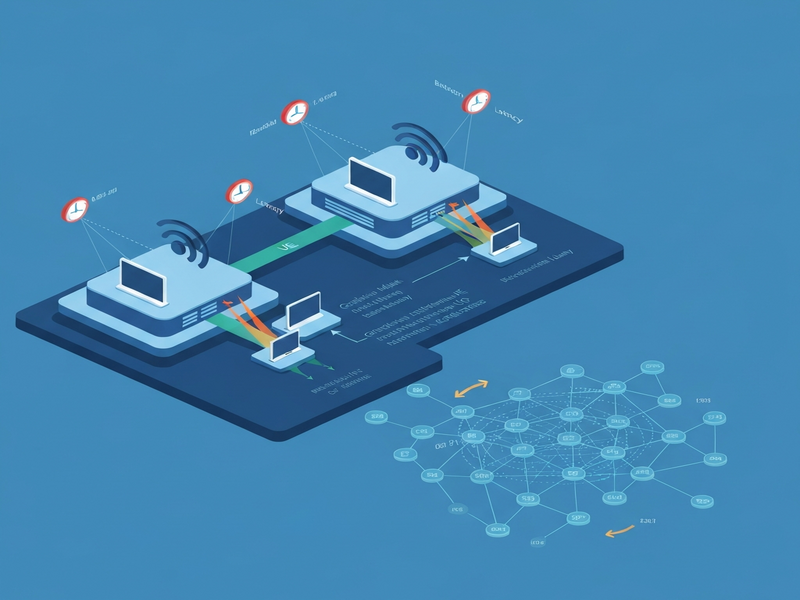
Coordinated beamforming (CBF) is a cornerstone of modern distributed 5G networks, enabling inter‑cell interference mitigation and enhanced spectral efficiency. However, backhaul latency introduces stale scheduling information, degrading CBF‑SLNR performance. In this work, we present a two‑stage predictive framework that leverages a Spectral Temporal Graph Neural Network (StemGNN) to forecast future user equipment (UE) scheduling states, effectively compensating for backhaul delays.
Key Contributions
- Design of StemGNN, a graph‑based neural architecture that captures spatio‑temporal dependencies among UEs across cells.
- Comprehensive evaluation on a three‑cell massive MIMO downlink (64 antennas per BS, 60 UEs) using Quadriga Urban Micro channels and a proportional‑fair scheduler.
- Achieving 87.57% mean scheduling prediction accuracy, outperforming LSTM, GRU, Simple RNN, and Markov‑chain baselines.
- Recovering 57‑73% of the sum‑rate loss caused by a single TTI backhaul delay, with up to 14.35% sum‑rate improvement over the no‑prediction baseline.
- Restoring up to 83% of the fairness loss for cell‑edge users, demonstrating robustness of the predictive approach.
Technical Overview
The proposed framework first collects delayed scheduling observations from the backhaul. StemGNN processes these observations on a graph that encodes inter‑cell UE relationships and temporal evolution, producing future scheduling predictions. These predictions replace stale inputs to the CBF‑SLNR precoder, enabling proactive beamforming decisions.
Performance Evaluation
Simulation results show that StemGNN consistently outperforms traditional recurrent models across all prediction horizons. Notably, at longer horizons where spatial dependencies dominate, StemGNN yields up to a 7.71% gain over LSTM. Integrated with coordinated beamforming, the predictions mitigate the adverse effects of backhaul latency, delivering significant throughput and fairness gains.
Implications for 5G Networks
By treating backhaul latency as a spatio‑temporal forecasting problem, network operators can enhance inter‑cell coordination without additional hardware upgrades. The approach is compatible with existing massive MIMO deployments and can be incorporated into standard 5G scheduling pipelines.
For a deeper dive into the methodology and results, visit the arXiv pre‑print. Explore related resources and implementation details on our site ubos.tech.
Andrii Bidochko
CTO UBOS
Andrii Bidochko is an AI entrepreneur and researcher focused on AI agents, reinforcement learning, and autonomous systems. He writes about the technologies shaping the future of machine intelligence, from frontier models and agent architectures to real-world AI applications.