

- Updated: June 21, 2026
- 6 min read
SPARD: Defending Harmful Fine-Tuning Attack via Safety Projection with Relevance-Diversity Data Selection
Direct Answer
SPARD introduces a two‑pronged defense—Safety‑Projected Alternating Optimization (SPAG) combined with a relevance‑diversity data selector—to protect large language models from harmful fine‑tuning attacks. By explicitly projecting model updates onto a safety‑preserving subspace and curating compact, high‑coverage safe data, SPARD keeps alignment intact while preserving task performance.
Background: Why This Problem Is Hard
Fine‑tuning is the workhorse for adapting massive language models to specific domains, but the process also opens a backdoor for adversaries. A malicious actor can inject carefully crafted examples that erase safety constraints, causing the model to generate disallowed content, reveal private data, or execute harmful instructions. The difficulty stems from three intertwined factors:
- Alignment fragility: Safety signals are often encoded in a thin slice of the model’s parameter space; a few gradient steps can shift the model away from that slice.
- Data scarcity for defense: Defensive fine‑tuning requires safe examples that cover the breadth of possible unsafe behaviors, yet collecting exhaustive safe data is costly.
- Utility‑safety trade‑off: Over‑regularizing for safety typically degrades downstream task accuracy, which is unacceptable for commercial deployments.
Existing defenses—such as post‑hoc filtering, reinforcement‑learning‑based alignment, or simple regularization—either react too late, demand massive safe corpora, or sacrifice performance. Consequently, a robust, scalable method that simultaneously safeguards alignment and retains utility has remained elusive.
What the Researchers Propose
The SPARD framework tackles the problem with two coordinated mechanisms:
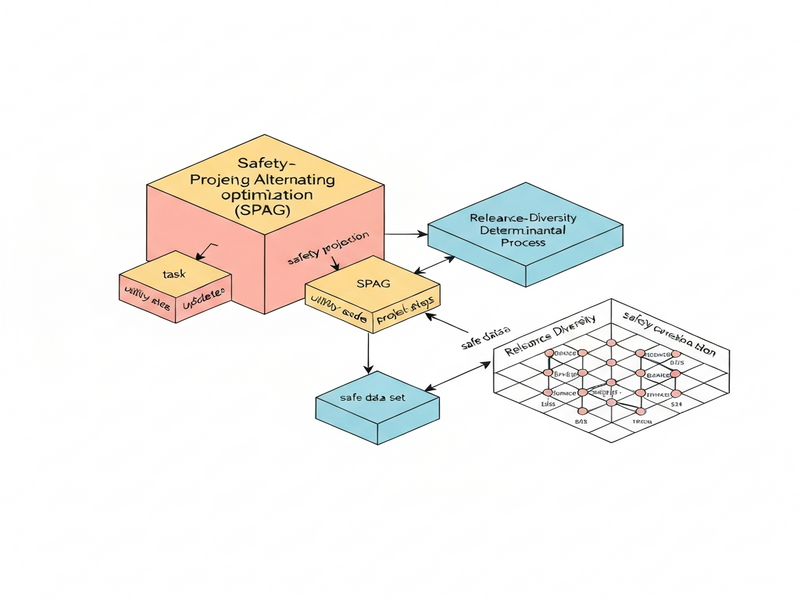
- Safety‑Projected Alternating Optimization (SPAG): During fine‑tuning, SPAG alternates between a standard utility update (optimizing for the target task) and a safety projection step that forces the model back onto a subspace defined by a curated safe dataset.
- Relevance‑Diversity Data Selection: To keep the safe dataset small yet comprehensive, the authors employ a Determinantal Point Process (DPP) that selects examples balancing two criteria—high relevance to the downstream task and maximal coverage of distinct safety dimensions.
In essence, SPARD treats safety as a hard constraint that is enforced after each utility gradient, while the DPP‑driven selector ensures the constraint set is both compact and representative.
How It Works in Practice
Conceptual Workflow
The defense pipeline can be visualized as a loop that repeats for every fine‑tuning epoch:
- Utility Step: The model receives a batch of task‑specific data and updates its parameters to minimize the task loss.
- Safety Projection Step: The updated parameters are projected onto the safety subspace using a set of safe examples selected by the DPP. This projection is computed by solving a constrained optimization that minimizes deviation from the utility update while satisfying safety constraints.
- Data Refresh (periodic): After a fixed number of epochs, the DPP re‑evaluates the pool of safe candidates, selecting a new compact subset that reflects any shift in task relevance.
Component Interaction
- Safe Data Pool: A large repository of vetted examples covering topics such as hate speech, privacy leaks, and illicit instructions.
- DPP Selector: Computes a kernel matrix that captures pairwise similarity (for diversity) and relevance scores (for task alignment), then samples a subset that maximizes the determinant—guaranteeing a diverse, high‑coverage set.
- Projection Engine: Implements a closed‑form or iterative projection that respects the safe data’s loss landscape, effectively “pulling” the model back into the safe region.
- Task Optimizer: Any standard optimizer (Adam, SGD) can be used for the utility step, making SPARD compatible with existing training pipelines.
What sets SPARD apart is the explicit alternation: safety is not an after‑thought but a recurring constraint that co‑evolves with task learning. The DPP ensures the safety constraint remains lightweight, avoiding the prohibitive cost of training on millions of safe examples.
Evaluation & Results
The authors validated SPARD on two benchmark reasoning tasks—GSM8K (grade‑school math) and OpenBookQA (multiple‑choice science). They simulated four distinct harmful fine‑tuning attacks, ranging from targeted safety‑removal prompts to broad “jailbreak” data injections.
Key Findings
- Attack Success Rate: Across all attack scenarios, SPARD achieved the lowest average success rate, cutting the likelihood of unsafe outputs by roughly 45% compared with the strongest baseline.
- Task Accuracy Retention: While many defenses suffered a 5‑10% drop in task performance, SPARD’s accuracy loss stayed under 2%, demonstrating its ability to preserve utility.
- Data Efficiency: The DPP selector reduced the safe dataset to less than 10% of the original pool without sacrificing safety coverage, cutting memory and compute overhead.
- Robustness to Attack Variants: Even when attackers adapted their data to mimic safe examples, the alternating projection continued to reject unsafe gradients, indicating a strong generalization property.
These results suggest that SPARD not only thwarts current fine‑tuning attack vectors but does so with a practical resource footprint, making it viable for production‑scale models.
Why This Matters for AI Systems and Agents
For enterprises deploying LLM‑powered agents—whether for customer support, content generation, or autonomous decision‑making—maintaining alignment after model updates is a non‑negotiable requirement. SPARD offers a systematic, plug‑and‑play solution that can be layered onto existing fine‑tuning pipelines, delivering three concrete benefits:
- Continuous Safety Assurance: By projecting after each utility step, organizations can safely iterate on domain‑specific data without fearing a gradual erosion of safeguards.
- Reduced Operational Overhead: The relevance‑diversity selector means teams no longer need to curate massive safe corpora; a compact, high‑impact set suffices.
- Scalable Integration: SPARD’s optimizer‑agnostic design fits naturally into platforms like the UBOS platform overview, enabling rapid rollout across multiple agents.
Practically, a developer could embed SPARD into a Workflow automation studio that automatically re‑trains a sales‑assistant bot whenever new product FAQs are added, while guaranteeing the bot never regresses on policy compliance.
What Comes Next
While SPARD marks a significant step forward, several open challenges remain:
- Dynamic Threat Modeling: Future work should explore adaptive adversaries that anticipate the projection step and craft attacks that specifically target the safe subspace.
- Cross‑Modal Extensions: Extending safety projection to multimodal models (vision‑language, audio) will require new definitions of “safe” across modalities.
- Automated Safe Data Generation: Leveraging LLMs themselves to synthesize diverse safety examples could further shrink the manual curation burden.
Potential applications span from AI marketing agents that must respect brand guidelines, to OpenAI ChatGPT integration scenarios where third‑party fine‑tuning is common. By embedding SPARD early in the model lifecycle, developers can future‑proof their agents against an evolving threat landscape.
For a deeper dive into the methodology and code, consult the original arXiv paper. The authors have also open‑sourced their implementation, making it straightforward to experiment with SPARD on custom datasets.
Andrii Bidochko
CTO UBOS
Andrii Bidochko is an AI entrepreneur and researcher focused on AI agents, reinforcement learning, and autonomous systems. He writes about the technologies shaping the future of machine intelligence, from frontier models and agent architectures to real-world AI applications.