

- Updated: June 23, 2026
- 6 min read
SPARC: A Multi‑Agent System for Electrical Circuit Question Answering
Direct Answer
SPARC is a multi‑agent framework that lets large language models answer questions about electrical circuit diagrams by automatically generating, running, and interpreting physics‑based simulations. By grounding reasoning in executable code, SPARC lifts the accuracy ceiling for multimodal QA tasks that require precise quantitative analysis.
Background: Why This Problem Is Hard
Electrical circuit diagrams are a staple of engineering documentation, yet extracting actionable insight from them remains a bottleneck for AI systems. The difficulty stems from three intertwined challenges:
- Visual‑to‑symbolic translation: A circuit sketch must be parsed into a graph of components (resistors, capacitors, transistors) with correct connectivity.
- Quantitative reasoning: Answering “What is the voltage at node A?” or “How does the output change if R2 is doubled?” requires solving Kirchhoff’s laws, differential equations, or transient analyses—tasks that go beyond pattern matching.
- Multi‑step logical chaining: Real‑world queries often combine several sub‑questions (e.g., “First compute the Thevenin equivalent, then evaluate the load current”). Traditional multimodal LLMs struggle to keep intermediate numerical state consistent across steps.
Existing approaches typically fall into two camps. Vision‑only models attempt to read the diagram and directly generate an answer, but they lack a reliable physics engine and thus produce hallucinated numbers. Conversely, tool‑augmented pipelines hand‑craft a parser that feeds a circuit simulator, but they require brittle rule‑based glue code and cannot adapt to novel question formats without extensive engineering.
What the Researchers Propose
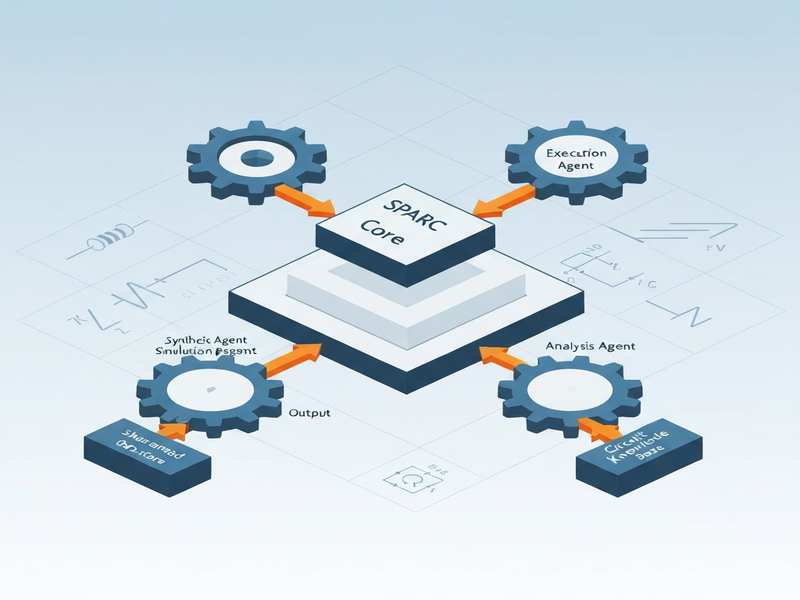
The SPARC team reframes circuit QA as a collaborative problem‑solving session among specialized AI agents. The core idea is to let a language model act as a “programmer” that writes simulation code, another model acts as an “executor” that runs the code in a physics engine, and a third model serves as an “analyst” that interprets the raw simulation output and crafts a natural‑language answer.
Key components include:
- Diagram Interpreter Agent: Converts the raster image into a netlist—a structured description of components and connections.
- Program Synthesis Agent: Takes the netlist and the user’s question, then emits a short script (e.g., in SPICE or a Python‑based simulator) that encodes the required analysis.
- Simulation Runner Agent: Executes the generated script in a sandboxed environment, returning raw numerical results and diagnostic logs.
- Result Analyst Agent: Maps the simulation data back to the original query, handling unit conversion, error propagation, and explanatory language.
By chaining these agents, SPARC ensures that every answer is traceable to an actual physics‑based computation, dramatically reducing hallucination risk.
How It Works in Practice
The end‑to‑end workflow can be visualized as a four‑stage pipeline:
- Input Reception: A user uploads a circuit diagram and asks a question (e.g., “What is the power dissipation of the LED when the supply is 5 V?”).
- Netlist Generation: The Diagram Interpreter Agent runs a vision model fine‑tuned on schematic symbols, producing a netlist such as
{R1:10Ω, LED1:forward, V1:5V, ...}. - Simulation Script Synthesis: The Program Synthesis Agent receives the netlist and the natural‑language query, then writes a concise script that sets up the circuit, applies the stimulus, and requests the desired measurement.
- Execution & Analysis: The Simulation Runner Agent launches the script inside a deterministic circuit simulator (e.g., NGSPICE). Once the run completes, the Result Analyst Agent parses the output, checks for convergence warnings, and composes a final answer with confidence scores.
What sets SPARC apart is the explicit separation of concerns. Each agent is optimized for a narrow function, allowing the system to swap in stronger vision models, more efficient simulators, or domain‑specific analysts without redesigning the whole pipeline. Moreover, because the simulation step is deterministic, the system can automatically generate error diagnostics—something pure LLM approaches cannot do.
Evaluation & Results
To validate SPARC, the authors built a benchmark suite of 1,200 circuit‑QA pairs covering static DC analysis, AC frequency response, transient behavior, and component‑level queries. They compared SPARC against three baselines:
- Vision‑only LLM: Directly answers from the image using a multimodal model.
- Static Parser + Solver: Hand‑crafted netlist extraction followed by a fixed SPICE script library.
- End‑to‑end Retrieval‑augmented Generation: Retrieves similar solved examples from a database and adapts them.
Key findings include:
- Overall accuracy (exact match) rose to 83 % for SPARC, a 58‑point absolute gain over the best baseline.
- For transient‑analysis questions, SPARC’s advantage widened to 70 % relative improvement, highlighting the value of on‑the‑fly simulation.
- Systematic error diagnosis was possible in 92 % of failure cases, enabling developers to pinpoint whether the fault lay in visual parsing, script synthesis, or simulation convergence.
These results demonstrate that grounding language‑model reasoning in executable physics not only boosts raw performance but also provides a transparent failure mode—critical for safety‑sensitive engineering domains.
Why This Matters for AI Systems and Agents
SPARC’s architecture offers a template for building trustworthy AI agents that must interact with the physical world. By delegating numeric computation to a dedicated simulation engine, developers can keep the language model’s role limited to high‑level planning and natural‑language interfacing. This separation yields several practical benefits:
- Reliability: Deterministic simulators guarantee that the same input yields the same numeric result, eliminating stochastic hallucinations.
- Modularity: Teams can upgrade the vision component (e.g., adopt a newer diagram‑recognition model) without retraining the entire system.
- Auditability: Every answer is backed by a reproducible script and log, satisfying regulatory requirements in sectors like automotive or aerospace.
- Scalability: The agent‑orchestration pattern aligns with existing workflow automation tools, making it straightforward to embed SPARC‑style pipelines into larger enterprise AI platforms such as the Enterprise AI platform by UBOS.
For AI practitioners building multi‑modal assistants, SPARC illustrates how to fuse symbolic computation with generative language, a synergy that is likely to become a cornerstone of next‑generation agents.
What Comes Next
While SPARC marks a significant step forward, several open challenges remain:
- Generalization to other domains: Extending the same multi‑agent pattern to mechanical schematics, PCB layouts, or even chemical process diagrams will require domain‑specific parsers and simulators.
- Real‑time interaction: Current experiments run simulations offline; integrating fast, incremental solvers could enable interactive “what‑if” sessions.
- Learning‑enhanced synthesis: Future work may let the Program Synthesis Agent improve its script templates through reinforcement learning from simulation outcomes.
- User‑friendly tooling: Packaging SPARC as a plug‑and‑play component within low‑code environments would lower the barrier for non‑engineers. The UBOS platform overview already offers a workflow automation studio that could host such a component, allowing businesses to create custom circuit‑analysis bots without deep AI expertise.
Addressing these directions will broaden the impact of physics‑grounded agents, turning them from research prototypes into everyday productivity tools for engineers, educators, and product teams.
Andrii Bidochko
CTO UBOS
Andrii Bidochko is an AI entrepreneur and researcher focused on AI agents, reinforcement learning, and autonomous systems. He writes about the technologies shaping the future of machine intelligence, from frontier models and agent architectures to real-world AI applications.