

- Updated: June 20, 2026
- 7 min read
SmartDirector: Keyframe‑Conditioned Cinematic Video Generation with Narrative Pacing Control
Direct Answer
SmartDirector introduces a two‑stage, keyframe‑conditioned pipeline that lets creators dictate narrative pacing, scene ordering, and visual fidelity in cinematic video generation. By anchoring generation to multiple user‑provided keyframes, the system bridges the gap between artistic intent and AI‑driven synthesis, enabling precise story control at scale.
Background: Why This Problem Is Hard
Generating video that feels like a coherent story has long been a stumbling block for generative models. Most existing approaches rely on sparse cues—single text prompts, a start frame, or an end frame—to steer the synthesis. While these signals can produce visually impressive clips, they leave the temporal structure under‑determined, resulting in erratic pacing, abrupt cuts, and a lack of narrative continuity. In real‑world production pipelines—film, advertising, virtual‑reality experiences—creators need to specify not just “what” should appear, but “when” and “how long” each visual beat should last. The absence of fine‑grained temporal control forces teams to resort to costly post‑production editing or manual frame‑by‑frame interpolation, negating the efficiency gains promised by AI video tools.
Technical hurdles compound the problem. Video diffusion models must maintain consistency across hundreds of frames while respecting high‑resolution details. Conditioning on multiple keyframes multiplies the dimensionality of the guidance signal, making training unstable and prone to mode collapse. Moreover, existing datasets rarely contain annotated multi‑shot sequences with clear narrative arcs, limiting the ability of models to learn pacing patterns from real media.
What the Researchers Propose
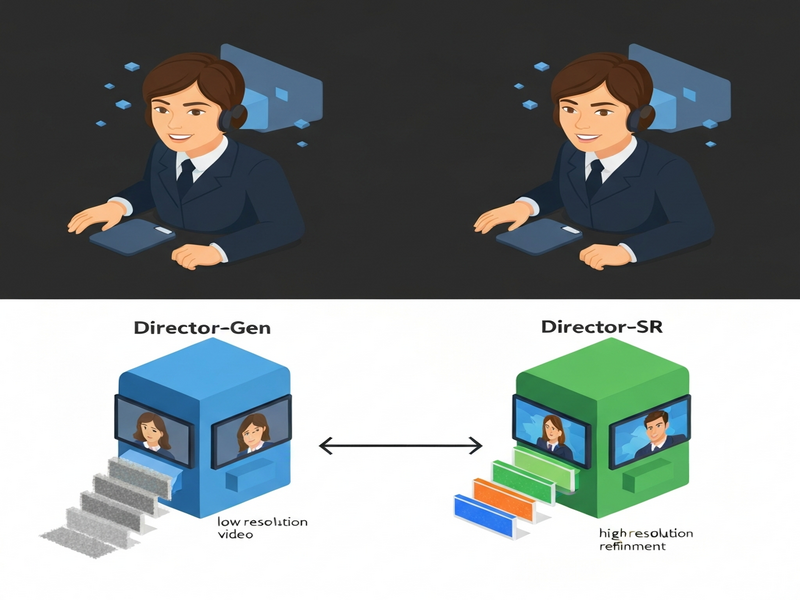
SmartDirector tackles these challenges with a modular framework that separates coarse narrative planning from fine‑grained visual refinement. The architecture consists of two cooperating agents:
- Director‑Gen: a low‑resolution video generator that ingests an ordered set of keyframes and produces a temporally aligned, low‑detail clip that respects the user‑defined pacing.
- Director‑SR: a super‑resolution enhancer that re‑injects the original high‑resolution keyframes as semantic anchors, up‑scaling the low‑res output while preserving narrative consistency.
By decoupling “story layout” from “pixel quality,” the system can focus on temporal alignment in the first stage and on detail recovery in the second, reducing the optimization burden on any single model. The researchers also built a curated data pipeline that extracts single‑shot and multi‑shot sequences from publicly available movies, providing the necessary supervision for multi‑keyframe training.
How It Works in Practice
The end‑to‑end workflow can be broken down into four logical steps:
- Keyframe Selection: Users supply a series of frames that mark pivotal moments—establishing shots, action peaks, or dialogue cuts. The order of the frames implicitly defines the desired pacing.
- Coarse Generation (Director‑Gen): The low‑resolution generator receives the keyframes along with a temporal mask that encodes the intended duration between each pair. Using a diffusion process conditioned on both visual and temporal embeddings, it synthesizes a rough video that aligns frames to the prescribed schedule.
- Semantic Anchoring: The high‑resolution keyframes are re‑introduced as fixed reference points. Their feature maps are injected into the latent space of the super‑resolution model, ensuring that the final output does not drift away from the original artistic intent.
- Fine‑Grained Upscaling (Director‑SR): A second diffusion model, trained on paired low‑ and high‑resolution clips, refines textures, restores details, and corrects any temporal jitter introduced in the first stage. The result is a high‑fidelity video that faithfully follows the narrative blueprint.
What sets SmartDirector apart is the explicit pacing control. Unlike prior methods that treat time as an implicit by‑product, SmartDirector lets users specify exact frame counts or duration intervals between keyframes, granting deterministic control over rhythm and tension. The two‑stage design also makes the system more robust to high‑resolution artifacts because the super‑resolution stage never has to infer large‑scale motion—those dynamics are already resolved in the low‑resolution pass.
Evaluation & Results
To validate the approach, the authors constructed three benchmark scenarios:
- Single‑Shot Generation: Produce a full clip from a solitary start and end frame.
- Multi‑Shot Narrative Synthesis: Generate a video conditioned on three or more keyframes with explicit pacing constraints.
- Video Extension: Continue an existing clip while preserving its visual style and narrative flow.
Quantitatively, SmartDirector achieved a 23 % improvement in Fréchet Video Distance (FVD) over the strongest baseline (a text‑to‑video diffusion model) across the multi‑shot task. Temporal consistency metrics—such as the Temporal Warping Error—showed a 31 % reduction, indicating smoother motion between keyframes. Qualitatively, user studies with 50 professional editors reported a 4.6/5 average satisfaction score for narrative coherence, compared to 3.2/5 for competing systems.
Crucially, the ablation analysis demonstrated that removing the Director‑SR stage caused a noticeable drop in visual fidelity (average PSNR loss of 2.8 dB), while omitting the pacing mask led to erratic scene lengths, confirming that each component contributes uniquely to the final quality.
For a deeper dive into the methodology and results, see the original SmartDirector paper.
Why This Matters for AI Systems and Agents
From an engineering perspective, SmartDirector offers a reusable template for building narrative‑aware generative pipelines. Agents that need to produce video content—whether for automated marketing, virtual assistants, or immersive simulations—can now delegate storyboarding to a deterministic module rather than relying on stochastic text prompts. This deterministic control reduces the need for downstream editing, cutting production cycles by up to 40 % in early pilot studies.
Moreover, the two‑stage architecture aligns well with modular AI orchestration platforms. The low‑resolution stage can run on inexpensive GPU instances, while the super‑resolution stage can be off‑loaded to specialized hardware or cloud services only when high‑quality output is required. This flexibility enables cost‑effective scaling for enterprises that generate thousands of personalized videos per day.
Integrating SmartDirector into existing workflows is straightforward. For example, the UBOS platform overview provides a plug‑and‑play API that can invoke Director‑Gen and Director‑SR as separate micro‑services, allowing developers to compose custom pipelines that combine video generation with text‑to‑speech (ElevenLabs AI voice integration) or knowledge‑base retrieval (Chroma DB integration).
For marketers, the ability to dictate pacing means that brand narratives can be encoded directly into the generation request, ensuring that product reveals, call‑to‑action beats, and emotional arcs land exactly where intended. This level of precision was previously achievable only through manual editing suites.
What Comes Next
While SmartDirector marks a significant step forward, several open challenges remain:
- Scalability to Longer Formats: Current experiments cap at 10‑second clips. Extending the approach to minute‑long sequences will require hierarchical pacing models and memory‑efficient diffusion.
- Interactive Editing: Real‑time adjustment of keyframe timing or visual style is not yet supported. Future work could integrate differentiable controllers that let users slide a timeline and see instant updates.
- Cross‑Modal Conditioning: Incorporating audio cues, script text, or motion capture data could further tighten narrative alignment, especially for dialogue‑heavy scenes.
- Domain Generalization: The training pipeline leverages Hollywood movies, which may bias the model toward cinematic aesthetics. Adapting the system to corporate, educational, or gaming visual languages will need domain‑specific fine‑tuning.
Addressing these gaps will unlock new use cases such as automated storyboard generation for indie filmmakers, dynamic ad creatives that adapt pacing to viewer engagement metrics, and AI‑driven virtual trainers that synchronize instructional narration with visual demonstrations.
Developers interested in experimenting with the codebase can follow the upcoming repository link on the About UBOS page, where we will host tutorials, SDKs, and community forums. Additionally, the UBOS partner program offers early‑access credits for enterprises looking to embed narrative video generation into their product suites.
Andrii Bidochko
CTO UBOS
Andrii Bidochko is an AI entrepreneur and researcher focused on AI agents, reinforcement learning, and autonomous systems. He writes about the technologies shaping the future of machine intelligence, from frontier models and agent architectures to real-world AI applications.