

- Updated: July 5, 2026
- 6 min read
SLeDGe: Semi‑Supervised Learning on Data Streams with Graph Structure Learning
Direct Answer
SLeDGe introduces a semi‑supervised learning framework that simultaneously trains a predictive model and an evolving graph structure for high‑velocity data streams, all while operating under strict memory and label‑budget constraints. This matters because it unlocks reliable, label‑efficient learning on continuously changing data where traditional static‑graph or fixed‑similarity methods quickly become obsolete.
Background: Why This Problem Is Hard
Modern enterprises increasingly rely on streaming data—clickstreams, sensor feeds, financial tickers, and social‑media firehoses—to power real‑time analytics and autonomous agents. Two intertwined challenges arise:
- Label scarcity: Human annotation cannot keep pace with the volume, leaving only a tiny fraction of samples labeled.
- Evolving relationships: The similarity between samples drifts as new concepts appear, making static similarity metrics or pre‑computed graphs quickly inaccurate.
Existing semi‑supervised learning (SSL) approaches typically assume a fixed similarity function or a static graph built once from a batch of data. In a streaming context, these assumptions cause two failures:
- Stale edges propagate outdated label information, degrading accuracy.
- Memory‑limited systems cannot retain enough historic samples to reconstruct a reliable graph, leading to over‑fitting on recent noise.
Consequently, practitioners face a trade‑off between rapid adaptation to novel patterns and preserving the consistency of long‑term knowledge—a dilemma that SLeDGe aims to resolve.
What the Researchers Propose
SLeDGe (Semi‑Supervised Learning on Data Streams with Graph Structure Learning) is a dual‑objective framework that learns:
- A predictive classifier that maps incoming instances to target labels.
- An adaptive relational graph that captures the evolving similarity among both labeled and unlabeled samples.
The key components are:
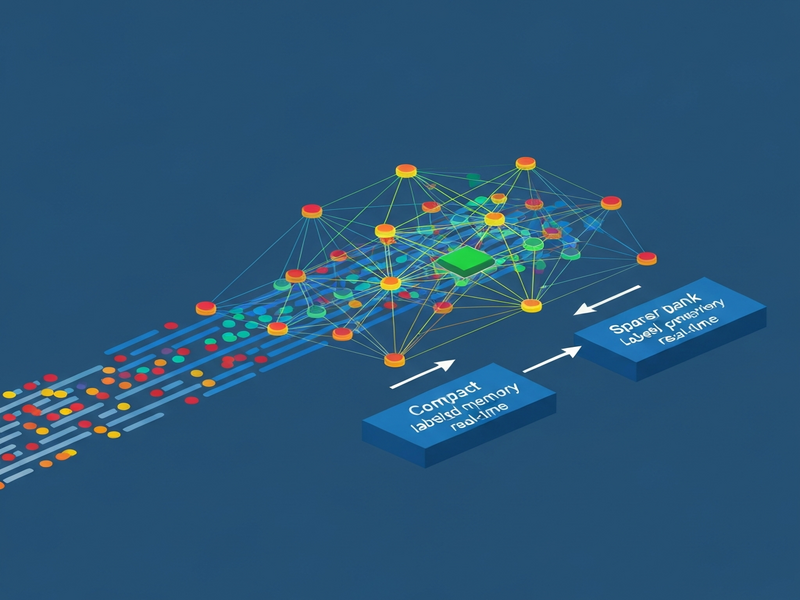
- Labeled Memory (LM): A compact buffer that stores a carefully selected subset of labeled instances, updated with a “diversity‑preserving” policy to keep the most informative points.
- Unlabeled Memory (UM): A larger buffer that retains recent unlabeled samples, refreshed using a “recency‑weighted” strategy to reflect the latest data distribution.
- Graph Learner: An online module that constructs a sparse adjacency matrix over LM ∪ UM, encouraging edge sparsity to filter out spurious connections.
- Label Propagation Engine: A lightweight diffusion process that spreads the scarce label information across the graph, providing pseudo‑labels for unlabeled nodes.
- Joint Optimization Loop: The classifier and graph learner are updated together, allowing each to inform the other in real time.
How It Works in Practice
The SLeDGe workflow can be visualized as a continuous loop that processes each incoming data point:
- Ingestion: A new sample arrives from the stream.
- Memory Update: If the sample is labeled, it is considered for insertion into LM using a diversity score; otherwise, it is placed into UM based on recency.
- Graph Refresh: The Graph Learner recomputes edges only for the affected region of the memory buffers, maintaining a sparse structure (e.g., k‑nearest‑neighbors with adaptive k).
- Label Propagation: Pseudo‑labels are generated for unlabeled nodes by diffusing the few true labels through the updated graph.
- Model Training: The classifier consumes both true and pseudo‑labels, updating its parameters via stochastic gradient descent.
- Prediction: The updated classifier immediately produces a prediction for the incoming sample, which can be routed to downstream agents or dashboards.
What sets SLeDGe apart is the tight coupling between graph adaptation and model learning. Traditional pipelines treat graph construction as a pre‑processing step; SLeDGe treats it as a first‑class citizen that evolves alongside the classifier, ensuring that the relational information always reflects the current data landscape.
Evaluation & Results
The authors benchmarked SLeDGe on twelve publicly available streaming datasets spanning image, text, and sensor domains. Evaluation focused on two realistic label budgets: 0.1 % and 1 % of the total stream.
- Baseline comparison: State‑of‑the‑art streaming SSL methods (fixed‑graph SSL, online label propagation, and memory‑augmented classifiers) served as baselines.
- Metric: Classification accuracy measured after each epoch of the stream, averaged across datasets.
Key findings:
- With only 0.1 % labeled data, SLeDGe achieved an average relative accuracy gain of **31.7 %** over the strongest baseline.
- Even at a more generous 1 % label budget, SLeDGe still outperformed competitors by **14.8 %** on average.
- The adaptive graph remained ~70 % sparser than static k‑NN graphs, reducing memory overhead while improving label propagation quality.
- Ablation studies confirmed that both the dual‑memory scheme and the joint optimization loop contributed significantly to performance; removing either component dropped accuracy by more than 10 %.
These results demonstrate that SLeDGe not only tolerates extreme label scarcity but also scales gracefully with streaming volume, making it a practical choice for production‑grade AI pipelines.
Why This Matters for AI Systems and Agents
For AI engineers building real‑time agents—whether for fraud detection, recommendation, or autonomous robotics—the ability to learn from a trickle of labeled feedback while continuously adapting to new patterns is a game‑changer. SLeDGe offers several concrete benefits:
- Reduced annotation cost: By extracting maximal value from a handful of labels, teams can allocate human expertise to higher‑impact tasks.
- Robustness to concept drift: The adaptive graph automatically re‑weights relationships as data evolves, preventing stale knowledge from contaminating predictions.
- Memory efficiency: Sparse graph structures and bounded memories fit comfortably within edge devices or micro‑service containers, enabling deployment in latency‑sensitive environments.
- Seamless integration with agent orchestration: The joint learning loop can be wrapped as a modular component within a larger workflow, such as the Workflow automation studio for end‑to‑end pipeline construction.
- Enhanced downstream services: Improved label propagation feeds more accurate signals to downstream modules like AI marketing agents, boosting campaign ROI without additional data labeling.
What Comes Next
While SLeDGe marks a significant step forward, several avenues remain open for exploration:
- Multi‑modal streams: Extending the graph learner to jointly handle heterogeneous data (e.g., video + text) could broaden applicability.
- Active learning loops: Integrating a query strategy that requests labels for the most informative nodes would further reduce annotation effort.
- Distributed memory management: Scaling the dual‑memory buffers across a cluster could support ultra‑high‑throughput scenarios like IoT sensor farms.
- Explainability: Leveraging the sparse graph to surface why a particular prediction was made would aid compliance in regulated sectors.
Practitioners interested in prototyping SLeDGe can start by combining the OpenAI ChatGPT integration for natural‑language label generation with the Chroma DB integration for efficient vector storage of streaming embeddings. For teams focused on real‑time user interaction, the ChatGPT and Telegram integration offers a low‑friction channel to collect occasional human feedback that can seed the labeled memory.
References
Andrii Bidochko
CTO UBOS
Andrii Bidochko is an AI entrepreneur and researcher focused on AI agents, reinforcement learning, and autonomous systems. He writes about the technologies shaping the future of machine intelligence, from frontier models and agent architectures to real-world AI applications.