

- Updated: June 28, 2026
- 6 min read
Skin-Deep: A Geometric Diagnostic for Alignment Fragility in Large Language Model Representations
Direct Answer
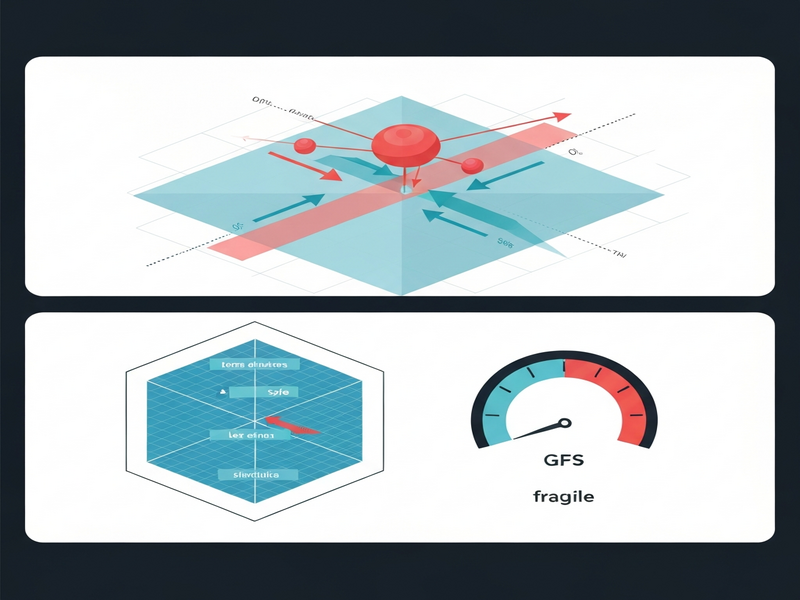
The paper Skin-Deep paper on arXiv introduces a geometric diagnostic called Skin‑Deep that measures how fragile a large language model’s (LLM) alignment is to downstream fine‑tuning. By compressing layer‑wise safety geometry into a single scalar— the Geometric Fragility Score (GFS)—the method predicts, before any fine‑tuning occurs, whether a model will retain its refusal behavior when exposed to a small set of benign examples.
Background: Why This Problem Is Hard
Alignment tuning aims to make LLMs reliably refuse harmful requests. In practice, developers release an “aligned” checkpoint that passes extensive refusal tests, only to discover that a few innocuous fine‑tuning examples can erase that safety. This phenomenon creates a deployment risk for open‑weight models: a model that looks safe at release can become unsafe after low‑cost downstream adaptation.
Existing safety evaluations typically run a battery of adversarial prompts after fine‑tuning, which means the fragility is only discovered post‑mortem. Moreover, most prior work focuses on what fails (the refusal rate) rather than why it fails. Without a way to inspect the model’s internal geometry before an attack, practitioners lack a proactive safeguard.
Key challenges include:
- Hidden‑state opacity: LLMs encode safety signals across many layers, making it hard to isolate the subspace responsible for refusal.
- Low‑rank nature: Safety may reside in a tiny subspace that standard probing methods miss.
- Scalability: Any diagnostic must work across model families ranging from 3 B to 32 B parameters and across diverse alignment recipes.
What the Researchers Propose
Skin‑Deep treats the aligned model’s hidden‑state activations as a high‑dimensional point cloud and searches for a low‑rank “safety subspace” that consistently separates safe from unsafe responses. The core ideas are:
- Geometric extraction: Using singular‑value decomposition (SVD) on activation matrices collected from a curated set of refusal and non‑refusal prompts, the method isolates the dominant directions that encode refusal behavior.
- Layer‑wise aggregation: Each transformer layer contributes a sub‑vector; these are concatenated and then reduced to a single scalar—the Geometric Fragility Score (GFS).
- Predictive scoring: A low GFS indicates that the safety subspace is narrow and thus more vulnerable to being overwritten by downstream fine‑tuning.
The framework does not require any additional training data beyond the standard refusal benchmark, making it a lightweight, pre‑deployment audit.
How It Works in Practice
The diagnostic follows a three‑step workflow:
- Activation collection: Run the aligned checkpoint on a balanced set of prompts—half that should be refused, half that should be answered. Record hidden‑state vectors from every transformer layer.
- Safety subspace discovery: Perform SVD on the stacked activation matrix. The top‑k singular vectors (typically k ≈ 5) form the candidate safety directions.
- Score synthesis: Project each layer’s activation onto its local safety directions, compute the norm, and aggregate across layers to produce the GFS.
What sets Skin‑Deep apart is its focus on geometry rather than classification. By treating safety as a spatial property, the method can detect subtle shifts that would not change a model’s output on the original test set but would make it vulnerable to fine‑tuning.

Evaluation & Results
The authors evaluated Skin‑Deep on 21 instruction‑tuned models spanning six alignment recipes (RLHF, DPO, etc.) and three size buckets (3 B, 7 B, 32 B). The experimental protocol involved:
- Measuring baseline refusal rates on a standard harmful‑request benchmark.
- Applying low‑rank LoRA fine‑tuning with as few as 100 benign examples.
- Re‑evaluating refusal rates post‑fine‑tuning.
- Correlating pre‑fine‑tuning GFS with the observed drop in refusal performance.
Key findings include:
- Consistent low‑rank safety subspace: Across all model families, the dominant safety directions occupied less than 2 % of the total activation space.
- Direction ablation proof: Zero‑ing out the identified safety directions caused a statistically significant reduction in refusal rates, confirming causal relevance.
- Predictive power of GFS: Models with higher GFS retained up to 85 % of their original refusal capability after fine‑tuning, whereas low‑GFS models fell below 30 %.
- Scalability: The diagnostic’s runtime grew linearly with model size, remaining practical (< 10 minutes on a single GPU) even for 32 B parameters.
These results demonstrate that Skin‑Deep can flag fragile models before any downstream adaptation, offering a proactive safety checkpoint.
Why This Matters for AI Systems and Agents
For product teams building AI assistants, chatbots, or autonomous agents, the Geometric Fragility Score provides a quantifiable “safety health metric” that can be integrated into CI/CD pipelines. Instead of waiting for a post‑deployment incident, engineers can run Skin‑Deep on every new checkpoint and reject those that fall below a predefined GFS threshold.
Practical implications include:
- Pre‑deployment gating: Incorporate GFS checks alongside traditional performance benchmarks to ensure alignment robustness.
- Fine‑tuning guardrails: When customizing a model for a specific domain (e.g., customer support), monitor GFS after each LoRA update to detect early signs of safety erosion.
- Model selection guidance: Choose among multiple alignment recipes based on their GFS profiles, favoring those that produce higher scores.
- Regulatory compliance: A measurable safety score can satisfy emerging AI governance frameworks that require demonstrable alignment verification.
Organizations that already use the UBOS platform overview can embed the diagnostic as a custom node in their Workflow automation studio, automating the safety‑score generation for every new model version.
What Comes Next
While Skin‑Deep marks a significant step forward, several open challenges remain:
- Extending beyond refusal: Current experiments focus on harmful‑request refusal. Future work should explore other safety dimensions such as bias mitigation and factuality.
- Dynamic safety subspaces: Alignment may evolve during multi‑stage training. Detecting how the safety subspace shifts over time could enable continuous monitoring.
- Cross‑modal applicability: Applying the geometric diagnostic to multimodal models (vision‑language, audio‑text) is an unexplored frontier.
- Integration with adversarial training: Combining GFS‑based gating with adversarial fine‑tuning could produce models that are both high‑performing and intrinsically robust.
Developers interested in building safety‑aware agents can start by experimenting with the AI marketing agents template, which now includes a pre‑deployment GFS check. For startups looking to prototype quickly, the UBOS for startups page offers a sandbox environment where the diagnostic can be run on custom LoRA adapters.
Ultimately, the goal is to make alignment diagnostics as routine as unit testing—turning “skin‑deep” from a research novelty into an industry standard.
Andrii Bidochko
CTO UBOS
Andrii Bidochko is an AI entrepreneur and researcher focused on AI agents, reinforcement learning, and autonomous systems. He writes about the technologies shaping the future of machine intelligence, from frontier models and agent architectures to real-world AI applications.