

- Updated: June 24, 2026
- 6 min read
Skill Coverage: A Test Adequacy Metric for Agent Skills
Direct Answer
The paper introduces skill coverage, a test‑adequacy metric that evaluates how thoroughly an AI agent’s documented skills are exercised during benchmark executions. It matters because high task‑success rates can mask large gaps in the verification of the underlying procedural knowledge that agents rely on.
Background: Why This Problem Is Hard
Large language model (LLM) agents are increasingly built around skill libraries—structured, reusable pieces of procedural knowledge such as “search the web”, “summarize a contract”, or “schedule a meeting”. These skills are authored as human‑readable documents that describe expected inputs, internal reasoning steps, and observable outputs. In production, developers typically assess an agent by running it on a suite of benchmark tasks and reporting a single success metric (e.g., accuracy, completion rate).
That approach suffers from two fundamental blind spots:
- Granularity loss: A task‑level score tells you whether the end goal was reached, but it does not reveal which sub‑behaviors of a skill were actually triggered.
- Undocumented variance: Skills often contain multiple conditional branches (“if the user asks for a summary, first retrieve the document, then condense”). A successful task may only traverse a single branch, leaving other documented pathways untested.
Consequently, developers cannot confidently claim that an agent’s skill set has been validated. This uncertainty hampers safety reviews, regulatory compliance, and the iterative improvement of skill libraries.
What the Researchers Propose
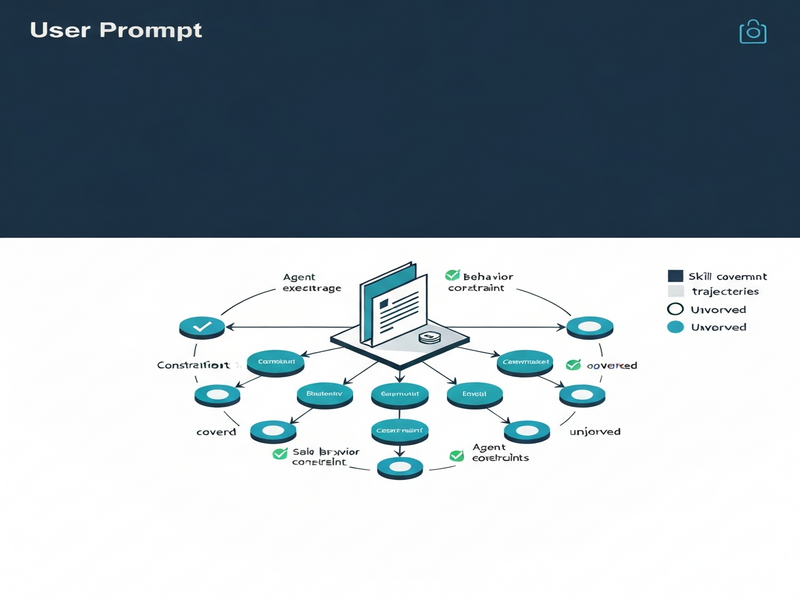
The authors propose a new adequacy metric called skill coverage. Rather than treating the benchmark task as the unit of measurement, skill coverage treats the skill artifact itself as the object under test. The framework operates in two stages:
- Constraint extraction: From each skill document, the system automatically extracts a set of observable behavior constraints. These constraints are concrete, testable statements such as “the agent must call the
search_apiwith a non‑empty query” or “the response must contain a bullet‑point summary”. - Binary coverage judgment: For any given execution trace (the sequence of calls, prompts, and outputs produced by the agent), the framework checks whether each extracted constraint is sufficiently evidenced. The result is a simple “cover” or “not cover” label per constraint, without assigning a separate success/failure outcome.
This shift from outcome‑centric to behavior‑centric evaluation enables a more fine‑grained view of how completely an agent’s skills have been exercised.
How It Works in Practice
The practical workflow can be broken down into four interacting components:
1. Skill Repository
A centralized store (e.g., a Git‑backed knowledge base) holds skill specifications written in a structured markup language. Each skill includes sections for preconditions, procedural steps, and observable postconditions.
2. Constraint Extractor
An NLP pipeline parses the markup, identifies actionable verbs, API calls, and output patterns, and translates them into formal constraints expressed as predicate‑logic statements. For example, “retrieve_document(url) → response.contains(‘Title’)”.
3. Execution Logger
During benchmark runs, a lightweight instrumentation layer records every prompt, function call, and system response. The log is timestamped and indexed by skill identifier, making it easy to map trace segments back to the originating skill.
4. Coverage Analyzer
The analyzer matches logged events against the extracted constraints. If a constraint’s antecedent appears in the trace and the consequent is observed, the constraint is marked as covered. Otherwise, it remains uncovered. The final coverage report aggregates results per skill and per benchmark suite.
What distinguishes this approach is its binary judgment model. By avoiding a graded “partial‑coverage” score, the metric sidesteps subjective weighting and provides a clear, actionable signal: “this documented behavior has never been exercised – add a test” or “this behavior is consistently exercised – confidence grows”.
Evaluation & Results
To validate the metric, the researchers applied skill coverage to the Skill Coverage paper’s own benchmark suite, SkillsBench. SkillsBench comprises dozens of tasks designed to trigger a wide variety of agent skills across domains such as web browsing, data extraction, and natural‑language generation.
Key findings include:
- Low overall coverage: Only between 39.90 % and 43.98 % of the extracted behavior constraints were exercised across all benchmark runs.
- Uneven distribution: Certain high‑impact skills (e.g., “search and retrieve”) achieved coverage above 70 %, while niche skills (e.g., “format legal citations”) fell below 20 %.
- Task success ≠ coverage: Several tasks reported >90 % success rates, yet their execution traces covered less than half of the associated skill constraints, revealing hidden blind spots.
These results demonstrate that existing benchmark suites, even when they appear comprehensive, leave large portions of documented skill behavior untested. The skill coverage metric surfaces these gaps without requiring additional manual annotation.
Why This Matters for AI Systems and Agents
For practitioners building production‑grade agents, skill coverage offers a concrete lever to improve reliability, safety, and maintainability:
- Targeted test generation: Uncovered constraints pinpoint exactly which procedural branches need new test cases, reducing the guesswork in test design.
- Regulatory compliance: Industries such as finance or healthcare demand evidence that every documented decision rule has been validated. Skill coverage provides that audit trail.
- Continuous integration pipelines: By integrating the coverage analyzer into CI/CD, teams can enforce coverage thresholds before promoting new skill versions.
- Product differentiation: Companies can market agents that not only succeed on tasks but also demonstrate high skill‑coverage scores, signaling deeper verification.
These practical benefits align with broader trends in enterprise AI adoption. For example, the UBOS platform overview emphasizes modular skill libraries and automated testing; skill coverage can be baked directly into that workflow. Similarly, developers leveraging OpenAI ChatGPT integration can use coverage reports to verify that custom prompts are exercising the intended API calls.
What Comes Next
While the initial study establishes the feasibility of skill coverage, several open challenges remain:
- Scalable constraint extraction: Current NLP pipelines work well on well‑structured skill documents but may struggle with informal or legacy specifications. Future work could explore few‑shot prompting or fine‑tuned models to improve extraction robustness.
- Dynamic skill composition: Agents often compose multiple skills on the fly. Extending coverage analysis to capture emergent behaviors across skill chains is an open research direction.
- Coverage‑aware benchmark design: Rather than retrofitting existing suites, new benchmarks could be generated with coverage goals in mind, ensuring a balanced distribution of constraints.
- Human‑in‑the‑loop validation: Binary judgments are clear, but they do not capture the quality of the observed behavior. Integrating human review for ambiguous cases could refine the metric.
From an application standpoint, several pathways are already emerging:
- Embedding the coverage analyzer into the Workflow automation studio to automatically flag uncovered constraints after each workflow run.
- Using coverage data to prioritize skill refactoring in AI marketing agents, ensuring that promotional content generation follows verified procedural steps.
- Extending the metric to multimodal agents that combine text, voice, and visual inputs; the ElevenLabs AI voice integration could serve as a testbed for voice‑driven skill coverage.
In summary, skill coverage reframes agent evaluation from “did the task finish?” to “did we actually test what we claimed to know how to do?”. As LLM agents become foundational components of enterprise workflows, adopting such behavior‑centric metrics will be essential for building trustworthy, maintainable AI systems.
Illustrative Diagram
[Insert Skill Coverage Diagram here]

Andrii Bidochko
CTO UBOS
Andrii Bidochko is an AI entrepreneur and researcher focused on AI agents, reinforcement learning, and autonomous systems. He writes about the technologies shaping the future of machine intelligence, from frontier models and agent architectures to real-world AI applications.