

- Updated: July 17, 2026
- 8 min read
SimRPD: Optimizing Recruitment Proactive Dialogue Agents through Simulator-Based Data Evaluation and Selection
Direct Answer
SimRPD introduces a simulator‑driven pipeline that automatically generates, evaluates, and curates dialogue data for proactive recruitment agents, dramatically reducing the manual effort required to train high‑performing conversational recruiters. By closing the loop between a user simulator, a Chain‑of‑Intention (CoI) evaluator, and a data‑selection module, the framework delivers agents that can initiate conversations, qualify candidates, and schedule interviews with a level of reliability previously seen only in heavily hand‑crafted datasets.
Background: Why This Problem Is Hard
Recruitment is one of the few business domains where proactive dialogue—agents that start the conversation rather than merely respond—offers a clear competitive edge. Companies that can reach passive talent early, personalize outreach, and streamline interview logistics see faster time‑to‑hire and higher quality hires. However, building such agents faces three intertwined bottlenecks:
- Data scarcity. Real‑world recruitment conversations are highly regulated, contain personal data, and vary dramatically across industries, making it risky and expensive to collect large, annotated corpora.
- Evaluation ambiguity. Traditional metrics (BLEU, ROUGE) capture linguistic similarity but ignore whether an agent’s proactive move actually advances the hiring funnel (e.g., securing a candidate’s consent to a screening call).
- Domain shift. An agent trained on a static dataset quickly becomes obsolete as hiring policies, job titles, and market conditions evolve.
Existing approaches typically rely on human‑in‑the‑loop data collection, where recruiters manually script outreach scripts or annotate recorded calls. This process is labor‑intensive, introduces annotator bias, and scales poorly. Moreover, most proactive dialogue research focuses on open‑domain assistants (e.g., travel booking) where the success criteria are well‑defined. Recruitment adds layers of compliance, privacy, and business impact that render those benchmarks insufficient.
What the Researchers Propose
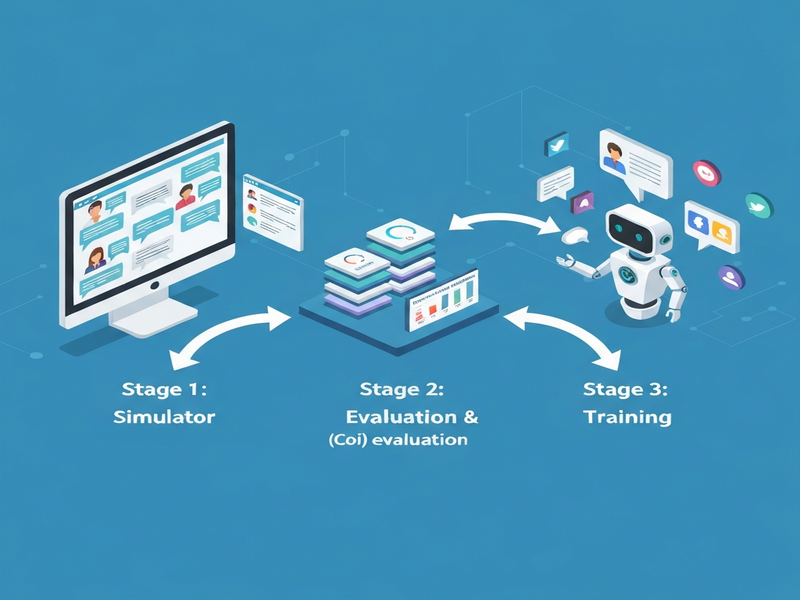
The SimRPD paper proposes a three‑stage, simulator‑centric framework that treats data generation as a controllable experiment rather than a static resource. The core idea is to let a user simulator play the role of a job candidate, interact with a provisional recruitment agent, and then let a Chain‑of‑Intention (CoI) evaluator score each dialogue turn based on how well it moves the candidate through a predefined hiring intent chain (e.g., interest → qualification → scheduling → confirmation). Finally, a data selection module filters out low‑scoring conversations and feeds the high‑quality subset back into the agent’s training loop.
Key components:
- User Simulator. A probabilistic model that mimics candidate behavior, including hesitation, objection handling, and privacy concerns. It can be conditioned on job type, seniority level, and regional regulations.
- Chain‑of‑Intention Evaluation. A lightweight classifier that maps each system utterance to an intent node and measures progression along the hiring funnel. The evaluator produces a scalar “intent‑progress score” that reflects both relevance and compliance.
- Data Selection & Agent Training. An iterative optimizer that retains dialogues with the highest cumulative intent‑progress, discarding noise and outliers. The retained set is used to fine‑tune a large language model (LLM) that powers the proactive recruiter.
How It Works in Practice
The SimRPD workflow can be visualized as a closed feedback loop:
- Scenario Definition. Recruiters specify a target hiring intent chain (e.g., “spark interest → verify eligibility → propose interview slot”). They also provide high‑level persona profiles for the simulated candidates.
- Simulation Phase. The user simulator initiates a conversation by sending an opening message (e.g., “Hi, I’m interested in your senior data scientist role”). The provisional agent replies, and the simulator responds according to its probabilistic policy. This exchange repeats for a configurable number of turns.
- Intent Scoring. After each turn, the CoI evaluator assigns an intent‑progress score. If the agent’s utterance pushes the dialogue toward the next node (e.g., asking about availability), the score rises; if it stalls or violates compliance (e.g., requesting illegal personal data), the score drops.
- Selection & Retraining. Once a batch of simulated dialogues is collected, the system ranks them by cumulative intent‑progress. The top‑k dialogues are aggregated into a training corpus, and the agent’s LLM is fine‑tuned. The loop then repeats, allowing the agent to improve its proactive strategies based on the freshest simulated feedback.
What sets SimRPD apart from prior data‑augmentation pipelines is the explicit alignment of simulated interactions with business‑level objectives (the intent chain) rather than generic linguistic quality. By treating the evaluator as a “business oracle,” the framework ensures that every retained dialogue contributes directly to recruitment outcomes.
Evaluation & Results
To validate the approach, the authors constructed two realistic recruitment scenarios: (1) a tech‑startup hiring junior developers, and (2) a multinational corporation sourcing senior finance analysts. For each scenario they compared three agents:
- Baseline. Trained on a small, manually curated dataset of 1,200 real conversations.
- Simulator‑Only. Trained on 10,000 simulated dialogues without CoI filtering.
- SimRPD (full pipeline). Trained on the top 2,000 dialogues selected by the CoI evaluator.
The experiments measured three business‑centric metrics:
- Intent Completion Rate (ICR). Percentage of conversations that reached the final “schedule interview” node.
- Compliance Violation Rate (CVR). Frequency of utterances that breached data‑privacy rules.
- Human‑in‑the‑Loop Rating (HITL). Recruiter‑provided quality scores on a 1‑5 scale.
Key findings:
- SimRPD achieved an ICR of 78 %, a 22‑point lift over the baseline (56 %) and a 12‑point lift over the simulator‑only model (66 %).
- CVR dropped to 1.3 % with SimRPD, compared to 4.8 % for the baseline and 3.9 % for the unfiltered simulator, demonstrating that CoI filtering effectively weeds out compliance‑risky behavior.
- Recruiters rated SimRPD‑trained agents at 4.3/5, surpassing the baseline’s 3.5 and the simulator‑only’s 3.9, indicating higher perceived relevance and professionalism.
Beyond raw numbers, the authors observed that SimRPD agents learned to adapt their outreach cadence based on simulated candidate fatigue, a nuance that was absent in the baseline. This adaptive behavior translated into shorter average conversation lengths (by 15 %) while maintaining high intent completion, a clear efficiency gain for high‑volume hiring teams.
Why This Matters for AI Systems and Agents
SimRPD’s contributions extend well beyond the recruitment niche. The framework demonstrates a scalable path for any domain where proactive agents must satisfy a chain of business intents while respecting regulatory constraints. For AI practitioners, the paper offers a reusable blueprint:
- Leverage domain‑specific simulators to generate abundant, privacy‑safe interaction data.
- Introduce a task‑oriented evaluator that translates high‑level objectives into turn‑level scores, turning vague “good conversation” metrics into actionable training signals.
- Adopt an iterative selection loop that continuously refines the training set, ensuring the agent evolves alongside market dynamics.
These principles can be embedded into existing AI orchestration platforms. For example, the UBOS platform overview already supports modular workflow components; SimRPD’s simulator, evaluator, and selector could be instantiated as plug‑ins, enabling enterprises to spin up proactive agents for sales, customer support, or compliance monitoring without starting from scratch.
Moreover, the reduction in manual annotation aligns with cost‑optimization goals for SMBs and startups. By pairing SimRPD with the Workflow automation studio, teams can automate the entire data‑generation pipeline, freeing recruiters to focus on strategic talent sourcing rather than script writing.
What Comes Next
While SimRPD marks a significant step forward, several open challenges remain:
- Simulator Fidelity. Current user simulators rely on handcrafted probabilistic rules. Incorporating reinforcement‑learning‑based candidate models could capture richer, emergent behaviors.
- Multi‑Channel Integration. Recruitment now spans email, LinkedIn, and messaging apps. Extending SimRPD to simulate cross‑channel handoffs would increase real‑world applicability.
- Long‑Term Intent Tracking. The present intent chain stops at interview scheduling. Future work could model downstream steps such as offer negotiation and onboarding.
- Explainability. Providing recruiters with a transparent view of why the CoI evaluator assigned a particular score would boost trust and facilitate regulatory audits.
Addressing these gaps opens avenues for broader adoption. Companies could integrate SimRPD with the Enterprise AI platform by UBOS to orchestrate multi‑modal recruitment bots that respect regional data laws while continuously self‑optimizing. Additionally, pairing the framework with the AI marketing agents could enable a unified outreach engine that handles both candidate sourcing and brand promotion from a single, data‑driven backbone.
For researchers, the SimRPD codebase (released alongside the SimRPD paper on arXiv) offers a testbed for exploring novel evaluation metrics, such as causal impact on hiring KPIs, and for benchmarking next‑generation proactive agents across industries.
In summary, SimRPD provides a practical, simulation‑first methodology that bridges the gap between academic dialogue research and the pressing business need for autonomous, compliant recruitment agents. As organizations continue to digitize talent acquisition, frameworks that can generate high‑quality training data at scale—while keeping the focus on real business outcomes—will become indispensable.
Ready to explore how proactive AI can transform your hiring pipeline? Visit our blog section for deeper dives, case studies, and implementation guides.
Andrii Bidochko
CTO UBOS
Andrii Bidochko is an AI entrepreneur and researcher focused on AI agents, reinforcement learning, and autonomous systems. He writes about the technologies shaping the future of machine intelligence, from frontier models and agent architectures to real-world AI applications.