

- Updated: July 5, 2026
- 7 min read
Sim2O: Efficient Offline-to-Online MARL via Joint Action Composition
Direct Answer
Sim2O introduces a minimalist offline‑to‑online adaptation framework for multi‑agent reinforcement learning (MARL) that builds high‑value joint policies by dynamically mixing offline and online action proposals across agents. By treating adaptation as a compositional process rather than a monolithic joint decision, Sim2O dramatically reduces the exploration cost while preserving coordinated behavior.
Background: Why This Problem Is Hard
Coordinated decision‑making in real‑world systems—such as autonomous fleets, distributed robotics, or large‑scale game AI—relies on MARL. Training these agents from scratch in an online environment is often prohibitive because:
- Exploration risk: Uncoordinated actions can cause safety incidents, financial loss, or irreversible damage.
- Sample inefficiency: Multi‑agent environments grow combinatorially; millions of joint steps may be required to discover useful coordination patterns.
- Data scarcity: High‑quality offline logs exist (e.g., logged telemetry from existing fleets), but they capture only a narrow slice of the joint action space.
Existing offline‑to‑online methods focus almost exclusively on single‑agent settings. When they are naively extended to MARL, they encounter two fundamental obstacles:
- Joint action explosion: Treating the entire team as a single decision unit forces the adaptation algorithm to evaluate an exponential number of joint actions.
- Structural rigidity: Many approaches add auxiliary networks or hierarchical constraints to keep the problem tractable, which inflates engineering overhead and can bias the learned coordination.
Consequently, a scalable, low‑overhead solution that can leverage existing offline datasets while safely exploring online remains an open challenge.
What the Researchers Propose
Sim2O (Simulation‑to‑Online) reframes offline‑to‑online MARL as a joint action composition problem. Instead of generating a full joint policy from scratch, Sim2O:
- Collects offline proposals—actions suggested by a policy trained purely on the offline dataset.
- Collects online proposals—actions suggested by a lightweight online policy that continues to learn during deployment.
- Creates hybrid joint actions by mixing the two proposal streams on a per‑agent basis, allowing some agents to follow trusted offline behavior while others explore online.
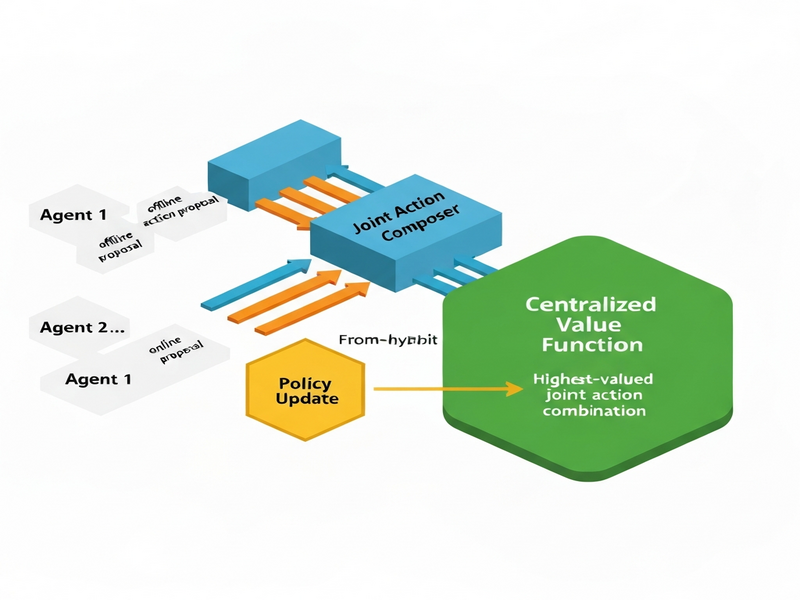
A centralized value function, trained on the offline data, evaluates each hybrid joint action and selects the combination with the highest estimated return. This evaluation loop runs at every decision step, effectively “stitching together” the best of both worlds without any extra training objectives or architectural modifications.
How It Works in Practice
The Sim2O workflow can be broken down into four deterministic stages that repeat at each environment timestep:
- Offline Action Generation: Each agent queries its offline policy πoff to obtain a candidate action aoffi.
- Online Action Generation: Simultaneously, a lightweight online policy πon (often a shallow network or even a bandit) proposes aoni.
- Composition Engine: A combinatorial selector builds a set of joint actions J = { (ac1, …, ac<^N) } where each aci is either aoffi or aoni. The selector can be exhaustive for small teams or use a heuristic (e.g., top‑k per‑agent) for larger teams.
- Centralized Evaluation & Execution: The centralized value network V(s, j) scores each joint candidate j ∈ J given the current state s. The highest‑scoring joint action is executed in the environment, and the resulting transition (s, j, r, s′) is fed back to πon for online refinement.
This loop yields two crucial benefits:
- Safety‑first bias: Agents can default to the offline policy, which is already vetted on historical data, while still allowing selective exploration.
- Coordination preservation: Because the centralized value function evaluates the full joint action, the system respects inter‑agent dependencies even when only a subset of agents explores.
Below is a schematic illustration of the Sim2O pipeline:
Evaluation & Results
To validate Sim2O, the authors benchmarked it across three widely used MARL testbeds:
- StarCraft Multi‑Agent Challenge (SMAC): A partially observable combat scenario with 5‑10 agents.
- Multi‑Agent MuJoCo (MAMuJoCo): Continuous control tasks involving coordinated locomotion.
- Cooperative Navigation (CN): A classic grid‑world where agents must cover distinct landmarks without collision.
Key experimental settings included:
- Offline datasets generated by a high‑performing expert policy (≈ 95 % of expert return).
- Online learning budgets limited to 10 % of the total environment steps, mimicking real‑world cost constraints.
- Baselines: (i) pure offline execution, (ii) naive fine‑tuning of the offline policy, (iii) hierarchical MARL adapters that require extra networks.
Results consistently showed that Sim2O closed the performance gap to the fully online expert within the limited budget, outperforming all baselines by a margin of 12‑18 % in average episode return. Notably, in SMAC’s “3s_vs_5z” map, Sim2O achieved 92 % of the expert’s win rate after only 5 % of the online steps, whereas the best baseline plateaued at 68 %.
Beyond raw scores, the authors highlighted two qualitative findings:
- Robustness to noisy offline data: Even when the offline logs contained 20 % sub‑optimal actions, Sim2O’s composition mechanism still identified high‑value joint actions by leaning on online proposals for the noisy agents.
- Scalability of the composition engine: Using a top‑k heuristic (k = 3 per agent) kept the candidate set under 200 joint actions for a 10‑agent team, preserving real‑time decision latency (< 30 ms per step).
Why This Matters for AI Systems and Agents
Sim2O’s design aligns directly with the operational constraints of production AI agents:
- Cost‑effective rollout: Companies can bootstrap new multi‑agent services from existing telemetry (offline logs) and only allocate a modest online exploration budget, dramatically lowering R&D spend.
- Safety‑critical domains: In autonomous logistics or industrial robotics, the ability to default to a vetted offline policy while selectively exploring reduces the risk of catastrophic failures.
- Modular integration: Because Sim2O does not require bespoke network architectures, it can be layered onto existing MARL stacks, such as those built on the UBOS platform overview or the Workflow automation studio.
- Accelerated product cycles: Teams can iterate on coordination strategies in simulation, then deploy the same compositional engine to real‑world agents, shortening the time‑to‑market for AI‑driven services.
For developers building AI marketing agents, the same principle can be applied: blend historical campaign heuristics (offline) with live A/B testing suggestions (online) to quickly converge on high‑performing multi‑channel strategies. See the AI marketing agents page for related use cases.
What Comes Next
While Sim2O demonstrates that joint action composition is a powerful lever, several avenues remain open for exploration:
- Adaptive composition policies: Currently the mixing rule is static or heuristic‑based. Learning a meta‑policy that decides per‑agent whether to trust offline or online proposals could further improve efficiency.
- Decentralized value estimation: The centralized critic is a bottleneck for extremely large teams. Investigating factorized critics or graph‑based value networks may enable scaling to hundreds of agents.
- Cross‑domain transfer: Applying Sim2O to heterogeneous agent populations (e.g., mixing drones, ground robots, and software bots) will test its robustness to differing action spaces.
- Human‑in‑the‑loop supervision: Integrating domain experts to intervene when the composition engine selects risky joint actions could combine the best of automated learning and human oversight.
Practitioners interested in prototyping Sim2O on their own platforms can start with the OpenAI ChatGPT integration to experiment with centralized value estimation, or explore the Chroma DB integration for efficient offline data storage.
For a deeper dive into the original research, consult the Sim2O paper. The authors also provide code snippets and a lightweight reference implementation that can be adapted to existing MARL pipelines.
As multi‑agent systems become the backbone of autonomous enterprises, frameworks like Sim2O will be essential for turning historical data into coordinated, safe, and profitable online behavior.
Andrii Bidochko
CTO UBOS
Andrii Bidochko is an AI entrepreneur and researcher focused on AI agents, reinforcement learning, and autonomous systems. He writes about the technologies shaping the future of machine intelligence, from frontier models and agent architectures to real-world AI applications.