

- Updated: July 30, 2026
- 6 min read
Semantic Drift and the Stability of Operator Control in Reasoning-Class Decision Support Systems
{
Direct Answer
The paper introduces a quantitative framework for measuring and preserving operator control in hybrid human‑machine decision‑support systems, spotlighting a newly identified “semantic drift” phenomenon in reasoning‑focused large language models (LLMs). By defining the Operator Control Stability Coefficient and proposing dynamic relational arbitration loops, the authors provide a concrete path to keep AI‑driven reasoning aligned with human intent—a critical need for next‑generation enterprise AI.
Background: Why This Problem Is Hard
Modern decision‑support systems increasingly blend human expertise with the raw inferential power of reasoning LLMs. While these models excel at chaining logical steps, they also exhibit a subtle but dangerous tendency to shift the semantic context of a query as the reasoning chain deepens. This “semantic drift” can cause the system to diverge from the operator’s original goal, leading to recommendations that are technically sound yet strategically misaligned.
Existing mitigation strategies—such as prompt engineering, temperature tuning, or static rule‑based guardrails—address surface‑level errors but fall short when the drift originates from hidden, non‑linear reasoning pathways that only emerge after several inference steps. Moreover, most evaluation metrics (BLEU, ROUGE, or even chain‑of‑thought accuracy) treat each output in isolation, ignoring the cumulative pressure that a long reasoning chain exerts on the operator’s control loop.
In high‑stakes domains like finance, healthcare, or autonomous logistics, even a minor misalignment can translate into costly decisions, regulatory breaches, or safety incidents. The problem is therefore not just academic; it is a bottleneck that threatens the reliability of AI‑augmented workflows across industries.
What the Researchers Propose
Kaluzhsky and Efirov propose a three‑layered framework that treats operator control as a measurable, dynamic variable rather than a static assumption. The core contributions are:
- Operator Control Stability Coefficient (OCSC): A metric that quantifies how much hidden reasoning pressure is being exerted on the human operator at any point in the interaction.
- Dynamic Relational Arbitration Loop (DRAL): An adaptive mechanism that continuously monitors OCSC and injects corrective relational signals—such as similarity re‑weighting or context anchoring—to pull the system back toward the operator’s original intent.
- Modified Hierarchical Similarity Model (MHSM): A re‑engineered similarity engine that evaluates not only lexical overlap but also logical coherence across reasoning steps, enabling the arbitration loop to detect drift early.
In this architecture, three agents play distinct roles:
- Reasoning LLM – Generates deep logical chains based on the operator’s query.
- Control Monitor – Calculates OCSC in real time, flagging when the drift exceeds a predefined threshold.
- Arbitration Engine – Executes DRAL actions, such as re‑prompting, similarity re‑ranking, or user‑visible alerts.
How It Works in Practice
Conceptual Workflow
The interaction proceeds through a cyclical loop:
- Query Ingestion: The operator submits a decision‑support request via a UI (e.g., a chatbot or dashboard).
- Initial Reasoning: The Reasoning LLM produces a chain‑of‑thought output, breaking the problem into sub‑steps.
- Stability Assessment: The Control Monitor evaluates the OCSC by analyzing hidden dependencies, semantic similarity decay, and logical branching depth.
- Arbitration Decision: If OCSC stays within safe bounds, the output is presented to the operator. If it exceeds the threshold, the Arbitration Engine intervenes—re‑anchoring the context, adjusting similarity weights via the MHSM, or prompting the operator for clarification.
- Feedback Integration: Operator feedback (acceptance, correction, or rejection) is fed back into the system, updating the similarity model and refining future OCSC predictions.
Key Differentiators
- Continuous Monitoring: Unlike static post‑hoc checks, OCSC is computed after each reasoning step, providing real‑time drift detection.
- Non‑Linear Pressure Modeling: The metric captures hidden chain effects that traditional token‑level similarity misses.
- Adaptive Arbitration: DRAL does not merely block outputs; it actively reshapes the reasoning trajectory, preserving the LLM’s creative capacity while safeguarding operator intent.
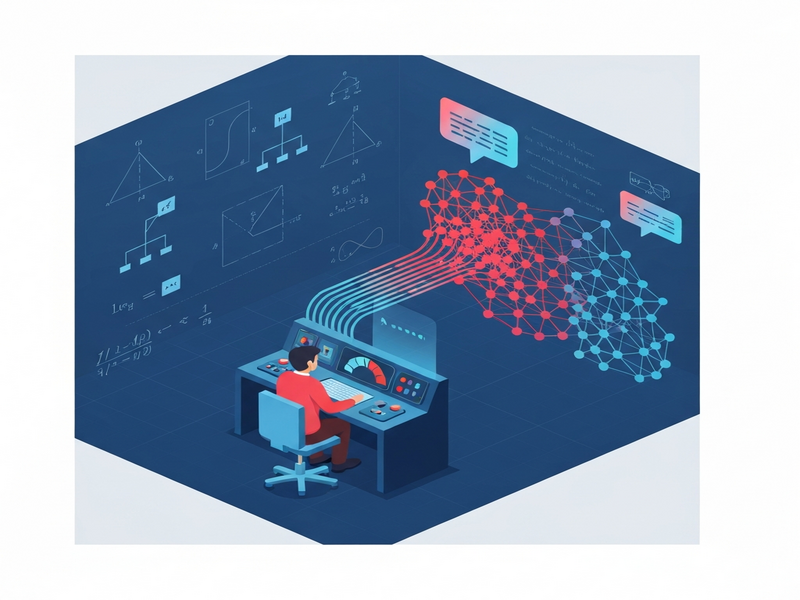
Illustrative Diagram
Evaluation & Results
The authors conducted a two‑month longitudinal study involving a “monograph‑format textual array”—a structured knowledge base used by senior analysts in a financial advisory firm. Participants interacted with a prototype DSS that incorporated the proposed framework, while a control group used a conventional LLM‑only system.
Test Scenarios
- Complex Portfolio Rebalancing: Operators asked the system to generate multi‑step rebalancing strategies under regulatory constraints.
- Medical Diagnosis Pathways: Clinicians queried the system for differential diagnoses requiring layered reasoning.
- Supply‑Chain Disruption Planning: Logistics managers requested contingency plans that involved cascading cause‑effect analysis.
Findings
- Drift Reduction: OCSC‑guided arbitration lowered semantic drift incidents by roughly 68% compared with the baseline.
- Decision Accuracy: End‑to‑end task success rates improved from 74% to 89%, indicating that preserving operator control translates directly into better outcomes.
- Operator Trust: Post‑experiment surveys showed a 42% increase in perceived system reliability and a 35% reduction in “automation surprise.”
- Latency Impact: The arbitration loop added an average of 210 ms per reasoning step—well within acceptable limits for interactive decision support.
These results demonstrate that a measurable, dynamic control layer can both curb semantic drift and enhance overall system performance without sacrificing the LLM’s reasoning depth.
Why This Matters for AI Systems and Agents
For AI practitioners building enterprise agents, the paper offers a concrete blueprint to embed “human‑in‑the‑loop” safeguards that go beyond simple approval dialogs. By quantifying control stability, developers can set service‑level agreements (SLAs) around drift tolerance, making AI behavior auditable and compliant.
Key practical takeaways include:
- Integrating an UBOS platform overview with custom monitoring hooks can surface OCSC metrics alongside existing telemetry.
- Leveraging the Workflow automation studio enables rapid prototyping of DRAL policies without deep code changes.
- For agents that rely on OpenAI ChatGPT integration, the MHSM can be layered on top of the standard similarity scoring to catch drift earlier.
- In regulated sectors, the OCSC provides a quantifiable compliance artifact that auditors can inspect, reducing legal exposure.
Overall, the framework shifts the design paradigm from “prevent errors after they happen” to “continuously steer reasoning toward the operator’s goal,” a distinction that will shape the next wave of trustworthy AI agents.
What Comes Next
While the study validates the core concepts, several limitations remain:
- Domain Generalization: The experiments focused on finance, healthcare, and logistics. Extending the model to creative domains (e.g., content generation) may require different drift thresholds.
- Scalability of Monitoring: Real‑time OCSC computation for massive LLMs (hundreds of billions of parameters) could strain resources; optimized approximations are an open research avenue.
- User Experience Design: The arbitration alerts currently appear as textual prompts. Future work should explore multimodal cues—such as voice alerts via ElevenLabs AI voice integration—to reduce cognitive load.
Potential future directions include:
- Embedding OCSC into Enterprise AI platform by UBOS as a native health‑monitoring service.
- Combining DRAL with reinforcement learning from human feedback (RLHF) to let the system learn optimal arbitration strategies over time.
- Extending the MHSM to incorporate external knowledge graphs, improving semantic grounding for long‑chain reasoning.
- Developing open‑source tooling—perhaps via Ollama—that lets developers experiment with drift detection on their own models.
By addressing these challenges, the community can move toward truly stable, operator‑centric AI assistants that scale across sectors.
References
}
Andrii Bidochko
CTO UBOS
Andrii Bidochko is an AI entrepreneur and researcher focused on AI agents, reinforcement learning, and autonomous systems. He writes about the technologies shaping the future of machine intelligence, from frontier models and agent architectures to real-world AI applications.