

- Updated: August 15, 2026
- 2 min read
Segment‑Level Automatic Prompt Optimization (SAPO): A Deep Dive
Segment‑Level Automatic Prompt Optimization (SAPO): A Deep Dive
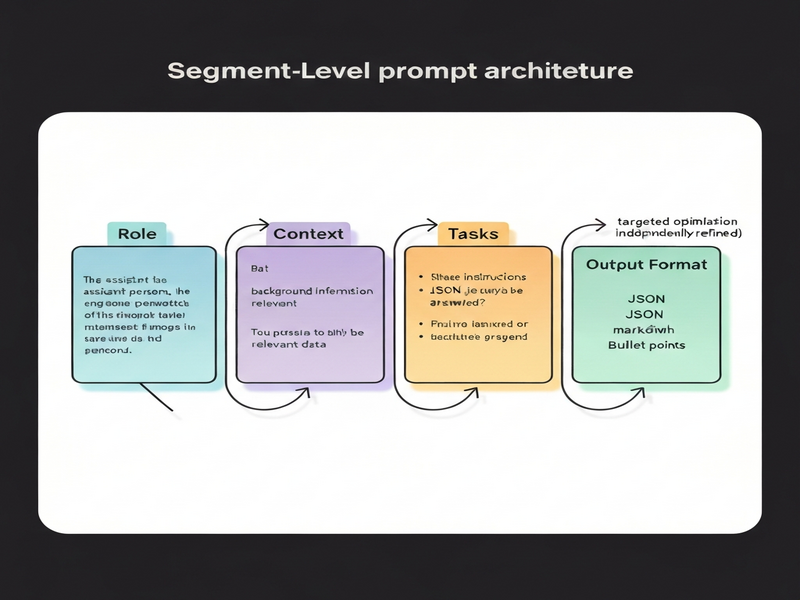
Automatic Prompt Optimization (APO) has traditionally treated prompts as monolithic blocks, often improving one behavior while unintentionally degrading another. The recent arXiv paper “From Monolithic to Modular: Segment‑level Automatic Prompt Optimization” introduces SAPO, a novel framework that decomposes prompts into four logical segments—role, context, tasks, and output format—and applies targeted refinements to each.
Key Contributions
- Modular prompt representation that isolates weaknesses and strengths per segment.
- Two‑stage generation pipeline: (1) segment‑level diagnosis & recommendation extraction, (2) constrained candidate synthesis.
- Comprehensive evaluation across SQuADv2, TweetEval, XSUM, CommonGen, and GSM8K using GPT‑3.5‑Turbo and GPT‑4o‑mini.
- Consistent outperformance of strong baselines such as APE, OPRO, EvoPrompt, GEPA, and StraGO.
Methodology
SAPO employs a single LLM equipped with static meta‑prompts to produce structured outputs for:
- Segmentation: Split the original prompt into the four defined blocks.
- Weakness Analysis: Identify the bottom‑5 examples for each segment.
- Strength Extraction: Highlight the top‑5 examples per segment.
- Candidate Generation: Synthesize new prompt variants constrained by the identified weak/strong signals.
The approach ensures that improvements in one segment do not inadvertently harm others, addressing a core limitation of monolithic APO methods.
Results
Across the five benchmark datasets, SAPO achieved the highest average scores, delivering notable gains in both accuracy and robustness. Detailed results are available in the paper’s appendix.
Implications & Future Work
The segment‑level perspective opens new avenues for fine‑grained prompt engineering, enabling developers to tailor LLM behavior with precision. Future research may explore:
- Extending segmentation to multilingual and multimodal prompts.
- Automating the selection of segment granularity based on task complexity.
- Integrating user feedback loops for continuous prompt refinement.
For more insights on prompt engineering and AI‑driven content creation, visit our UBOS resources and explore the UBOS blog.
Conclusion
SAPO demonstrates that breaking prompts into logical components and optimizing each individually yields superior performance over traditional monolithic approaches. This modular strategy not only boosts benchmark scores but also provides clearer diagnostics for prompt designers, paving the way for more reliable and controllable LLM applications.
Andrii Bidochko
CTO UBOS
Andrii Bidochko is an AI entrepreneur and researcher focused on AI agents, reinforcement learning, and autonomous systems. He writes about the technologies shaping the future of machine intelligence, from frontier models and agent architectures to real-world AI applications.