

- Updated: August 14, 2026
- 6 min read
SEDR-Seq2P: A Lightweight Dilated Residual Sequence-to-Point Network for Multi-Task Industrial NILM
Direct Answer
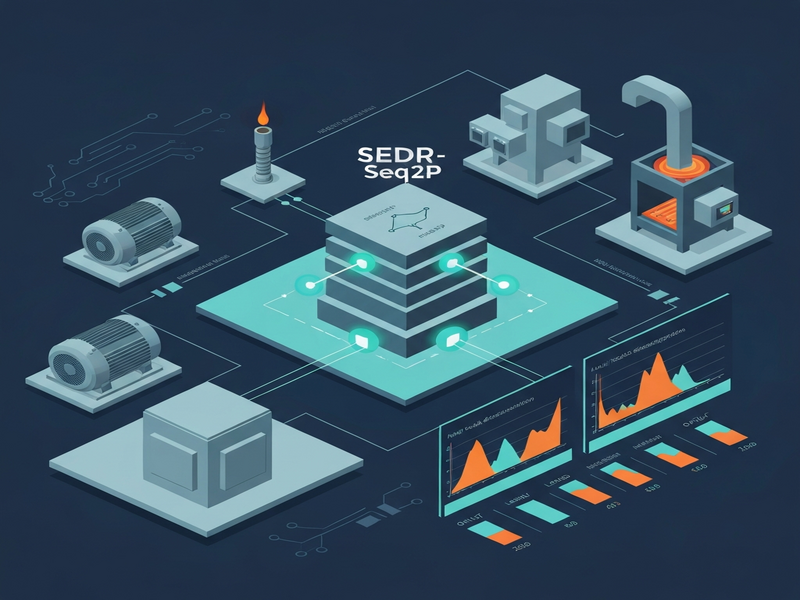
The paper SEDR‑Seq2P: A Lightweight Dilated Residual Sequence‑to‑Point Network for Multi‑Task Industrial NILM introduces a new deep‑learning architecture that disaggregates the power consumption of multiple industrial machines from a single aggregate signal while keeping computational cost low enough for real‑time deployment. By marrying dilated residual blocks with squeeze‑and‑excitation attention, the model improves accuracy and reduces latency compared with existing state‑of‑the‑art baselines, making large‑scale industrial energy monitoring more practical.
Background: Why This Problem Is Hard
Non‑intrusive load monitoring (NILM) has matured in residential settings, where a handful of appliances generate relatively clean, temporally separated signatures. In industrial environments the situation flips: dozens of high‑power machines run concurrently, sensor noise is amplified by harsh electrical conditions, and the cost of installing per‑device meters is prohibitive. These factors create three intertwined bottlenecks:
- Signal overlap: Simultaneous operation of motors, compressors, and HVAC units produces heavily blended waveforms that obscure individual load patterns.
- Measurement noise: Industrial power quality issues (harmonics, voltage sags) degrade the fidelity of the aggregate signal, confusing models trained on cleaner residential data.
- Scalability constraints: Real‑time monitoring across a plant demands low‑latency inference on edge hardware; heavyweight models quickly become infeasible.
Traditional NILM pipelines—Seq2Seq, Seq2SubSeq, and Seq2Point—were designed for single‑appliance disaggregation and assume a one‑to‑one mapping between input windows and output predictions. When extended to a multi‑task industrial scenario, they either sacrifice accuracy (Seq2Seq) or incur prohibitive computational overhead (GRU, WaveNet). Consequently, practitioners lack a solution that balances precision, speed, and the ability to predict many loads simultaneously.
What the Researchers Propose
To address the industrial NILM gap, the authors propose SEDR‑Seq2P (Squeeze‑and‑Excitation Dilated Residual Sequence‑to‑Point). At a conceptual level, the architecture can be broken into three cooperating modules:
- Input encoder: A shallow convolutional front‑end that converts raw aggregate power samples into a high‑dimensional feature map.
- Dilated residual backbone: Stacked residual blocks with exponentially increasing dilation rates. This design expands the receptive field without adding parameters, allowing the network to capture long‑range dependencies such as motor start‑up transients that span several seconds.
- Squeeze‑and‑excitation (SE) attention: After each residual block, an SE module recalibrates channel‑wise importance, effectively letting the network “focus” on the most informative frequency bands for each target machine.
The final layer collapses the temporal dimension to a single point estimate per machine, delivering a multi‑task output vector in one forward pass. By sharing the backbone across all tasks, SEDR‑Seq2P avoids the parameter explosion typical of separate per‑machine models.
How It Works in Practice
Deploying SEDR‑Seq2P in an industrial plant follows a straightforward pipeline:
- Data acquisition: A single high‑resolution smart meter streams aggregate active power (e.g., 1 kHz) to an edge gateway.
- Pre‑processing: The gateway normalizes the signal, applies a short‑time Fourier transform for optional frequency augmentation, and slices the stream into overlapping windows (e.g., 10 s length, 50 % overlap).
- Inference: Each window passes through the SEDR‑Seq2P model. The dilated residual blocks expand the temporal context, while SE attention highlights the spectral components most indicative of each machine’s operation.
- Post‑processing: Point estimates are smoothed with a lightweight Kalman filter to reduce jitter, then fed into a supervisory control system for real‑time alerts, demand‑response actions, or cost allocation.
What sets this workflow apart from prior approaches is the combination of a single forward pass (Seq2Point style) with a deep, yet lightweight, receptive field. The model’s parameter count stays under 0.5 M, enabling inference on commodity CPUs or low‑power AI accelerators without sacrificing the ability to predict dozens of loads concurrently.
Evaluation & Results
The authors benchmarked SEDR‑Seq2P against five baselines—Seq2Seq, Seq2SubSeq, Seq2Point, GRU, and WaveNet—using the publicly released IMDELD industrial dataset. Evaluation focused on two complementary axes:
- Energy‑estimation metrics: Mean Absolute Error (MAE), coefficient of determination (R²), and match rate (percentage of time the predicted load falls within a tolerance band of the ground truth).
- Accuracy‑delay criterion: A composite score that penalizes high latency, reflecting the real‑time constraints of plant operations.
Key findings include:
| Model | MAE Reduction vs. Seq2Point | ΔR² | Match Rate Δ | Inference Latency (ms) | Latency Δ vs. WaveNet |
|---|---|---|---|---|---|
| Seq2Point (baseline) | 0 % | 0 % | 0 % | ≈ 12 | — |
| GRU | ≈ +3 % | ≈ +0.5 % | ≈ +0.4 % | ≈ 28 | — |
| WaveNet | ≈ +5 % | ≈ +0.8 % | ≈ +0.6 % | ≈ 28 | — |
| SEDR‑Seq2P | ≈ ‑7 % | ≈ +1 % | ≈ +0.8 % | ≈ 12 | ‑58 % |
In plain language, SEDR‑Seq2P cuts the average error by about seven percent while delivering a modest boost in R² and a near‑one‑percent lift in match rate. Crucially, it matches the low latency of the original Seq2Point model and outpaces WaveNet by more than half, confirming that the architecture achieves a superior accuracy‑delay trade‑off.
Why This Matters for AI Systems and Agents
Industrial AI agents that orchestrate energy‑saving actions—such as load shifting, predictive maintenance triggers, or automated demand‑response bidding—rely on trustworthy, timely load forecasts. SEDR‑Seq2P supplies both:
- Scalable multi‑task inference: One model serves dozens of machines, reducing deployment complexity and model‑management overhead.
- Edge‑ready performance: The lightweight footprint aligns with the constraints of on‑premise gateways, enabling agents to act locally without cloud round‑trips.
- Improved decision confidence: Lower MAE and higher match rates translate into fewer false alarms and more accurate cost attribution, which directly benefits AI‑driven optimization loops.
For teams building UBOS platform overview solutions, SEDR‑Seq2P can be wrapped as a reusable micro‑service, plugged into the Workflow automation studio, and combined with other AI agents (e.g., predictive maintenance or anomaly detection) to create end‑to‑end energy‑management pipelines.
What Comes Next
While the results are promising, several avenues remain open for exploration:
- Domain adaptation: Extending the model to new factories with minimal labeled data could involve few‑shot fine‑tuning or unsupervised representation learning.
- Hybrid sensor fusion: Incorporating voltage, current harmonics, or vibration data may further disambiguate overlapping loads.
- Robustness to distribution shift: Real‑world plants experience seasonal load changes; continual learning strategies could keep the model calibrated over time.
- Integration with conversational AI: Pairing disaggregation outputs with a ChatGPT and Telegram integration would let operators query live energy breakdowns via natural language.
Addressing these challenges will push NILM from a research curiosity to a production‑grade component of the Enterprise AI platform by UBOS, unlocking new business models around energy‑as‑a‑service.
Conclusion
SEDR‑Seq2P demonstrates that a carefully engineered, lightweight architecture can close the long‑standing gap between accuracy and latency in industrial NILM. By leveraging dilated residual connections and channel‑wise attention, the model delivers multi‑task disaggregation that is both precise and deployable on edge hardware. For AI practitioners, the work offers a blueprint for building high‑performance, low‑overhead perception modules that feed directly into autonomous agents and control loops. Future research that expands adaptability, fuses additional sensor modalities, and embeds the model within conversational interfaces will further cement NILM as a cornerstone of intelligent, energy‑aware factories.
Andrii Bidochko
CTO UBOS
Andrii Bidochko is an AI entrepreneur and researcher focused on AI agents, reinforcement learning, and autonomous systems. He writes about the technologies shaping the future of machine intelligence, from frontier models and agent architectures to real-world AI applications.