

- Updated: July 5, 2026
- 6 min read
Scalable Hierarchical Attention Transformers for Multi‑Turn Jailbreak Detection in Long Conversations
Direct Answer
The paper introduces a Scalable Hierarchical Attention Transformer (HAT) designed to detect multi‑turn jailbreak attempts in long‑form conversations without concatenating the entire dialogue into a single massive context. By encoding each turn separately and then applying a lightweight conversation‑level module that mixes cross‑attention and self‑attention, the model achieves near‑human‑level detection while cutting inference cost in half.
Background: Why This Problem Is Hard
Modern conversational AI systems—chatbots, virtual assistants, and generative agents—are increasingly deployed in open‑ended settings where users can interact over dozens or hundreds of turns. Malicious actors exploit this flexibility through multi‑turn jailbreaks, gradually steering the model toward unsafe behavior by spreading harmful intent across many messages. Traditional moderation pipelines focus on turn‑level analysis, flagging each utterance in isolation. This approach fails when the unsafe signal is only apparent after aggregating context, such as subtle role‑playing or incremental escalation.
Existing solutions typically resort to one of two extremes:
- Full‑context concatenation: Append the entire conversation into a single prompt for a large language model (LLM). While this preserves all information, it quickly exceeds token limits and incurs quadratic attention costs, making it impractical for real‑time moderation.
- Heuristic windowing: Slide a fixed‑size window over recent turns and run a classifier on each slice. This reduces compute but discards long‑range dependencies, causing many sophisticated jailbreaks to slip through.
Consequently, there is a pressing need for a method that (1) respects the token constraints of current LLMs, (2) retains the ability to reason across distant turns, and (3) remains efficient enough for production‑scale deployment.
What the Researchers Propose
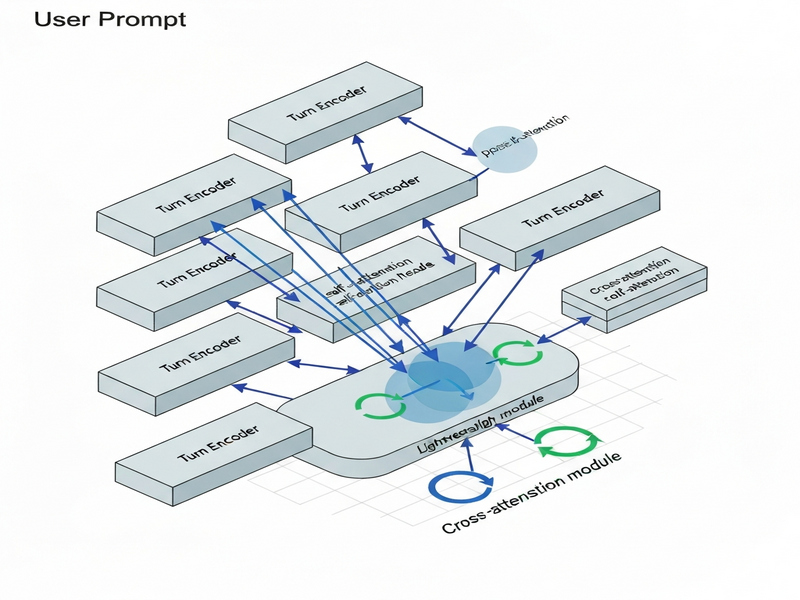
The authors present a two‑tier architecture that separates turn‑level encoding from conversation‑level reasoning. The first tier, called the Turn Encoder, compresses each individual utterance into a dense vector representation using a modest transformer backbone. The second tier, the Conversation Module, consumes the sequence of turn embeddings and applies a hybrid attention mechanism:
- Self‑Attention: Captures intra‑turn dynamics and local patterns within the turn‑embedding sequence.
- Cross‑Attention: Allows the module to selectively focus on specific turn embeddings when evidence of a jailbreak emerges, effectively “zooming in” on the most relevant parts of the dialogue.
By decoupling the heavy lifting of language understanding (handled once per turn) from the lighter, context‑aware reasoning (handled once per conversation), the system scales linearly with the number of turns while preserving the ability to detect subtle, multi‑turn threats.
How It Works in Practice
The workflow can be broken down into three concrete steps:
- Turn Segmentation & Encoding: As a conversation unfolds, each incoming message is tokenized and passed through a pre‑trained, size‑efficient transformer (e.g., a 6‑layer encoder). The output is a fixed‑dimensional embedding that summarizes the semantic content of the turn.
- Conversation Buffer Management: Embeddings are stored in a FIFO buffer that represents the dialogue history. The buffer size is configurable (e.g., 100 turns) to balance memory usage and coverage.
- Hierarchical Attention Inference: When a new turn arrives, the Conversation Module receives the updated buffer. It first runs self‑attention to model temporal relationships, then cross‑attention queries the buffer with a learned “suspicion” vector. If the cross‑attention scores exceed a threshold, the module extracts the implicated turn embeddings and feeds them into a lightweight classifier that outputs a jailbreak probability.
This design differs from naïve concatenation in two key ways:
- Computational Efficiency: The heavy transformer runs once per turn (O(N) total), while the hierarchical attention operates on a compact embedding sequence (O(N²) with a much smaller constant).
- Selective Evidence Gathering: Cross‑attention acts as a learned retrieval mechanism, pulling only the most suspicious turns into the final decision path, which reduces false positives caused by noisy context.
Below is a schematic of the architecture (illustration courtesy of UBOS):
Evaluation & Results
To validate the approach, the researchers assembled a benchmark of 14,038 multi‑turn conversations sourced from public jailbreak datasets and synthetic adversarial scripts. The dataset includes a balanced mix of benign dialogues and carefully crafted jailbreak sequences that span 5–30 turns.
Key evaluation metrics were:
- F1 Score: Harmonic mean of precision and recall, reflecting overall detection quality.
- False‑Positive Rate (FPR): Critical for user experience, as over‑blocking legitimate conversations erodes trust.
- Inference Latency: Measured on a standard GPU (NVIDIA A100) to assess real‑time suitability.
The Hierarchical Attention Transformer achieved an F1 of 0.9394, surpassing the strongest baseline (Claude Opus 4.7) by 0.07 points while halving its false‑positive rate. Ablation studies revealed that:
- Removing cross‑attention increased FPR by 2.26 percentage points, confirming its role in precise evidence selection.
- Replacing the Turn Encoder with a larger language model yielded marginal gains (<0.5 % F1) but doubled inference cost, underscoring the efficiency of the proposed encoder.
- Limiting the buffer to 50 turns caused a 1.8 % drop in recall, indicating that the system benefits from moderate historical depth.
Overall, the experiments demonstrate that hierarchical attention can deliver state‑of‑the‑art jailbreak detection without the prohibitive overhead of full‑context processing.
Why This Matters for AI Systems and Agents
For product teams building conversational agents, the ability to flag multi‑turn jailbreaks reliably translates directly into safer deployments and lower compliance risk. The hierarchical design fits naturally into existing moderation pipelines:
- It can be plugged after the turn‑level NLU stage, using the same embeddings already generated for intent classification.
- Because the conversation module is lightweight, it can run on edge devices or within latency‑critical micro‑services, enabling real‑time intervention.
- The selective attention mechanism provides interpretable “evidence” turns, which can be surfaced to human reviewers for audit trails.
Integrating this detector with a broader AI safety stack—such as policy‑driven response generators or automated user warnings—creates a multi‑layered defense against adversarial prompting. Companies leveraging the UBOS platform overview can embed the hierarchical model as a modular component within their Workflow automation studio, orchestrating detection, escalation, and remediation without custom code.
What Comes Next
While the results are promising, several avenues remain open for improvement:
- Cross‑Domain Generalization: The current benchmark focuses on English‑language jailbreaks. Extending the model to multilingual settings will require language‑agnostic turn encoders or language‑specific adapters.
- Dynamic Buffer Strategies: Adaptive pruning based on attention scores could further reduce memory footprints while preserving critical context.
- Integration with Retrieval‑Augmented Generation (RAG): Pairing the detector with a RAG system could enable on‑the‑fly generation of safe fallback responses when a jailbreak is suspected.
- Human‑in‑the‑Loop Feedback: Leveraging moderator corrections to fine‑tune the cross‑attention queries could continuously improve detection accuracy.
From a product perspective, embedding the Hierarchical Attention Transformer into an Enterprise AI platform by UBOS would allow large organizations to enforce consistent safety policies across dozens of deployed agents. Moreover, the modular nature of the architecture makes it a strong candidate for inclusion in upcoming AI marketing agents, where brand‑safe communication is paramount.
For researchers, the paper opens a new line of inquiry into hierarchical attention mechanisms that balance scalability with deep contextual reasoning—a sweet spot that many safety‑critical applications will need.
References
Scalable Hierarchical Attention Transformers paper
Andrii Bidochko
CTO UBOS
Andrii Bidochko is an AI entrepreneur and researcher focused on AI agents, reinforcement learning, and autonomous systems. He writes about the technologies shaping the future of machine intelligence, from frontier models and agent architectures to real-world AI applications.