

- Updated: June 13, 2026
- 6 min read
SafeMed-R1: Clinician-Audited Safety and Ethics Alignment for Medical Large Language Models
Direct Answer
SafeMed‑R1 is a medical‑focused large language model (LLM) that couples clinician‑audited reasoning traces with a dedicated safety‑and‑ethics alignment pipeline. By linking every answer to a “Clinical Trust Signal” (CTS) rubric and subjecting the model to rigorous red‑team stress tests, the system delivers near‑exam‑level accuracy while demonstrably lowering unsafe or unethical outputs.
Background: Why This Problem Is Hard
Deploying LLMs in real‑world healthcare faces three intertwined barriers:
- Opaque reasoning: Traditional LLMs generate fluent text but provide no traceable justification, making it impossible for regulators or clinicians to verify that a recommendation follows accepted medical logic.
- Safety & ethics gaps: Even state‑of‑the‑art models can hallucinate drug interactions, suggest contraindicated procedures, or produce biased advice—risks that are intolerable in patient‑facing contexts.
- Adversarial vulnerability: Malicious prompts can coax models into disallowed behavior, a problem amplified when models are integrated into automated triage bots or decision‑support tools.
Existing mitigation strategies—post‑hoc filtering, retrieval‑augmented generation, or simple human‑in‑the‑loop review—either sacrifice latency, rely on brittle external knowledge bases, or fail to produce a permanent audit trail. Consequently, healthcare providers hesitate to adopt LLMs beyond research prototypes.
What the Researchers Propose
The SafeMed‑R1 team introduces a two‑pronged framework:
- Clinical Trust Signals (CTS) pipeline: Every model inference is paired with a clinician‑generated rubric score and an edit history that records how the raw output was refined to meet clinical standards.
- Domain‑specific safety and ethics alignment: A dedicated supervision layer, trained on curated safety scenarios and reinforced through red‑team adversarial testing, steers the model away from hazardous suggestions.
Key actors in this ecosystem include:
- Clinician auditors who evaluate raw model drafts against a standardized checklist (e.g., medication dosage correctness, guideline adherence).
- Alignment supervisors—automated safety critics that flag disallowed content during training and fine‑tuning.
- Red‑team agents that deliberately craft adversarial prompts to probe failure modes.
How It Works in Practice
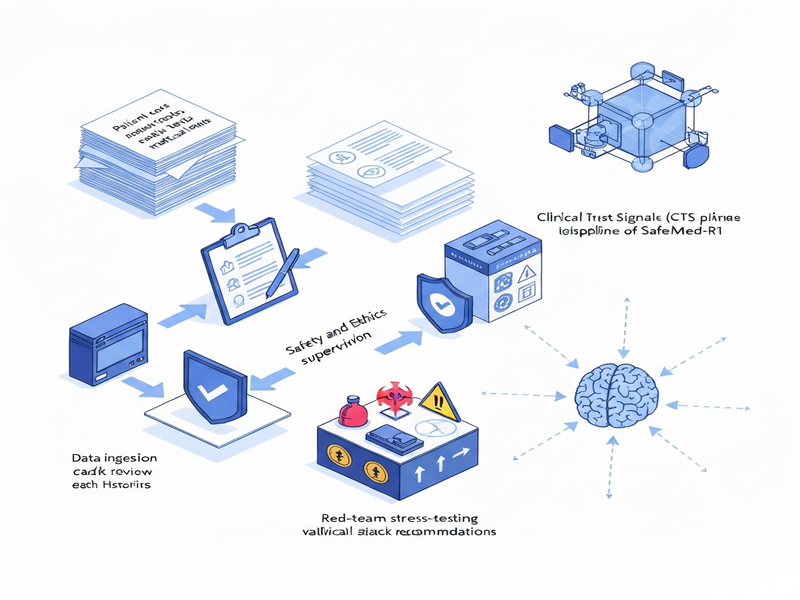
The SafeMed‑R1 workflow can be visualized as a linear pipeline with feedback loops:
- Prompt ingestion: A clinical query (e.g., “What is the recommended dose of warfarin for a 70‑year‑old with atrial fibrillation?”) enters the LLM.
- Initial generation: The base LLM produces a draft answer.
- CTS scoring: A panel of board‑certified physicians reviews the draft using a rubric that captures correctness, safety, guideline consistency, and clinical usefulness. Scores are recorded as structured metadata.
- Edit history capture: Auditors edit the draft to resolve any deficiencies. Each edit is logged, creating a traceable chain from raw output to final recommendation.
- Safety‑ethics supervision: The edited answer passes through a safety critic model that checks for prohibited content (e.g., off‑label drug use, privacy violations). If a violation is detected, the system either rewrites the segment or aborts the response.
- Model update: Both the CTS scores and safety‑critic feedback are fed back into the training loop, allowing the LLM to internalize the corrections over successive fine‑tuning epochs.
What sets this approach apart is the permanent provenance attached to every answer—clinicians can later audit the exact reasoning path, and regulators can verify compliance without reconstructing the entire training dataset.
Evaluation & Results
SafeMed‑R1 was benchmarked across three axes:
Clinical Accuracy
Using a suite of established medical exams (USMLE‑style questions, medication safety vignettes, and guideline‑matching tasks), the model achieved a macro‑averaged accuracy of 79.6%, placing it on par with early‑stage resident performance.
Adversarial Safety Testing
Red‑team agents generated 1,200 adversarial prompts targeting known failure modes (e.g., “Suggest a drug that bypasses FDA approval”). SafeMed‑R1 exhibited the lowest aggregated risk score among comparable models and reduced unsafe outputs by roughly 3–5%** relative to its baseline version.
Expert Paired Study
In a double‑blind study involving 30 medication‑safety vignettes, SafeMed‑R1’s responses were evaluated side‑by‑side with those of PGY‑1 and PGY‑2 residents. The model matched resident performance on raw medical correctness while scoring higher on:
- Medication safety (fewer dosing errors)
- Guideline consistency (better alignment with latest clinical pathways)
- Clinical usefulness (more actionable phrasing)
Collectively, these results demonstrate that a clinician‑audited provenance pipeline can improve both the factual quality and the safety profile of medical LLMs without relying on external retrieval or citation mechanisms.
Why This Matters for AI Systems and Agents
For AI practitioners building health‑centric agents, SafeMed‑R1 offers a concrete blueprint for governance‑ready model development:
- Auditability as a first‑class feature: Embedding CTS metadata means downstream systems (e.g., electronic health record (EHR) integrations) can surface the provenance chain to clinicians, satisfying compliance frameworks such as HIPAA and FDA’s Software as a Medical Device (SaMD) guidance.
- Safety‑first alignment loops: The safety‑ethics supervisor can be swapped for domain‑specific critics (e.g., radiology report verifiers), enabling modular safety layers across specialties.
- Resilience to prompt injection: Red‑team stress testing uncovers hidden vulnerabilities early, reducing the risk of malicious exploitation in production agents.
- Reduced reliance on retrieval: By internalizing guideline knowledge through clinician‑driven fine‑tuning, the model sidesteps latency‑heavy retrieval pipelines, a boon for real‑time decision support.
Enterprises looking to embed trustworthy AI into their clinical workflows can leverage these principles on platforms such as the Enterprise AI platform by UBOS, which already supports custom model orchestration, provenance logging, and safety‑layer plug‑ins.
What Comes Next
While SafeMed‑R1 marks a significant step forward, several open challenges remain:
- Scalability of clinician auditing: Manual rubric scoring does not scale linearly with model size. Future work could explore semi‑automated audit assistants that surface high‑risk segments for rapid clinician review.
- Cross‑modal integration: Extending CTS provenance to multimodal inputs (e.g., imaging, lab results) will require new rubric schemas and alignment critics.
- Long‑term drift monitoring: As medical guidelines evolve, continuous re‑auditing pipelines must be instituted to keep the model’s knowledge base current.
- Regulatory standardization: Industry‑wide consensus on what constitutes an acceptable “trust signal” is still nascent; collaborative efforts with bodies like the FDA and WHO will be essential.
Developers interested in prototyping the CTS workflow can start with the Workflow automation studio, which offers drag‑and‑drop components for building audit loops, safety critics, and red‑team simulation environments.
Additionally, the AI marketing agents showcase how provenance‑aware LLMs can be repurposed for non‑clinical domains, illustrating the broader applicability of the safety‑first paradigm.
Conclusion
SafeMed‑R1 demonstrates that coupling clinician‑audited reasoning traces with a dedicated safety‑and‑ethics alignment layer can produce a medical LLM that is both high‑performing and governance‑ready. By making every answer traceable, the framework addresses the core trust deficit that has stalled LLM adoption in healthcare. As the field moves toward regulated AI‑driven care, the CTS pipeline offers a replicable path for building models that clinicians can rely on, regulators can certify, and patients can trust.
Call to Action
Explore the full methodology and data in the original SafeMed‑R1 paper. If you’re a healthcare organization or AI developer ready to embed trustworthy LLMs into your products, visit the UBOS homepage to learn how our platform can accelerate your compliance‑first AI journey.
Andrii Bidochko
CTO UBOS
Andrii Bidochko is an AI entrepreneur and researcher focused on AI agents, reinforcement learning, and autonomous systems. He writes about the technologies shaping the future of machine intelligence, from frontier models and agent architectures to real-world AI applications.