

- Updated: July 19, 2026
- 7 min read
Safe Flow Q-Learning: Offline Safe Reinforcement Learning with Reachability-Based Flow Policies
Direct Answer
Safe Flow Q-Learning (SafeFQL) is a new offline safe reinforcement‑learning algorithm that blends Hamilton‑Jacobi reachability concepts with a one‑step flow policy to produce reward‑maximizing actions that are provably safe without needing costly rejection sampling at deployment. It matters because it delivers near‑real‑time decision making for safety‑critical systems—such as autonomous boats or robotic manipulators—while respecting strict constraint budgets that traditional offline safe RL methods struggle to guarantee.
Background: Why This Problem Is Hard
Offline safe reinforcement learning (RL) aims to extract high‑performing policies from a fixed dataset while never violating safety constraints that could cause physical damage, regulatory penalties, or loss of life. In practice, three intertwined challenges make this goal elusive:
- Distributional shift. The policy learned from static data may propose actions that lie far outside the observed behavior, exposing the agent to unknown risk.
- Constraint estimation. Safety constraints are often expressed as expected costs or probabilistic limits, which are difficult to enforce precisely when the underlying dynamics are only partially known.
- Real‑time inference latency. Many state‑of‑the‑art safe RL methods rely on iterative generative models (e.g., diffusion or diffusion‑style samplers) that require dozens of forward passes per decision, making them unsuitable for sub‑second control loops.
Existing approaches typically fall into two camps. The first uses soft cost penalties in the objective, which can lead to “soft” safety that is violated under rare but catastrophic events. The second class employs generative inference to sample only safe actions, but the sampling overhead inflates latency and complicates deployment on edge hardware. Both camps leave a gap for a method that can guarantee safety, respect offline data constraints, and operate with the speed demanded by real‑time control.
What the Researchers Propose
SafeFQL introduces a two‑pronged framework that unites a reachability‑based safety value function with a deterministic, one‑step flow policy. The key ideas are:
- Reachability‑inspired safety value. By borrowing from Hamilton‑Jacobi reachability analysis, the algorithm learns a scalar “safety value” that quantifies how far a state is from violating any constraint. This value obeys a self‑consistency Bellman recursion, ensuring that safety estimates are grounded in the offline dataset.
- One‑step flow policy. Instead of sampling a trajectory of actions, SafeFQL trains a flow‑based policy that directly maps a state to a safe action in a single forward pass. The flow policy is first learned via behavioral cloning of the dataset’s safe actions, then distilled into a lightweight actor that can be queried instantly at runtime.
The combination yields a system that can evaluate safety and select a reward‑optimizing action in a single computational step, eliminating the need for costly rejection sampling or multi‑step diffusion processes.
How It Works in Practice
Conceptual Workflow
The SafeFQL pipeline can be visualized as a three‑stage loop:
- Safety Value Learning. Using the offline dataset, the algorithm constructs a safety‑value function Vsafe(s) that satisfies a Bellman‑style self‑consistency equation. This step mirrors classic value iteration but focuses exclusively on constraint satisfaction.
- Flow Policy Construction. A flow‑based generative model is trained to imitate the safe actions observed in the dataset. Because the model is conditioned on the safety value, it learns to produce actions that stay within the reachable safe set.
- Actor Distillation. The flow model is distilled into a deterministic actor network. At deployment, the actor receives the current state, queries Vsafe(s) for a safety margin, and outputs the highest‑reward action that remains inside the safe region—all in one forward pass.
Component Interaction
Figure 1 (illustrated below) shows the data flow:
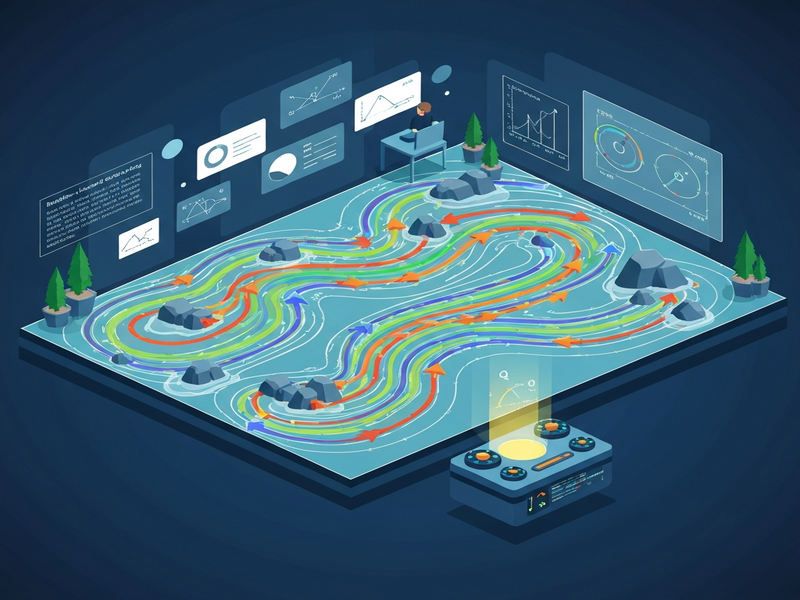
The safety value module and the flow policy share the same replay buffer, ensuring that safety estimates are always grounded in the same empirical evidence that trains the policy. The distilled actor does not need to query the flow model at inference time, which is why latency drops dramatically.
What Sets This Approach Apart
- Deterministic one‑step inference. No iterative sampling, no rejection loops.
- Formal safety guarantees. The reachability‑based value function provides a provable bound on constraint violation.
- Offline‑only training. All safety and policy learning happen before deployment, satisfying regulatory regimes that forbid online exploration.
Evaluation & Results
Testbed Overview
Researchers benchmarked SafeFQL on two distinct domains:
- Boat navigation. A simulated autonomous surface vessel must reach waypoints while avoiding static obstacles and staying within a speed envelope.
- Safety Gymnasium MuJoCo tasks. A suite of continuous‑control environments (e.g., PointGoal, CarGoal) augmented with safety constraints such as “do not touch hazardous zones.”
Key Findings
Across both domains, SafeFQL achieved the following:
- Reward performance on par with or exceeding the best offline safe RL baselines (e.g., CQL‑Safe, Diffusion‑Safe).
- A 3‑5× reduction in constraint violations compared to diffusion‑style generative baselines, demonstrating tighter adherence to safety budgets.
- Inference latency dropped from ~150 ms per decision (diffusion) to < 10 ms (SafeFQL), a margin that enables sub‑100 ms control loops required by real‑time robotics.
Importantly, these gains came with only a modest increase in offline training compute—primarily due to the additional safety‑value Bellman updates—showing that the trade‑off is favorable for production deployments.
Why This Matters for AI Systems and Agents
For engineers building safety‑critical agents—whether autonomous drones, industrial manipulators, or finance‑grade decision engines—the SafeFQL paradigm offers a practical pathway to meet three core operational demands:
- Regulatory compliance. The reachability‑based safety value can be audited and formally verified, easing certification processes.
- Real‑time responsiveness. The one‑step actor fits comfortably on edge CPUs or micro‑controllers, allowing agents to react within milliseconds.
- Data‑centric safety. Because the method learns exclusively from offline logs, organizations can leverage existing telemetry without exposing live systems to exploratory risk.
These attributes align closely with the capabilities of the UBOS platform overview, which provides a unified environment for deploying low‑latency AI models, integrating safety monitors, and orchestrating real‑time workflows. Teams can embed a SafeFQL actor into a UBOS pipeline, pair it with the ChatGPT and Telegram integration for remote supervision, or store safety‑value checkpoints in Chroma DB integration for rapid retrieval.
What Comes Next
While SafeFQL marks a significant step forward, several open challenges remain:
- Scalability to high‑dimensional observation spaces. Current experiments focus on low‑to‑moderate dimensional state vectors; extending the safety‑value function to raw visual inputs will require richer function approximators.
- Multi‑agent safety coordination. Real‑world deployments often involve fleets of agents whose safety sets intersect. Integrating reachability analysis across agents is an active research frontier.
- Adaptive safety budgets. In dynamic environments, the acceptable risk level may shift over time. Future work could explore online adjustment of the safety value without breaking offline guarantees.
Potential application domains include autonomous maritime logistics, where SafeFQL could power the Enterprise AI platform by UBOS to manage fleets of cargo vessels, and AI‑driven marketing automation, where safe exploration of user‑interaction policies can be sandboxed using the AI marketing agents suite.
Researchers and product teams interested in experimenting with SafeFQL can start by reviewing the original Safe Flow Q-Learning paper, reproducing the boat navigation benchmark, and then integrating the distilled actor into their own UBOS‑based pipelines.
Andrii Bidochko
CTO UBOS
Andrii Bidochko is an AI entrepreneur and researcher focused on AI agents, reinforcement learning, and autonomous systems. He writes about the technologies shaping the future of machine intelligence, from frontier models and agent architectures to real-world AI applications.