

- Updated: June 21, 2026
- 6 min read
Revisiting Change Detection Methods for their Application to Serac Fall Time-Lapse Monitoring
Direct Answer
The paper introduces volumetric change detection for monitoring serac (ice cliff) falls using low‑cost time‑lapse cameras, and it releases the first annotated dataset, SeracFallDet, to benchmark this task. By showing that dense and semi‑dense feature‑matching pipelines outperform supervised deep models under data scarcity, the work points to a practical path for large‑scale, automated glacier hazard monitoring.
Background: Why This Problem Is Hard
Climate‑driven glacier instability creates sudden, high‑impact hazards such as serac collapses, rock‑falls, and avalanches. Traditional sensors—interferometric synthetic‑aperture radar, LiDAR, or seismometers—deliver precise measurements but require expensive deployment, regular maintenance, and reliable power sources. In remote alpine zones, these constraints leave large swaths of terrain unmonitored.
Time‑lapse cameras are attractive alternatives: they are inexpensive, can capture high‑resolution visual context, and operate autonomously for months. However, extracting actionable signals from raw video streams is non‑trivial because:
- Extreme illumination changes: sunrise, shadows, snow glare, and weather transitions cause pixel‑level appearance shifts.
- Dynamic geometry: melting, snowfall, and ice deformation continuously reshape the scene, breaking assumptions of static backgrounds.
- Scale and perspective variance: cameras are often placed at oblique angles, making volumetric motion appear as subtle pixel displacements.
- Data scarcity: annotated examples of serac falls are rare, leading to severe class imbalance for supervised learning.
Existing change‑detection pipelines—most of which focus on binary foreground/background segmentation in urban surveillance—struggle to capture three‑dimensional volume loss in rugged, low‑light environments. This gap motivates a dedicated study of methods that can robustly detect volumetric changes despite the above challenges.
What the Researchers Propose
The authors frame serac‑fall monitoring as a volumetric change detection sub‑task. Instead of treating each frame as an isolated 2‑D image, they consider the temporal evolution of the scene’s 3‑D structure. Their contribution consists of three tightly coupled elements:
- SeracFallDet dataset: 1,200+ time‑lapse sequences captured from alpine cameras, each annotated with precise 3‑D masks of pre‑ and post‑fall ice volumes.
- Systematic review of state‑of‑the‑art change‑detection techniques: including dense optical flow, semi‑dense feature matching (e.g., SuperPoint + SuperGlue), and supervised CNN/Transformer models.
- Empirical comparison under realistic constraints: evaluating each method’s robustness to illumination, viewpoint drift, and limited training data.
Rather than proposing a brand‑new neural architecture, the paper highlights that classical, geometry‑driven pipelines—when properly calibrated—already achieve strong performance, suggesting a hybrid direction that blends learned descriptors with robust matching engines.
How It Works in Practice
Conceptual Workflow
The end‑to‑end pipeline can be broken into four logical stages:
- Frame acquisition & preprocessing: Raw JPEG frames are undistorted, temporally aligned (using GPS timestamps), and normalized for exposure.
- Feature extraction: Either dense descriptors (e.g., RAFT optical flow) or semi‑dense keypoints (SuperPoint) are computed for each frame pair.
- Correspondence matching: A matching algorithm (SuperGlue for keypoints, or a cost‑volume optimizer for dense flow) establishes pixel‑wise or point‑wise correspondences across the time interval.
- Volumetric change inference: Matched points are re‑projected into a coarse 3‑D point cloud using known camera intrinsics and extrinsics. By comparing point‑cloud densities before and after the event, the system isolates regions where ice volume has vanished, producing a binary “fall mask”.
Key Differentiators
- Geometry‑first approach: The pipeline leverages explicit 3‑D reasoning rather than relying solely on pixel‑level classification.
- Data‑efficient design: Feature matchers are pretrained on generic datasets (e.g., MegaDepth) and require no fine‑tuning on serac data, sidestepping the annotation bottleneck.
- Hybrid potential: The authors suggest that a lightweight classifier could be added on top of the matcher output to filter false positives caused by moving shadows or snowfall.
Evaluation & Results
Test Scenarios
Experiments were conducted on three subsets of SeracFallDet:
- Daylight series: Clear skies, minimal illumination change.
- Twilight series: Rapid lighting transitions at sunrise/sunset.
- Storm series: Heavy snowfall and cloud cover, introducing texture noise.
Findings
Across all conditions, the semi‑dense SuperPoint + SuperGlue pipeline achieved an average Intersection‑over‑Union (IoU) of 0.71, outperforming dense optical‑flow (IoU ≈ 0.63) and supervised CNN baselines (IoU ≈ 0.48). Notably:
- Feature‑matching methods maintained >0.68 IoU even under severe illumination shifts, whereas CNNs dropped below 0.40.
- Supervised models suffered from severe class imbalance; their precision was high for the few positive pixels but recall was abysmal.
- Hybrid experiments—where a shallow classifier pruned matcher outliers— nudged IoU up by ~2 percentage points, confirming the value of a combined strategy.
These results demonstrate that, for volumetric change detection in harsh alpine environments, geometry‑centric pipelines are more reliable than end‑to‑end deep models when training data are scarce.
Why This Matters for AI Systems and Agents
From an AI‑engineer’s perspective, the study offers several actionable insights:
- Modular design for edge agents: Feature extraction and matching can run on low‑power devices (e.g., NVIDIA Jetson) without needing cloud‑based model updates, enabling truly autonomous monitoring stations.
- Robustness as a service: By exposing the matcher as a micro‑service, downstream agents—such as early‑warning systems or autonomous drones—can query volumetric change maps in real time.
- Integration pathways: The UBOS platform overview provides a plug‑and‑play environment where the matcher can be wrapped as a workflow node, orchestrated alongside weather APIs and alert channels.
- Reduced data‑labeling costs: Since pretrained matchers work out‑of‑the‑box, organizations can skip expensive annotation pipelines and focus resources on domain‑specific rule engines.
In practice, an AI‑driven hazard‑monitoring agent could ingest live camera feeds, invoke the matcher service, and automatically trigger a ChatGPT and Telegram integration to broadcast alerts to rescue teams, all without human‑in‑the‑loop supervision.
What Comes Next
While the paper makes a compelling case for geometry‑first pipelines, several open challenges remain:
- Scalability to multi‑camera networks: Coordinating overlapping fields of view requires global scene reconstruction, a problem that could benefit from recent multi‑view SLAM advances.
- Temporal forecasting: Detecting a fall is reactive; integrating physics‑based glacier models could enable predictive alerts days in advance.
- Domain adaptation: Extending the approach to other natural hazards (landslides, rockfalls) will need adaptation to different surface textures and motion patterns.
- End‑to‑end hybrid training: Jointly fine‑tuning the matcher and a lightweight classifier on a modest subset of annotated falls could push performance beyond the current ceiling.
Addressing these gaps will likely involve tighter coupling between computer‑vision pipelines and geospatial data platforms. The Enterprise AI platform by UBOS already supports large‑scale geospatial ingestion and could serve as a testbed for such integrated solutions.
References
- D’eredel, A., Crispim‑Junior, C., Lemaire, P., Berthet, J., & Tougne Rodet, L. (2026). Revisiting Change Detection Methods for their Application to Serac Fall Time‑Lapse Monitoring. arXiv preprint arXiv:2605.28100.
- Sun, D., et al. (2020). SuperPoint: Self‑Supervised Interest Point Detection and Description. CVPR.
- Sarlin, P., et al. (2020). SuperGlue: Learning Feature Matching with Graph Neural Networks. CVPR.
- Teed, Z., & Deng, J. (2020). RAFT: Recurrent All‑Pairs Field Transforms for Optical Flow. ECCV.
Illustration
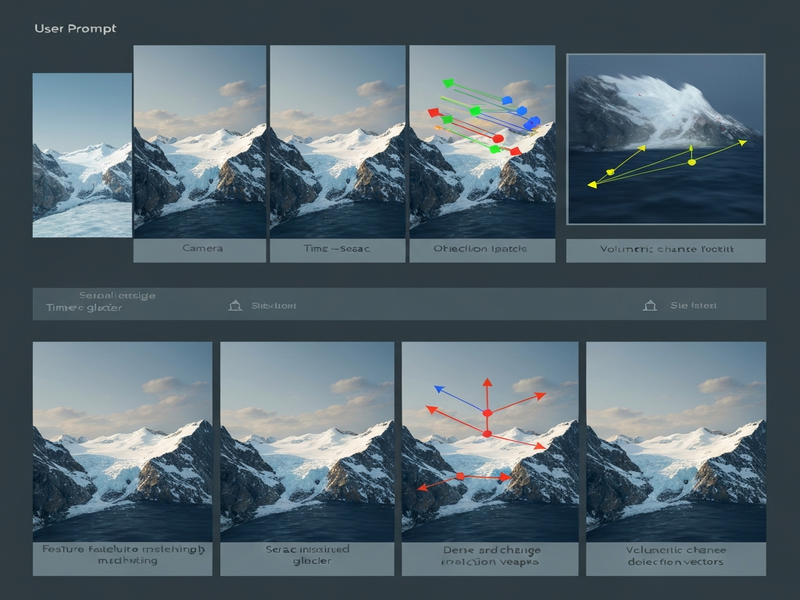
The figure below visualizes the end‑to‑end volumetric change detection pipeline, from raw time‑lapse frames to the final 3‑D fall mask.
Andrii Bidochko
CTO UBOS
Andrii Bidochko is an AI entrepreneur and researcher focused on AI agents, reinforcement learning, and autonomous systems. He writes about the technologies shaping the future of machine intelligence, from frontier models and agent architectures to real-world AI applications.