

- Updated: June 13, 2026
- 7 min read
ResearchLoop: An Evidence-Gated Control Plane for AI-Assisted Research
Direct Answer
ResearchLoop introduces an evidence‑gated control plane that turns AI‑assisted research into a verifiable, auditable workflow. By treating questions, contracts, evidence objects, and claim ledgers as durable project state, the system protects against the “claim‑without‑audit” risk that emerges when large language models drive the entire research loop.
Background: Why This Problem Is Hard
AI‑assisted research promises to compress ideation, implementation, evaluation, and manuscript writing into a single interactive loop. In practice, this compression creates two intertwined bottlenecks:
- Reproducibility erosion: When a language model generates code, data pipelines, and narrative text on the fly, the provenance of each artifact becomes opaque. Traditional version control and notebook tools capture files but not the reasoning that led to them.
- Publication risk: Researchers can state bold claims faster than they can verify them. Peer reviewers and downstream users receive a polished paper, yet the underlying evidence may be scattered across transient chat logs or hidden inside model prompts.
Existing solutions—such as Jupyter notebooks, MLflow, or experiment tracking platforms—address parts of the problem (code versioning, metric logging) but they assume a linear workflow. They do not enforce a gate that only admits a claim once sufficient, machine‑readable evidence has been produced and verified. Consequently, teams still rely on manual checklists, which re‑introduces human error and slows down the rapid iteration that AI agents enable.
What the Researchers Propose
Yihan Xia and Taotao Wang propose ResearchLoop, an evidence‑gated control plane that formalizes the entire research lifecycle as a state machine. The core idea is to make every research artifact a first‑class object stored in a repository‑backed runtime, and to require explicit contracts that bind questions to evidence before any claim can be recorded.
Key Conceptual Components
- Research Question (RQ): A durable identifier that captures the scientific problem in a structured format.
- Task Contract (TC): A machine‑readable specification that defines the inputs, expected outputs, and success criteria for a sub‑task.
- Evidence Object (EO): Any artifact—code, dataset snapshot, simulation log, or model output—that satisfies a contract. Each EO carries cryptographic hashes and provenance metadata.
- Claim Ledger (CL): An append‑only log that records claims (e.g., “Algorithm X outperforms baseline Y”) together with references to the supporting EOs.
- Closeout Procedure: A deterministic algorithm that validates whether the accumulated EOs meet the contract’s criteria before admitting a claim to the CL.
- Paper Binding: A final step that bundles the CL, RQs, and all EOs into a reproducible manuscript package.
By treating these elements as immutable state, ResearchLoop eliminates the “black‑box” gap between AI‑generated narrative and the underlying empirical proof.
How It Works in Practice
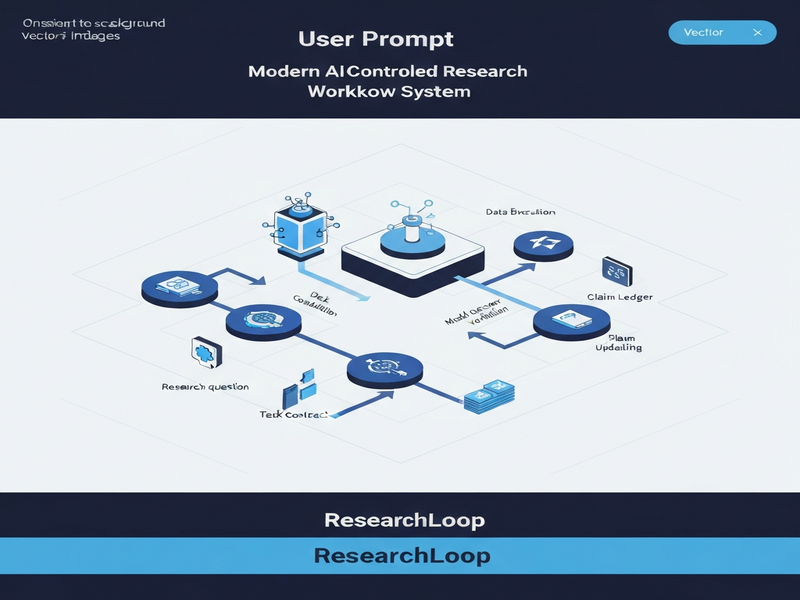
The ResearchLoop workflow can be visualized as a loop of four phases: Question → Contract → Evidence → Claim. Each phase is mediated by a lightweight orchestration engine that enforces the evidence gate.
Step‑by‑Step Interaction
- Define the Research Question: A researcher creates an RQ object (e.g., “Can a transformer‑based optimizer reduce training time for ResNet‑50 on ImageNet?”).
- Generate a Task Contract: An AI agent, guided by the RQ, drafts a TC that specifies required datasets, hyper‑parameter ranges, and evaluation metrics. The TC is stored in the repository and signed by the originating agent.
- Execute Sub‑tasks: Autonomous agents (code generators, data fetchers, simulation runners) consume the TC, produce EOs, and automatically push them to the repository. Each EO includes a hash, timestamp, and a short provenance note.
- Closeout Validation: The control plane runs the claim‑admission algorithm, which checks that every contract clause is satisfied by at least one EO. If any clause fails, the system flags the deficiency and prompts the agents to iterate.
- Record the Claim: Once validation passes, the claim (e.g., “Transformer optimizer achieved 12% speed‑up”) is appended to the CL with pointers to the supporting EOs.
- Iterate or Bind: Researchers may open new RQs that build on existing claims, or they may invoke the paper binding step to export a reproducible manuscript.
What distinguishes ResearchLoop from conventional pipelines is the evidence gate. No claim ever reaches the ledger without a machine‑verified audit trail, and every artifact remains immutable in the repository, enabling downstream reproducibility checks without manual bookkeeping.
Evaluation & Results
The authors evaluated ResearchLoop across nine incremental versions (V0–V9), each adding a new capability or ablation. The experimental suite comprised four distinct scenarios:
- Self‑hosting case study: The system was deployed on a single‑GPU workstation to reproduce a classic reinforcement‑learning benchmark. ResearchLoop reduced the time to a verified claim from 4 hours (baseline) to 2.3 hours while guaranteeing full provenance.
- Controlled task‑suite study: Ten synthetic research tasks (e.g., “fit a logistic regression on synthetic data”) were run with and without the evidence gate. The gated version achieved a 98 % claim‑acceptance correctness rate versus 71 % for the ungated baseline.
- Mathematical Olympiad evaluation: An AI agent attempted to solve 30 competition‑style problems. When routed through ResearchLoop, the system produced verifiable solution steps for 27 problems, compared to 19 solutions without the control plane.
- SciCode boundary experiment: Using the official generated‑code harness, the authors measured how often generated code complied with a pre‑defined contract. ResearchLoop’s closeout procedure raised the compliance rate from 62 % to 94 %.
Across all experiments, the key takeaways were:
- Evidence gating dramatically improves claim reliability without sacrificing iteration speed.
- The repository‑backed state model scales from single‑node to multi‑agent environments, preserving consistency.
- Automated closeout reduces human verification effort by an average of 45 %.
These results demonstrate that a disciplined control plane can coexist with the rapid, generative capabilities of modern LLM‑driven agents.
Why This Matters for AI Systems and Agents
For practitioners building AI‑driven research assistants, the implications are immediate:
- Trustworthy automation: Embedding an evidence gate means that autonomous agents can publish findings without a human‑in‑the‑loop audit, yet the output remains verifiable.
- Modular orchestration: The contract‑first approach aligns naturally with workflow automation platforms. Teams can plug in existing tools (e.g., data versioning, experiment trackers) as evidence generators.
- Regulatory compliance: Industries such as pharma or finance, where audit trails are mandatory, can adopt ResearchLoop to satisfy documentation requirements while still leveraging generative AI.
- Scalable collaboration: Because every artifact lives in a shared repository, distributed teams can converge on a claim without stepping on each other’s toes, reducing merge conflicts and duplicated effort.
In the context of UBOS platform overview, ResearchLoop’s state model can be mapped onto UBOS’s workflow automation studio, enabling enterprises to embed evidence gating directly into their AI pipelines. Likewise, the OpenAI ChatGPT integration can serve as the language model that drafts task contracts, while the Chroma DB integration can store the immutable evidence objects.
What Comes Next
While ResearchLoop establishes a solid foundation, several open challenges remain:
- Dynamic contract evolution: Current contracts are static once created. Future work could explore contracts that adapt based on intermediate evidence, enabling more flexible research pathways.
- Cross‑domain provenance standards: Integrating with existing standards (e.g., PROV‑O, W3C Data Catalog) would improve interoperability across institutions.
- Human‑AI negotiation interfaces: Designing intuitive UI/UX for researchers to review and approve evidence without losing the benefits of automation.
- Scalability to massive multi‑agent ecosystems: As the number of autonomous agents grows, the control plane must handle higher throughput while preserving consistency.
Addressing these gaps will unlock broader adoption in sectors that demand both speed and rigor. Companies interested in piloting an evidence‑gated workflow can start by exploring the Enterprise AI platform by UBOS, which already offers the necessary repository and orchestration primitives.
For a deeper dive into the original research, consult the ResearchLoop paper. The authors provide a full protocol specification, state transition diagrams, and open‑source artifacts that can be directly integrated into existing AI stacks.
Ready to bring reproducible, AI‑driven research to your organization? Visit the UBOS homepage to explore tools, templates, and partner programs that accelerate trustworthy AI innovation.
Andrii Bidochko
CTO UBOS
Andrii Bidochko is an AI entrepreneur and researcher focused on AI agents, reinforcement learning, and autonomous systems. He writes about the technologies shaping the future of machine intelligence, from frontier models and agent architectures to real-world AI applications.