

- Updated: July 13, 2026
- 7 min read
Remember When It Matters: Proactive Memory Agent for Long‑Horizon Agents
Direct Answer
The paper “Remember When It Matters: Proactive Memory Agent for Long‑Horizon Agents” introduces a plug‑and‑play Proactive Memory Agent (PMA) that runs alongside any existing action agent, continuously curates a structured memory bank, and decides when to inject concise, memory‑grounded reminders into the decision‑making loop. By doing so, it mitigates “behavioral state decay” – the loss of critical context as trajectories grow – and delivers consistent performance gains on demanding long‑horizon benchmarks.
Background: Why This Problem Is Hard
Long‑horizon autonomous agents—whether they are code‑generating assistants, robotic planners, or multi‑step web‑automation bots—must keep track of a sprawling set of facts: environment states, prior attempts, diagnostic clues, and open sub‑goals. As the number of steps increases, two forces conspire against reliable reasoning:
- Context window limits. Even the largest transformer models have a finite token window. When a trajectory exceeds that window, earlier but still relevant information is silently dropped.
- Attention dilution. Within a long prompt, the model’s attention is spread thin, making it unlikely to surface a specific piece of information unless it is explicitly highlighted.
Current mitigation strategies—such as naïve retrieval‑augmented generation (RAG) or static memory banks—treat memory as a passive lookup table. They either expose the entire bank to the model (overloading the context) or rely on the model to decide when to query, which often fails in practice. The result is “behavioral state decay”: the agent’s behavior gradually drifts because it can no longer recall the facts that originally guided its decisions.
What the Researchers Propose
The authors reframe memory from a passive repository to an active intervention mechanism. Their solution consists of three tightly coupled components:
- Memory Agent (MA). A lightweight policy network that observes the most recent slice of the trajectory, updates a structured memory bank, and predicts whether a reminder is needed.
- Structured Memory Bank. A hierarchical store (e.g., key‑value pairs, sub‑goal trees) that captures task‑relevant facts, diagnostics, and open objectives in a format that is easy to query.
- Intervention Engine. When the MA signals a reminder, the engine synthesizes a short, context‑rich prompt (the “reminder”) and injects it directly before the next action‑generation step of the unmodified action agent.
Crucially, the MA is trained separately from the action agent, allowing developers to attach the PMA to any existing LLM‑based planner without retraining the planner itself. This “plug‑and‑play” philosophy makes the approach immediately applicable to frontier agents such as GPT‑4, Claude, or open‑source alternatives.
How It Works in Practice
Conceptual Workflow
The end‑to‑end loop can be visualized in four stages, illustrated below:
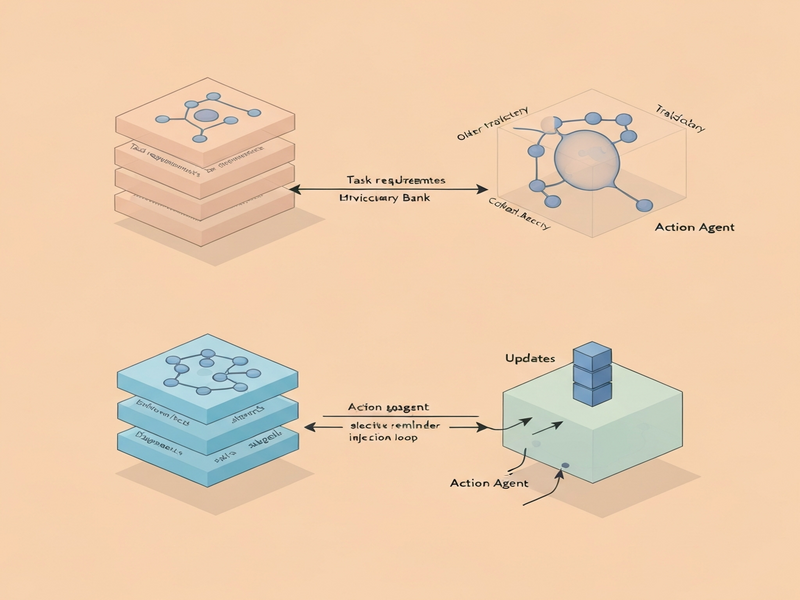
- Step Generation. The action agent receives the current prompt (which may already contain a reminder) and emits the next action or code snippet.
- Trajectory Buffer. The new step is appended to a short‑term buffer (e.g., last 50 tokens) that the MA monitors.
- Memory Update & Decision. The MA processes the buffer, updates the structured memory bank (adding new facts or marking sub‑goals as completed), and outputs a binary decision: inject reminder or stay silent.
- Reminder Injection (if triggered). The Intervention Engine formats the most relevant memory entries into a concise reminder (typically 1‑2 sentences) and prepends it to the next prompt sent to the action agent.
Key Differentiators
- Selective Intervention. Unlike always‑on RAG, the MA only intervenes when its learned policy predicts a high marginal benefit, preserving token budget.
- Task‑Agnostic Memory Schema. The memory bank is not hard‑coded to a specific domain; it can store arbitrary key‑value pairs, making the system adaptable to code, natural language, or multimodal tasks.
- Zero‑Modification Guarantee. The action agent’s weights remain untouched, which simplifies integration with proprietary or closed‑source models.
Evaluation & Results
Benchmarks Used
The authors evaluated the PMA on two state‑of‑the‑art long‑horizon suites:
- Terminal‑Bench 2.0. A collection of command‑line automation tasks that require up to 50 sequential actions, including file manipulation, network queries, and conditional branching.
- τ²‑Bench (tau‑squared Bench). A synthetic reasoning benchmark that mixes logical deduction, arithmetic, and sub‑goal tracking over 30‑plus steps.
Performance Highlights
Across both suites, the Proactive Memory Agent consistently lifted the pass@1 success metric:
- Terminal‑Bench 2.0: +8.3 percentage points over the baseline action agent.
- τ²‑Bench: +6.8 percentage points improvement.
These gains were observed for both “weaker” (e.g., 7B‑parameter) and “stronger” (e.g., 27B‑parameter) action agents, demonstrating that the memory intervention is orthogonal to raw model size.
Ablation Insights
The paper includes a thorough ablation study that isolates the contribution of each design choice:
| Variant | Intervention Style | Result Δ (pass@1) |
|---|---|---|
| Baseline | No memory | 0 |
| Passive Bank Exposure | Full bank appended each step | +2.1 pp |
| Always‑On Injection | Reminder injected every step | +3.4 pp |
| Advisor‑Only Guidance | Separate advisor model suggests actions | +4.0 pp |
| Proactive Memory Agent | Selective, learned intervention | +8.3 pp |
The selective nature of the PMA proved far more effective than flooding the model with context or delegating to a separate advisor. Moreover, training a Qwen3.5‑27B model on the SETA (Self‑Evolving Task‑Aware) dataset using supervised fine‑tuning (SFT) and a gradient‑reward‑policy‑optimization (GRPO) regime further boosted validation rewards, hinting at future open‑weight memory policies.
Why This Matters for AI Systems and Agents
For practitioners building enterprise‑grade autonomous agents, the Proactive Memory Agent offers a concrete pathway to overcome one of the most stubborn scalability bottlenecks: retaining relevant context over hundreds of steps. The implications are threefold:
- Reliability at Scale. Agents that can remember “when it mattered” reduce failure modes in critical workflows such as automated code refactoring, long‑running data pipelines, or multi‑turn customer support bots.
- Cost Efficiency. By injecting only the most needed reminders, the system conserves token usage, translating into lower inference costs on commercial LLM APIs.
- Modular Integration. Because the PMA does not require changes to the underlying action model, organizations can adopt it on top of existing investments—whether they run on OpenAI’s ChatGPT, a self‑hosted Ollama instance, or a proprietary model.
Teams looking to embed proactive memory into their AI pipelines can start by leveraging the UBOS platform overview, which already supports modular agent orchestration, memory store integrations, and workflow automation. The architecture aligns naturally with UBOS’s “Workflow automation studio,” enabling rapid prototyping of memory‑augmented agents without deep RL expertise.
What Comes Next
While the results are promising, several open challenges remain:
- Open‑Weight Memory Policies. The current implementation trains a separate policy network. Future work could explore joint training of memory and action policies, allowing end‑to‑end gradient flow.
- Cross‑Domain Generalization. The benchmarks focus on code and synthetic reasoning. Extending the PMA to multimodal domains (vision‑language agents, robotics) will require richer memory schemas.
- Scalable Memory Indexing. As the memory bank grows over days or weeks, efficient retrieval (e.g., via Chroma DB integration) becomes essential.
- Safety and Hallucination Control. Injected reminders must be trustworthy. Incorporating verification layers or provenance tracking could mitigate the risk of propagating erroneous facts.
Addressing these directions will likely unlock a new generation of “always‑on” assistants that can truly operate over months of interaction without losing track of their own history. Companies interested in experimenting with proactive memory can start by building a custom memory bank using UBOS’s templates for quick start and then layer the PMA logic on top.
Conclusion
The Proactive Memory Agent reframes memory as a decision‑making partner rather than a passive lookup table. By learning when to surface the right piece of context, it directly combats behavioral state decay, delivering measurable performance lifts on demanding long‑horizon benchmarks. Its plug‑and‑play nature, combined with modest computational overhead, makes it a practical addition for any organization deploying autonomous agents at scale. As the field moves toward ever‑longer horizons—think autonomous research assistants, self‑healing infrastructure bots, or lifelong personal companions—robust memory intervention will be a cornerstone of reliable, trustworthy AI.
Andrii Bidochko
CTO UBOS
Andrii Bidochko is an AI entrepreneur and researcher focused on AI agents, reinforcement learning, and autonomous systems. He writes about the technologies shaping the future of machine intelligence, from frontier models and agent architectures to real-world AI applications.