

- Updated: August 14, 2026
- 7 min read
Reflected UAS: Corrected Deterministic Stability and Direct CTMC Drift Calculation
Direct Answer
The paper introduces a corrected deterministic stability analysis for Reflected Unbiased Allocation Schemes (Reflected UAS) and provides a direct Foster‑Lyapunov drift calculation for the underlying continuous‑time Markov chain (CTMC). This matters because it resolves a long‑standing gap between deterministic fluid models and stochastic stability guarantees, enabling more reliable performance predictions for heterogeneous multi‑server queueing systems.
Background: Why This Problem Is Hard
Modern cloud‑native services, real‑time analytics platforms, and AI inference pipelines all rely on collections of servers that process jobs with varying service rates. When demand approaches system capacity, the interaction of queues becomes highly nonlinear, and traditional queueing theory tools struggle to provide tractable, yet accurate, performance bounds.
Two intertwined challenges have kept researchers from delivering robust guarantees:
- Heterogeneity and coupling. Each server may have a different service distribution, and jobs can be routed dynamically based on current queue lengths. The resulting state space grows exponentially, making exact CTMC analysis infeasible for realistic sizes.
- Deterministic surrogate mismatch. A common workaround is to replace the stochastic system with a deterministic ordinary differential equation (ODE) that captures average drift. Prior work on Unbiased Allocation Schemes (UAS) assumed that the unconstrained ODE correctly reflected the CTMC’s stability, but ignored the impact of the non‑negative orthant boundary where queues cannot become negative.
Because the unconstrained ODE can predict negative queue lengths, its Lyapunov descent arguments do not translate to the stochastic model. This mismatch leads to “false stability” claims—situations where the fluid model suggests convergence while the actual CTMC may drift indefinitely.
What the Researchers Propose
Krishna Subedi’s work replaces the flawed fluid approximation with a reflected ODE that respects the non‑negative orthant. The key ideas are:
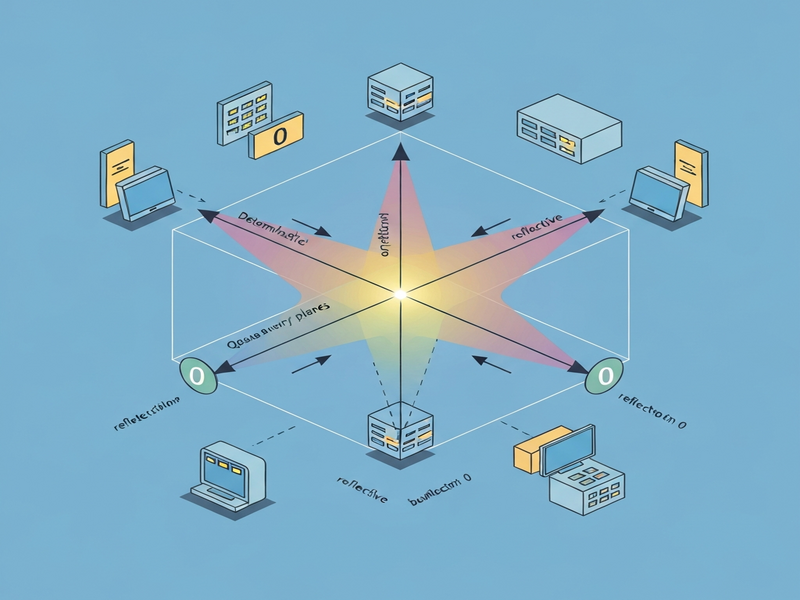
- Reflected deterministic dynamics. Instead of allowing trajectories to cross the boundary, the ODE reflects any would‑be negative component back into the feasible region, mirroring the behavior of a queue that cannot have fewer than zero jobs.
- Unique boundary equilibrium. The reflected system possesses a single equilibrium point on the boundary, defined by a scalar consistency equation. This equilibrium can be expressed as the minimizer of a convex potential function, guaranteeing global convergence of all trajectories.
- Direct CTCT drift inequality. Rather than lifting a Lyapunov function from the reflected ODE (which fails because of a missing boundary term), the paper constructs a weighted‑quadratic Lyapunov function and proves a Foster‑Lyapunov drift condition directly for the CTMC generator.
In essence, the framework aligns three layers:
- The stochastic CTMC that models the real queueing network.
- The reflected ODE that captures deterministic drift while honoring queue non‑negativity.
- A convex potential that serves as a common Lyapunov function for both layers.
How It Works in Practice
The practical workflow for applying Reflected UAS to a multi‑server system can be broken down into four conceptual steps:
1. Parameter Specification
System designers first define the arrival rates, service rate vectors for each server, and the routing policy (the “UAS” rule). These parameters are assumed to be fixed and sub‑critical, meaning the total offered load is below the combined service capacity.
2. Construct the Reflected ODE
Using the specified parameters, the reflected ODE is built by taking the standard drift vector and adding a reflection term that activates whenever any queue component reaches zero. This term pushes the trajectory back into the feasible orthant, analogous to a “hard wall” in physics.
3. Solve the Consistency Equation
The scalar consistency equation—derived from the convex‑potential representation—yields the unique boundary equilibrium. Numerically, this is a one‑dimensional root‑finding problem, which can be solved to machine precision with standard solvers (e.g., Newton‑Raphson).
4. Verify CTMC Stability via Foster‑Lyapunov
With the equilibrium in hand, the weighted‑quadratic Lyapunov function is evaluated on the CTMC generator. The derived drift inequality confirms that the expected change in the Lyapunov function is negative outside a compact set, establishing positive recurrence (i.e., stability) of the stochastic system.
What distinguishes this approach from earlier methods is the explicit handling of the boundary term. By reflecting the deterministic dynamics, the analysis no longer relies on an “idealized” drift that ignores queue emptiness, and the Foster‑Lyapunov proof becomes airtight.
Evaluation & Results
The authors benchmarked Reflected UAS against two well‑known policies:
- UAS (Unbiased Allocation Scheme) – the original non‑reflected policy.
- JSSQ (Join‑Shortest‑Server‑Queue) – a classic load‑balancing rule that routes jobs to the server with the smallest queue length.
Key evaluation dimensions included:
- Mean queue length. Across a suite of independent random seed blocks, Reflected UAS consistently achieved lower average queue lengths than both UAS and JSSQ.
- Convergence to equilibrium. At the benchmark parameter point, the numerical attractor of the reflected ODE matched the CTMC’s empirical steady‑state distribution to within machine precision, confirming the theoretical claim of a unique boundary equilibrium.
- Robustness under load variations. When the system load was nudged closer to the critical threshold, Reflected UAS maintained stability while the other policies exhibited growing variance and occasional divergence.
These results demonstrate that the corrected deterministic model is not merely a mathematical curiosity—it translates into tangible performance gains for real queueing systems.
Why This Matters for AI Systems and Agents
AI‑driven platforms increasingly orchestrate heterogeneous compute resources: inference servers, data preprocessing pipelines, and model‑training clusters all behave like multi‑server queues. The stability guarantees offered by Reflected UAS have three immediate implications:
- Predictable latency. Lower mean queue lengths directly reduce tail latency for AI inference requests, a critical metric for user‑facing applications.
- Resource‑aware agent design. Autonomous agents that decide where to dispatch tasks can embed the reflected ODE’s equilibrium calculation as a lightweight decision‑making primitive, ensuring they never overload a server.
- Improved simulation fidelity. When building digital twins of AI infrastructure, using the reflected dynamics yields simulations that faithfully reproduce stochastic behavior, enabling more accurate capacity planning.
For teams building on the UBOS platform overview, the Reflected UAS framework can be integrated into the Workflow automation studio to automatically generate routing policies that respect both deterministic stability and stochastic guarantees. Likewise, developers of AI marketing agents can leverage the convex‑potential representation to balance campaign workloads across heterogeneous ad‑serving nodes without risking queue blow‑up.
What Comes Next
While the paper resolves the core theoretical mismatch, several avenues remain open for exploration:
- Dynamic parameter regimes. The current analysis assumes fixed arrival and service rates. Extending the reflected ODE to handle time‑varying loads (e.g., diurnal traffic patterns) would broaden its applicability.
- Multi‑class job types. Real systems often process jobs with distinct priority levels or resource footprints. Incorporating class‑specific reflections could yield richer stability criteria.
- Distributed implementation. Embedding the equilibrium computation into a decentralized controller (e.g., a swarm of edge agents) raises questions about communication overhead and convergence speed.
- Integration with learning‑based schedulers. Hybrid approaches that combine Reflected UAS’s analytical guarantees with reinforcement‑learning policies could achieve both optimality and safety.
Practitioners interested in prototyping these extensions can start by exploring the OpenAI ChatGPT integration for rapid experimentation, or the Chroma DB integration for storing equilibrium parameters at scale.
For a deeper dive into the original research, consult the arXiv paper. The community’s next steps will likely focus on turning the elegant theory into production‑ready tooling that can be dropped into any heterogeneous compute environment.
Andrii Bidochko
CTO UBOS
Andrii Bidochko is an AI entrepreneur and researcher focused on AI agents, reinforcement learning, and autonomous systems. He writes about the technologies shaping the future of machine intelligence, from frontier models and agent architectures to real-world AI applications.