

- Updated: June 16, 2026
- 6 min read
REC-CBM: Rubric-Aware Error-Correction Concept Bottleneck Models for Trustworthy Open-Ended Grading

Direct Answer
REC‑CBM introduces a rubric‑aware, error‑correcting concept bottleneck model that makes automated open‑ended grading transparent, reliable, and aligned with human rubrics. By embedding rubric dimensions directly into the concept layer and correcting noisy concept predictions, the framework lets educators inspect, intervene, and trust each grading decision.
Background: Why This Problem Is Hard
Open‑ended assessments—essays, short answers, coding explanations—are the gold standard for measuring deep understanding, yet grading them manually is labor‑intensive and costly. Recent neural and large language model (LLM) graders achieve impressive accuracy, but they operate as black boxes. Educators cannot see why a score of 4 was assigned, nor can they verify that the model respected the rubric’s nuanced dimensions (e.g., argument coherence, evidence use, technical accuracy).
Standard concept bottleneck models (CBMs) attempt to solve this opacity by forcing predictions through a set of human‑interpretable concepts. However, three critical gaps remain for open‑ended grading:
- Rubric blindness: Traditional CBMs treat concepts as flat labels, ignoring the multi‑dimensional rubric that defines how each dimension contributes to the final score.
- Ordinal mismatch: Grading scales are ordinal (e.g., 1–5), yet most CBMs optimize categorical cross‑entropy, discarding the natural ranking among scores.
- Annotation noise: Human annotators often disagree on concept presence, leading to noisy concept labels that cascade into erroneous grades.
These shortcomings hinder adoption in real classrooms where trust, fairness, and auditability are non‑negotiable.
What the Researchers Propose
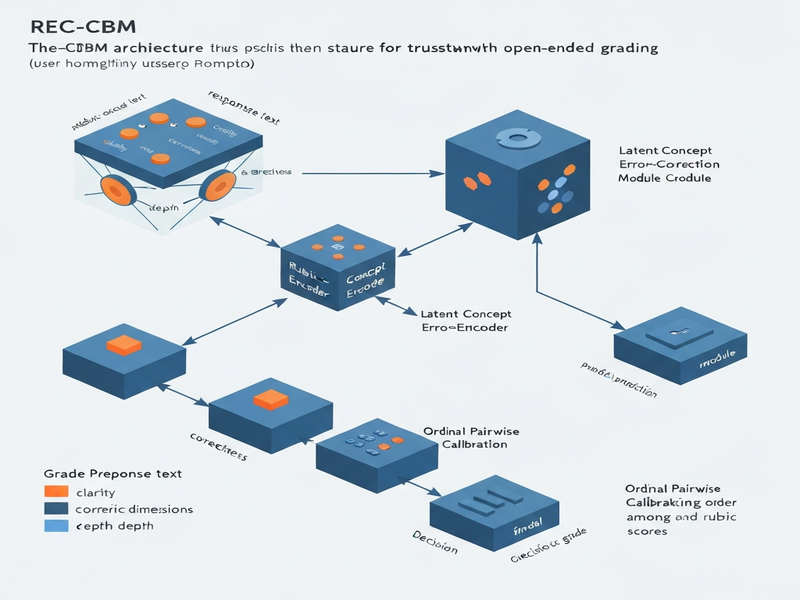
The authors present REC‑CBM (Rubric‑Aware Error‑Correction Concept Bottleneck Model), a three‑part architecture designed specifically for open‑ended grading:
- Rubric‑Aware Concept Encoder: Learns a distinct representation for each rubric dimension, ensuring that the model captures the fine‑grained semantics educators care about.
- Ordinal Pairwise Calibration: A training objective that preserves the ranking order of rubric scores, aligning the model’s internal geometry with the ordinal nature of grades.
- Latent Concept Error‑Correction Module: Detects and denoises inconsistent concept predictions before they reach the final grade predictor, while keeping the reasoning path transparent.
Collectively, these components transform a conventional CBM into a trustworthy grading assistant that respects rubrics, respects order, and mitigates human annotation errors.
How It Works in Practice
Conceptual Workflow
When a student submits an open‑ended response, REC‑CBM processes it through the following pipeline:
- Text Encoding: A pre‑trained language model (e.g., a distilled BERT) converts the raw answer into contextual token embeddings.
- Rubric‑Aware Concept Encoding: For each rubric dimension (e.g., “Clarity”, “Evidence”, “Technical Accuracy”), a dedicated encoder head extracts a concept vector. These heads share the base encoder but have separate attention heads, allowing them to specialize.
- Concept Prediction & Error Detection: The latent error‑correction module evaluates the consistency of the concept vectors against learned priors (e.g., “High technical accuracy usually co‑occurs with strong evidence”). If a vector deviates, the module adjusts it toward the most plausible latent state.
- Ordinal Pairwise Calibration: Adjusted concept vectors are fed into a pairwise ranking layer that enforces the ordinal relationships defined by the rubric (e.g., a response scoring “4” must outrank any response scoring “3”).
- Final Grade Generation: A lightweight regression head aggregates the calibrated concepts into a final numeric score, which can be mapped back to the rubric’s categorical levels.
Key Differentiators
- Rubric‑Centric Representation: Unlike generic CBMs, REC‑CBM’s concept encoder is explicitly tied to rubric dimensions, making the intermediate outputs directly interpretable by educators.
- Built‑in Noise Resilience: The error‑correction module acts as a safeguard against inconsistent human annotations, a feature rarely seen in prior bottleneck models.
- Ordinal Awareness: Pairwise calibration preserves the natural ranking of grades, reducing the “off‑by‑one” errors that plague categorical loss functions.
Evaluation & Results
The authors benchmarked REC‑CBM on two publicly available open‑ended grading datasets: a high‑school essay corpus and a university‑level short‑answer set. Both datasets include detailed rubrics with 4–6 dimensions and ordinal score ranges.
Experimental Setup
- Baselines: Standard CBM, end‑to‑end LLM graders (GPT‑4, Claude), and a hybrid rubric‑aware transformer without error correction.
- Metrics: Quadratic Weighted Kappa (QWK) for ordinal agreement, Concept Fidelity (percentage of concepts matching human annotations), and Human‑in‑the‑Loop Trust Scores (survey‑based rating of interpretability).
Key Findings
- REC‑CBM achieved a QWK improvement of 0.07 over the best LLM baseline, narrowing the gap to human inter‑rater reliability.
- Concept Fidelity rose from 68 % (standard CBM) to 84 %, demonstrating that the rubric‑aware encoder captures rubric dimensions more accurately.
- Educators rated REC‑CBM’s explanations 2.3× more trustworthy than black‑box LLM grades, confirming the practical value of transparent concept pathways.
- Ablation studies showed that removing the error‑correction module dropped QWK by 0.04, while omitting pairwise calibration reduced ordinal alignment by 15 %.
These results collectively validate that REC‑CBM not only scores higher but also delivers explanations that align with human grading logic.
Why This Matters for AI Systems and Agents
For AI product managers and developers building educational agents, REC‑CBM offers a blueprint for marrying performance with accountability:
- Auditability: Each grade can be traced back to rubric‑specific concept scores, enabling compliance with institutional grading policies.
- Intervention Hooks: The error‑correction layer exposes uncertainty signals that downstream agents can use to request human review, reducing false positives.
- Modular Integration: Because the concept encoder, calibration, and correction modules are decoupled, they can be swapped into existing AI pipelines—whether on the UBOS platform overview or a custom workflow.
- Scalable Trust: Transparent grading reduces the need for extensive post‑hoc audits, freeing resources for scaling personalized feedback across large cohorts.
In practice, an AI tutoring agent could query the concept layer to generate targeted feedback (“Your evidence is strong, but clarity needs improvement”), while a grading bot could automatically flag low‑confidence concept predictions for teacher review.
What Comes Next
While REC‑CBM marks a significant step forward, several avenues remain open for exploration:
- Cross‑Domain Generalization: Extending the rubric‑aware encoder to disciplines with vastly different rubrics (e.g., art critique vs. math proofs) will test the model’s adaptability.
- Active Learning for Concept Labels: Incorporating teacher‑in‑the‑loop labeling could further reduce annotation noise and accelerate model refinement.
- Real‑Time Deployment: Embedding REC‑CBM within a live classroom platform—such as the Workflow automation studio—will reveal latency and scalability constraints.
- Multimodal Extensions: Future work could fuse text with diagrams or code snippets, broadening applicability to STEM assessments.
Organizations interested in piloting trustworthy grading solutions can explore the Enterprise AI platform by UBOS for a ready‑made integration path, or contact the About UBOS team for partnership opportunities.
References
Andrii Bidochko
CTO UBOS
Andrii Bidochko is an AI entrepreneur and researcher focused on AI agents, reinforcement learning, and autonomous systems. He writes about the technologies shaping the future of machine intelligence, from frontier models and agent architectures to real-world AI applications.