

- Updated: July 14, 2026
- 6 min read
Reaction-network reasoning with frontier models for experimentally confirmed catalyst-selectivity hypotheses
Direct Answer
The paper introduces a human‑AI co‑thinking framework that forces frontier language models to reason over explicit reaction‑network graphs, enabling the discovery of new catalyst architectures with targeted selectivity. By extracting mechanistic “control levers” from the network, the authors experimentally validated a copper‑iron oxide catalyst that triples acetate selectivity in CO₂ electroreduction, demonstrating a shift from retrospective prediction to forward‑looking hypothesis generation.
Background: Why This Problem Is Hard
Catalyst design sits at the intersection of chemistry, materials science, and process engineering. In electrochemical CO₂ reduction, the product distribution (e.g., CO, formate, acetate, ethylene) is dictated by a tangled web of interfacial phenomena, electrolyte composition, applied potential, and competing kinetic pathways. Traditional discovery pipelines suffer from two major bottlenecks:
- Trial‑and‑error experimentation: Synthesizing and testing each material variant is time‑consuming and costly, especially when the reaction space includes dozens of possible intermediates and surface configurations.
- Static descriptor‑based ML: Most machine‑learning models rely on ground‑state properties (e.g., adsorption energies, bulk crystal descriptors) that ignore dynamic pathway branching and the influence of local reaction conditions.
Consequently, existing approaches struggle to answer the most actionable question for engineers: Which physical levers should we tune to steer the network toward a desired product? The inability to capture topological pathway competition limits both predictive accuracy and the generation of testable hypotheses.
What the Researchers Propose
The authors present a frontier‑model‑driven, network‑invariant reasoning architecture that couples a large language model (LLM) with a graph‑based representation of the full reaction network. The framework consists of three tightly coupled components:
- Explicit Reaction Graph Builder: Converts mechanistic literature, DFT calculations, and experimental observations into a directed graph where nodes are chemical species and edges are elementary steps.
- Network‑Invariant Prompt Engine: Generates prompts that enforce invariance to graph isomorphism, ensuring the LLM reasons about the chemistry rather than superficial token patterns.
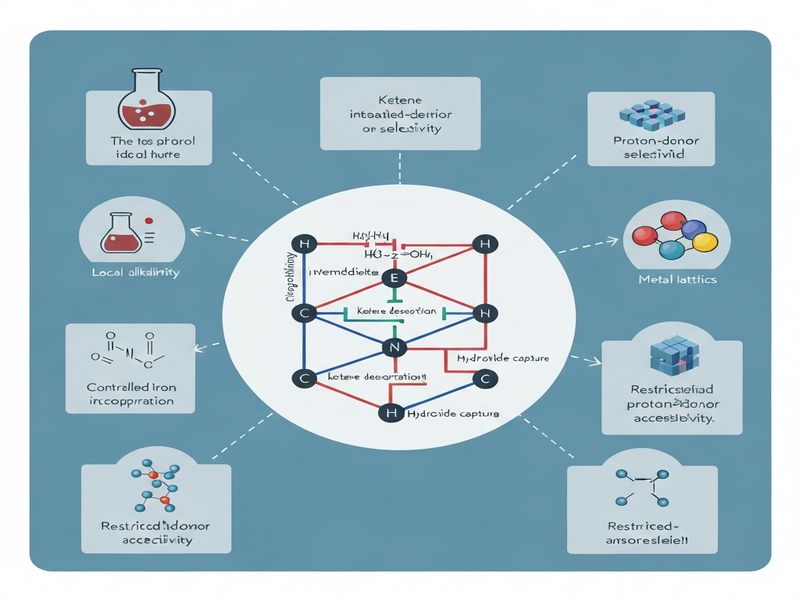
- Human‑AI Co‑Thinking Loop: Engineers iteratively review the model’s hypotheses, inject domain knowledge, and constrain the search space, producing a refined set of “control levers” (e.g., local pH, metal incorporation, proton‑donor accessibility).
This triad transforms the LLM from a passive text generator into an active mechanistic explorer that can propose new catalytic pathways, rank them by plausibility, and suggest concrete experimental modifications.
How It Works in Practice
The workflow can be visualized as a four‑stage pipeline:
- Data Ingestion: Researchers feed the system with curated reaction steps, kinetic parameters, and surface science data. The graph builder normalizes these inputs into a unified chemical graph.
- Prompt Construction: The prompt engine encodes the graph’s topology (e.g., adjacency lists, node attributes) into a textual description that respects network invariance. This prevents the LLM from exploiting arbitrary ordering of nodes.
- LLM Reasoning: A frontier language model (e.g., GPT‑4‑Turbo or Claude‑3) processes the prompt and outputs a set of candidate pathways, each annotated with the underlying physical levers that would favor its progression.
- Human‑Centric Validation: Domain experts evaluate the suggestions, prune chemically implausible routes, and may add constraints (e.g., maximum allowable metal loading). The refined hypotheses are fed back into the loop for further iteration.
What distinguishes this approach from prior descriptor‑based ML is the explicit preservation of reaction‑network topology throughout the reasoning cycle. By treating the network as a first‑class citizen, the system can identify branching points where a small change—such as increasing local alkalinity—shifts the flux toward a different product.
Evaluation & Results
The authors applied the framework to the electrochemical reduction of CO₂ on copper‑based electrodes, a benchmark system with well‑documented selectivity challenges. The evaluation comprised three phases:
- Hypothesis Generation: The LLM identified two previously underexplored levers: (a) enhanced desorption of ketene intermediates, and (b) capture of hydroxide ions to form acetate.
- Experimental Design: Guided by the model, the team synthesized a copper‑iron oxide composite, deliberately controlling iron incorporation to modulate local electronic structure and adjusting electrolyte alkalinity to favor hydroxide capture.
- Performance Validation: In a flow‑cell setup, the new catalyst achieved a threefold increase in acetate Faradaic efficiency compared with a copper‑rich baseline, while maintaining comparable overall current density.
Beyond the headline metric, the study demonstrated that the framework could isolate actionable levers that are experimentally tractable—something that pure statistical models rarely achieve. The successful translation from network‑level insight to a tangible material validates the hypothesis‑driven paradigm.
Why This Matters for AI Systems and Agents
For AI practitioners building autonomous scientific agents, the paper offers a concrete blueprint for embedding mechanistic reasoning into large‑scale language models:
- Mechanism‑Guided Prompting: By encoding domain graphs directly into prompts, agents can avoid hallucinations that stem from missing structural context.
- Iterative Human‑AI Loop: The co‑thinking design mirrors best practices in reinforcement learning from human feedback (RLHF) but is tailored to hypothesis generation rather than reward maximization.
- Actionable Output: The system produces “control levers” that map cleanly onto experimental variables, enabling seamless integration with laboratory automation platforms.
Enterprises looking to accelerate materials discovery can embed this reasoning engine within existing workflow orchestration tools. For example, the Workflow automation studio can trigger synthesis robots whenever the AI proposes a new catalyst composition, closing the loop between insight and execution.
What Comes Next
While the study marks a significant advance, several open challenges remain:
- Scalability of Graph Construction: Automating the extraction of reaction steps from the literature at scale will require robust NLP pipelines and standardized ontologies.
- Generalization Across Chemistries: Extending the framework to heterogeneous catalysis, enzymatic pathways, or solid‑state batteries will test its adaptability.
- Integration with Multi‑Modal Data: Combining spectroscopic time‑series, microscopy images, and operando measurements could enrich the graph’s node attributes, improving lever identification.
Future research may explore coupling the reasoning engine with Enterprise AI platforms that provide secure data lakes and compute orchestration, enabling cross‑institution collaborations. Additionally, embedding the system within conversational agents—such as a OpenAI ChatGPT integration—could democratize access for chemists who lack deep AI expertise.
References
- Choudhury, S., Banerjee, A., Sanyal, U., et al. “Reaction‑network reasoning with frontier models for experimentally confirmed catalyst‑selectivity hypotheses.” arXiv:2607.08003v1, 2026.
Andrii Bidochko
CTO UBOS
Andrii Bidochko is an AI entrepreneur and researcher focused on AI agents, reinforcement learning, and autonomous systems. He writes about the technologies shaping the future of machine intelligence, from frontier models and agent architectures to real-world AI applications.