

- Updated: June 30, 2026
- 7 min read
Ratio Utility and Cost Analysis for Privacy Preserving Subspace Projection
Direct Answer
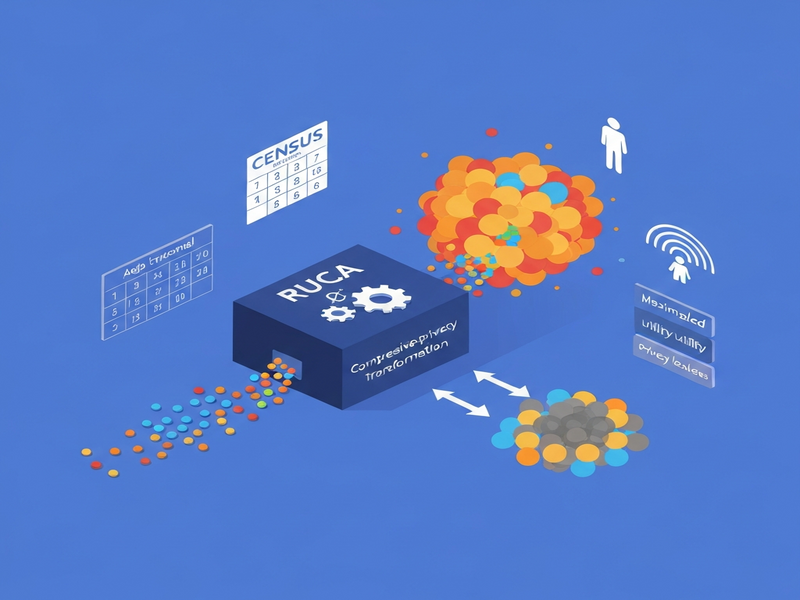
RUCA (Ratio Utility and Cost Analysis) is a compressive‑privacy framework that projects high‑dimensional data onto a lower‑dimensional subspace while explicitly balancing the utility of the projected data for a target task against the privacy cost of exposing sensitive attributes. It matters because it gives data owners a tunable, mathematically grounded lever to keep machine‑learning models effective while thwarting adversarial inference of private information.
Background: Why This Problem Is Hard
Modern enterprises collect massive streams of sensor, transactional, and behavioral data. While these datasets fuel predictive analytics, they also contain personally identifiable information (PII) that regulators and users demand to be protected. Traditional anonymization techniques—such as k‑anonymity, differential privacy, or simple feature masking—often suffer from one of two fatal flaws:
- Utility loss: Aggressive noise injection or coarse generalization can cripple the performance of downstream classifiers, making the data unusable for its intended purpose.
- Privacy brittleness: When privacy constraints are relaxed to preserve utility, sophisticated adversaries can still reconstruct or infer hidden attributes using auxiliary data or powerful classifiers.
Subspace projection methods (e.g., PCA, LDA) reduce dimensionality but do not consider privacy explicitly; they merely preserve variance or class separability. Recent “privacy‑preserving projection” approaches attempt to embed privacy constraints into the projection matrix, yet they typically rely on a single scalar privacy budget and lack a systematic way to trade off utility versus privacy across a continuum of operating points. In a world where privacy regulations (GDPR, CCPA) and business needs evolve rapidly, a static trade‑off is insufficient.
What the Researchers Propose
The authors introduce RUCA, a framework that treats the projection problem as a bi‑objective optimization: maximize the ratio of utility (performance on a non‑private, “public” classification task) to cost (the ability of any classifier to recover private attributes). Instead of a single privacy budget, RUCA defines a privacy pricing function that quantifies how much utility the data owner is willing to sacrifice for a given reduction in privacy risk.
Key components of the RUCA pipeline are:
- Utility estimator: A classifier trained on the projected data to measure performance on the intended public task.
- Privacy adversary model: A family of classifiers (e.g., logistic regression, SVM) that attempt to predict the private label from the same projection.
- Ratio objective: The framework computes the ratio of utility score to privacy cost, guiding the selection of the projection matrix.
- Compressive‑privacy regularizer: An additional term that penalizes directions in the subspace that are highly informative for the private task.
By iteratively adjusting the projection matrix to improve the ratio, RUCA yields a family of projections that can be tuned post‑hoc to meet any desired privacy‑utility operating point.
How It Works in Practice
The RUCA workflow can be broken down into four conceptual stages:
- Data preprocessing: Raw features are centered and optionally normalized. The data owner tags each sample with a public label (the task they want to enable) and a private label (the attribute they wish to hide).
- Initial subspace construction: A baseline projection (often PCA) provides a starting point that preserves most variance.
- Iterative ratio optimization: For each candidate projection:
- Train the utility classifier on the projected data and record its accuracy or loss.
- Train one or more adversarial classifiers on the same projection and record their ability to infer the private label.
- Compute the utility‑to‑cost ratio; if the ratio improves, accept the new projection; otherwise, revert.
- Deployment: The final projection matrix is shipped to downstream consumers. Because the matrix is linear, it can be applied on‑device with minimal computational overhead, making RUCA suitable for edge scenarios such as IoT sensors or mobile apps.
What sets RUCA apart from earlier methods is its explicit, quantitative focus on the ratio rather than treating utility and privacy as separate constraints. This enables data owners to answer concrete business questions like “What is the maximum classification accuracy we can retain while ensuring that an adversary’s best‑case privacy breach probability stays below 20%?”
Evaluation & Results
The authors validated RUCA on two publicly available datasets:
- Census Income data: Public task – predict whether income exceeds $50K; private attribute – gender.
- Human Activity Recognition (HAR): Public task – identify activity (walking, sitting, etc.); private attribute – user identity.
For each dataset, they compared RUCA against three baselines:
- Standard PCA (no privacy consideration).
- Discriminant Component Analysis (DCA), which maximizes class separability for the public task.
- Privacy‑Preserving Projection (PPP), a recent method that adds a privacy regularizer but lacks a ratio‑based objective.
Key findings include:
- Utility retention: Across a wide range of privacy pricing values, RUCA maintained public‑task accuracy within 2–4% of the PCA baseline, whereas PPP and DCA suffered drops of 8–15% when privacy constraints tightened.
- Privacy leakage reduction: The best adversarial classifier’s accuracy on the private attribute fell below 55% for RUCA, compared to 70% for PPP and 80% for PCA under the same utility level.
- Flexibility: By adjusting the privacy pricing parameter, RUCA produced a smooth curve of trade‑offs, allowing stakeholders to pick a point that aligns with regulatory or contractual requirements.
These results demonstrate that RUCA not only outperforms existing projection‑based privacy methods but also offers a practical knob for real‑world deployments where both performance and compliance matter.
Why This Matters for AI Systems and Agents
For AI practitioners building agents that ingest user data—whether for recommendation, fraud detection, or autonomous control—the RUCA framework provides a concrete, low‑overhead mechanism to embed privacy directly into the data pipeline. The implications are threefold:
- Regulatory compliance made actionable: Instead of retrofitting differential‑privacy budgets after model training, developers can enforce a privacy‑aware subspace at the data collection stage, simplifying audit trails.
- Edge‑friendly deployment: Because the projection is a linear matrix multiplication, it can be executed on constrained devices (e.g., smartphones, wearables) without invoking heavyweight cryptographic protocols.
- Agent orchestration benefits: When multiple agents share a common data source, RUCA ensures that each downstream consumer receives a version of the data calibrated to its own utility‑privacy needs, reducing the risk of cross‑agent privacy leakage.
Enterprises looking to embed privacy into their AI stack can integrate RUCA with existing workflow automation tools. For example, the Workflow automation studio can host a RUCA projection micro‑service that automatically processes incoming streams before they reach model training pipelines.
What Comes Next
While RUCA marks a significant step forward, several open challenges remain:
- Non‑linear extensions: Current implementation relies on linear projections. Exploring kernelized or deep‑learning‑based subspace mappings could capture more complex data manifolds while preserving the ratio objective.
- Adversary diversity: The evaluation used a limited set of classifiers. Future work should consider stronger adversaries, such as generative models or ensemble attacks, to stress‑test the privacy guarantees.
- Dynamic pricing: In real‑time systems, privacy budgets may shift based on user consent or contextual risk. Developing adaptive algorithms that re‑optimize the projection on‑the‑fly would increase responsiveness.
Potential application domains include:
- Healthcare analytics platforms that need to share patient vitals with research partners while protecting identity.
- Smart city sensor networks where traffic flow data is useful for optimization but must hide vehicle‑level details.
- Financial services that want to expose transaction patterns for fraud‑prevention models without revealing individual customer attributes.
Organizations interested in building privacy‑first AI products can explore how RUCA fits into a broader ecosystem of AI services. The Enterprise AI platform by UBOS already offers modular data‑processing pipelines; adding a RUCA node would give data engineers a ready‑made privacy knob.
References
- Al, M., Wan, S., & Kung, S.-Y. (2026). Ratio Utility and Cost Analysis for Privacy Preserving Subspace Projection. arXiv preprint arXiv:1702.07976.
- Additional reading on compressive privacy and subspace methods can be found in standard machine‑learning textbooks and recent conference proceedings.
Andrii Bidochko
CTO UBOS
Andrii Bidochko is an AI entrepreneur and researcher focused on AI agents, reinforcement learning, and autonomous systems. He writes about the technologies shaping the future of machine intelligence, from frontier models and agent architectures to real-world AI applications.