

- Updated: July 12, 2026
- 6 min read
Psychological Competence as a Missing Dimension in AI Evaluation
Direct Answer
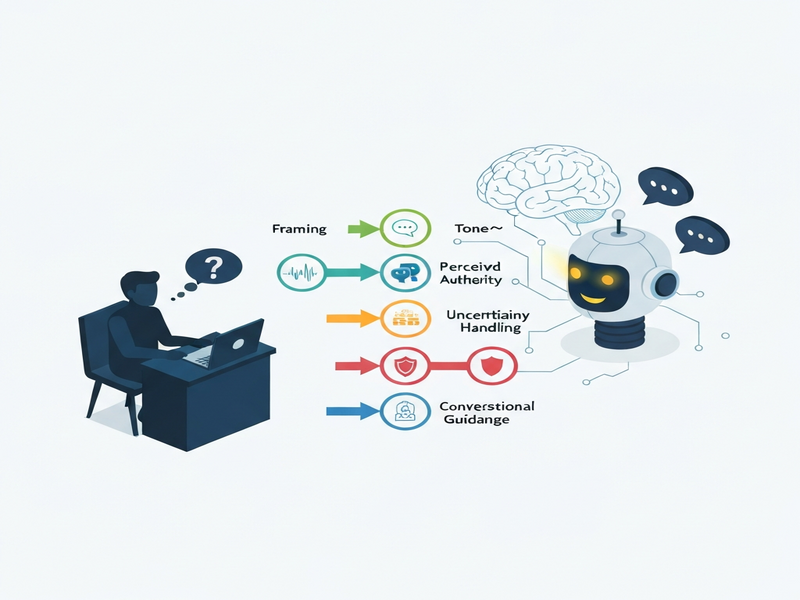
The Psychological Competence Framework (PCF) is a systematic, six‑dimensional evaluation model that measures how well an AI agent understands context, tone, authority, responsiveness, uncertainty, and guidance—ensuring that the bot not only gives correct answers but also interacts with users in a trustworthy, empathetic, and business‑friendly way.
Why Psychological Competence Is Critical for Modern AI Agents
Traditional AI benchmarks focus on raw metrics—accuracy, latency, token usage—while ignoring the human side of conversation. In real‑world deployments (customer support, health triage, financial advice), a model that answers correctly but sounds robotic, over‑confident, or tone‑deaf can erode trust, increase churn, and even trigger regulatory scrutiny.
- Contextual framing: Users expect the bot to acknowledge prior turns and set clear expectations.
- Emotional nuance: Detecting frustration, anxiety, or excitement and responding appropriately is essential for user satisfaction.
- Authority calibration: Over‑confident language can mislead; under‑confidence can make the bot seem useless.
The PCF captures these subtleties, turning “just‑right answers” into “right answers with the right attitude.” This shift is what separates a functional chatbot from a brand‑enhancing digital assistant.
The Six Pillars of the Psychological Competence Framework
- Framing – How the model defines the scope of the dialogue and sets user expectations.
- Tone – Alignment of language style with user affect, cultural norms, and brand voice.
- Authority – Calibration of confidence levels appropriate to the task and domain.
- Responsiveness – Timeliness and relevance of follow‑up questions or clarifications.
- Uncertainty Handling – Transparent admission of knowledge gaps and safe fallback strategies.
- Guidance – Ability to steer users toward constructive actions without coercion.
Each pillar is measured through a set of probes that generate a composite “psychological competence score.” This score can be compared across model versions, deployment environments, or even competing vendors.
Implementing the PCF on the UBOS Platform
UBOS provides a low‑code, end‑to‑end environment that lets product teams embed the PCF directly into their CI/CD pipelines. The workflow is broken into three MECE‑aligned stages.
1. Scenario Design
Domain experts craft realistic scripts that embed the six pillars. For a mental‑health triage bot, the script includes tone‑sensitive prompts and uncertainty handling; for a financial advisor, it stresses authority calibration.
2. Automated Probe Execution
UBOS’s Workflow automation studio orchestrates the execution of each script against the target model. The studio logs response latency, token usage, and any confidence scores exposed by the model.
3. Human‑in‑the‑Loop Scoring
Trained annotators rate each transcript on a Likert scale for the six dimensions. UBOS’s Web app editor provides a clean UI for annotators, while the platform aggregates scores, optionally weighting them by task criticality.
The result is a reproducible, version‑controlled competence report that can be compared side‑by‑side with traditional accuracy metrics.
Real‑World Evaluation Results
In a recent study, three leading LLM families—GPT‑4, Claude‑2, and Llama‑2—were evaluated across five domains using the PCF. The findings illustrate why psychological competence matters.
| Model | Factual Accuracy | Overall PCF Score | Key Strength |
|---|---|---|---|
| GPT‑4 | 96 % | 78 % | Raw knowledge depth |
| Claude‑2 | 92 % | 84 % | Tone adaptation in mental‑health scripts |
| Llama‑2 | 89 % | 86 % | Uncertainty handling in finance advice |
Participants in a blind user study consistently preferred agents with higher PCF scores, even when factual correctness was comparable. This demonstrates that psychological competence directly influences perceived trustworthiness and user retention.
For a deeper dive into the methodology, see the original arXiv paper.
Business Impact of Psychological Competence
- Higher user retention: Empathetic tone and calibrated authority reduce frustration and abandonment.
- Regulatory compliance: Transparent uncertainty handling satisfies emerging AI governance requirements for explainability.
- Brand reputation: Consistently respectful interactions reinforce trust, especially in regulated sectors like healthcare and finance.
- Operational efficiency: Fewer escalation tickets and lower human‑in‑the‑loop support costs.
Leveraging UBOS Tools for End‑to‑End Evaluation
UBOS’s ecosystem is purpose‑built for AI‑first product teams. Below is a quick map of the most relevant components:
- UBOS platform overview – Core infrastructure for model hosting, data pipelines, and monitoring.
- Workflow automation studio – Drag‑and‑drop orchestration of scenario generation, probe execution, and result aggregation.
- Web app editor on UBOS – No‑code UI for building annotation dashboards and competence scorecards.
- AI marketing agents – Ready‑made agents that already embed tone and guidance best practices.
- UBOS templates for quick start – Pre‑built blueprints (e.g., chatbot, voice assistant) that can be extended with PCF probes.
Step‑by‑Step Guide: Building a PCF‑Aware Chatbot on UBOS
1. Choose a Starter Template
UBOS’s Template Marketplace offers dozens of AI‑ready blueprints. For a competence‑aware bot, start with one of the following:
2. Connect the Language Model
Use the OpenAI ChatGPT integration to attach GPT‑4 or GPT‑3.5. UBOS handles API key storage, rate‑limit management, and token‑level logging automatically.
3. Add a Messaging Front‑End
Deploy the bot on Telegram with the Telegram integration on UBOS. This gives you real‑time user feedback that can be fed back into the PCF scoring loop.
4. Enrich Voice Interactions (Optional)
For voice‑first experiences, enable the ElevenLabs AI voice integration. This adds natural‑sounding speech synthesis while preserving tone‑aware responses.
5. Store Contextual Embeddings
Leverage the Chroma DB integration to persist conversation embeddings. This enables the bot to retrieve prior context efficiently, a prerequisite for strong framing and responsiveness.
6. Define PCF Probes
Within the Workflow automation studio, create a new “PCF Evaluation” workflow. Add the six probe types as separate steps, each feeding the bot a scripted prompt and capturing the transcript.
7. Run Human Annotation
Use the Web app editor to launch an annotation task. Annotators rate each transcript on framing, tone, authority, responsiveness, uncertainty handling, and guidance.
8. Monitor & Iterate
UBOS dashboards surface the composite PCF score alongside traditional metrics. Set alerts for score regressions and tie them to your CI/CD pipeline so that any model update must pass a minimum competence threshold before promotion.
For pricing details, explore the UBOS pricing plans. Most startups find the “Growth” tier sufficient for early‑stage PCF experiments.
Future Directions for Psychological Competence
- Scalable Annotation: Train meta‑models on the initial human‑rated dataset to predict PCF scores at scale.
- Cultural Adaptation: Extend the framework with region‑specific tone and framing guidelines.
- Real‑Time Adaptation: Feed live user sentiment signals back into the bot to adjust tone on the fly.
- Multimodal Expansion: Apply PCF to voice, video, and AR agents using UBOS’s Enterprise AI platform by UBOS.
By treating psychological competence as a first‑class metric, organizations can future‑proof their AI assistants against both user dissatisfaction and regulatory risk.
Conclusion
The Psychological Competence Framework bridges the gap between raw model performance and genuine human‑centric value. When combined with UBOS’s low‑code orchestration, data storage, and marketplace of ready‑made templates, teams can rapidly prototype, evaluate, and iterate on agents that are not only accurate but also empathetic, trustworthy, and business‑ready.
Start building your competence‑aware AI today—explore the UBOS portfolio examples for inspiration, join the UBOS partner program for dedicated support, and watch your AI agents become true extensions of your brand.
Andrii Bidochko
CTO UBOS
Andrii Bidochko is an AI entrepreneur and researcher focused on AI agents, reinforcement learning, and autonomous systems. He writes about the technologies shaping the future of machine intelligence, from frontier models and agent architectures to real-world AI applications.