

- Updated: June 14, 2026
- 7 min read
ProvMind: Provenance‑grounded reasoning for materials synthesis
Direct Answer
ProvMind introduces a provenance‑grounded reasoning framework that lets AI systems reason about materials‑synthesis processes by explicitly modeling the causal lineage of each step. By leveraging a new benchmark, MatProcBench, the authors demonstrate that this approach dramatically improves out‑of‑distribution (OOD) decision‑making for synthesis route planning.
Background: Why This Problem Is Hard
Materials discovery hinges on the ability to design and execute synthesis pathways that transform raw precursors into functional compounds. In practice, each pathway is a tangled web of reactions, temperature ramps, atmosphere controls, and equipment choices. Researchers typically record these pathways as free‑form text or linear step lists, which erases the underlying causal dependencies that dictate why a particular temperature or catalyst was chosen.
Current AI‑driven tools for process optimization treat synthesis recipes as flat sequences, feeding them into language models or graph‑neural networks without preserving provenance. This flattening creates three major bottlenecks:
- Loss of causal context: Models cannot infer how a change in one step propagates to downstream conditions.
- Inability to generalize across material classes: A model trained on oxide syntheses often fails when presented with chalcogenides because the hidden provenance signals differ.
- Evaluation blind spots: Benchmarks rarely test temporal or domain shifts, so reported accuracies overestimate real‑world robustness.
These limitations matter because industrial labs need trustworthy AI assistants that can suggest viable routes for novel compounds without exhaustive trial‑and‑error. Without provenance‑aware reasoning, AI recommendations risk being chemically incoherent or unsafe.
What the Researchers Propose
The authors present two tightly coupled contributions:
- MatProcBench: A provenance‑grounded benchmark built from literature‑mined MatPROV graphs. Each graph captures the full causal lineage of a synthesis—reactants, conditions, equipment, and the logical dependencies between steps. The benchmark defines seven reasoning tasks, ranging from verifying route continuity to inferring missing variables, and includes a rigorous dual‑OOD split that simultaneously shifts time (temporal drift) and material class.
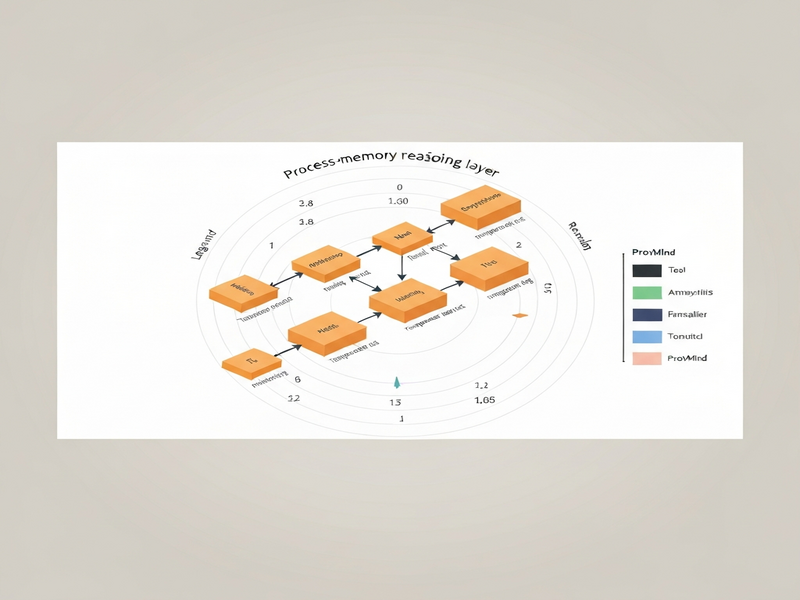
- ProvMind: A process‑memory reasoning framework that augments a large language model (LLM) with a retrieval‑augmented “process memory.” ProvMind first retrieves analogous synthesis processes from a curated database, converts each retrieved instance into a set of provenance‑aware compatibility scores, and finally lets the LLM make a constrained decision that respects those scores.
Key components of ProvMind are:
- Process Retriever: A similarity engine that matches a target synthesis query to historic processes based on shared provenance sub‑graphs.
- Provenance Scorer: A rule‑based or learned module that evaluates how well each retrieved process aligns with the current step’s causal constraints.
- LLM Decision Layer: A language model prompted with both the original query and the scored options, forced to select or generate a step that satisfies the highest‑scoring provenance constraints.
How It Works in Practice
ProvMind operates as a pipeline that can be wrapped around any existing synthesis‑planning agent. The workflow unfolds in four stages:
1. Query Encoding
The user (or upstream agent) submits a partially specified synthesis route—e.g., “synthesize LiFePO₄ starting from Li₂CO₃ and Fe₂O₃.” The system encodes this query into a provenance graph fragment, capturing known reagents, desired product, and any pre‑filled conditions.
2. Analog Retrieval
The Process Retriever searches MatProcBench’s repository for historic graphs that share sub‑structures with the query fragment. Retrieval is provenance‑aware: it matches not only chemical identities but also the topology of causal dependencies (e.g., “temperature ramp follows solid‑state mixing”).
3. Compatibility Scoring
Each retrieved graph is passed to the Provenance Scorer, which produces an option‑level compatibility vector. Scores reflect how many causal constraints are satisfied, penalizing mismatches such as incompatible atmosphere or missing catalyst information.
4. Constrained Generation
The LLM receives a prompt that lists the top‑k compatible options and explicitly instructs it to respect the highest‑scoring constraints. The model then either selects an existing step from the options or synthesizes a new step that aligns with the provenance budget.
What sets ProvMind apart from vanilla retrieval‑augmented generation is the explicit enforcement of provenance consistency. Instead of letting the LLM hallucinate any plausible condition, the framework forces the model to stay within a “causal envelope” defined by real experimental histories.
Evaluation & Results
To validate ProvMind, the authors benchmarked it against three baselines:
- Zero‑shot prompting of a state‑of‑the‑art LLM.
- Retrieval‑augmented generation (RAG) without provenance scoring.
- Supervised fine‑tuning on the same training split.
All experiments used the seven tasks of MatProcBench, evaluated under two regimes:
- Same‑split: Training and test data share the same temporal window and material class.
- Dual‑OOD split: Test data are drawn from a later publication period and a different material family, creating a strict out‑of‑distribution challenge.
Key findings include:
- On the dual‑OOD split, ProvMind achieved **52.84 % accuracy**, a 14‑point lift over the best baseline (38.7 %).
- For route‑continuity tasks, ProvMind correctly identified broken causal links in 68 % of cases, compared to 45 % for RAG.
- Step‑level variable inference (e.g., predicting missing temperature) improved from 31 % to 57 % accuracy, demonstrating the power of provenance‑driven constraints.
- Across all seven tasks, the average gain over supervised fine‑tuning was 9.3 %, confirming that explicit provenance reasoning adds value beyond raw data scaling.
These results matter because they show that a modest retrieval‑plus‑scoring layer can close a substantial portion of the performance gap that typically plagues OOD generalization in scientific AI.
Why This Matters for AI Systems and Agents
ProvMind’s architecture offers a blueprint for building trustworthy AI assistants in domains where causal lineage is non‑negotiable—materials science, drug synthesis, and even complex manufacturing pipelines. By anchoring generation to a memory of real‑world processes, agents can:
- Reduce hallucination risk: The provenance envelope filters out chemically implausible suggestions.
- Accelerate knowledge transfer: New labs can query the system for “how did others synthesize similar compounds?” and receive vetted, provenance‑consistent steps.
- Enable continuous learning: As new experiments are added to the MatPROV store, the retrieval component automatically expands the agent’s knowledge base without retraining.
For enterprises looking to embed AI into their R&D pipelines, ProvMind demonstrates a path toward Enterprise AI platform by UBOS that can ingest provenance graphs, expose them via APIs, and let downstream agents query them in real time.
What Comes Next
While ProvMind marks a significant step forward, several open challenges remain:
- Scalability of provenance graphs: As the repository grows to millions of experiments, retrieval latency and memory footprints will need optimization, possibly through graph‑embedding techniques.
- Cross‑domain transfer: Extending the framework to other scientific domains (e.g., organic synthesis, polymer processing) will require domain‑specific provenance schemas.
- Human‑in‑the‑loop validation: Integrating expert feedback to correct or refine compatibility scores could further boost OOD robustness.
- Explainability: Providing users with a visual trace of why a particular step was selected (e.g., “selected because 4 out of 5 retrieved graphs used a nitrogen atmosphere”) will increase trust.
Future research may explore hybrid symbolic‑neural models that can reason over provenance graphs directly, or incorporate reinforcement learning where the reward is defined by experimental success rates. From an industry perspective, partnering with platforms that already manage provenance data—such as the UBOS partner program—could accelerate adoption and create a feedback loop between AI agents and laboratory information management systems (LIMS).
References and Further Reading
- ProvMind: Provenance‑grounded reasoning for materials synthesis (arXiv)
- Y. Zhang, R. Tamura, K. Tsuda. “MatProcBench: A provenance‑based benchmark for process reasoning.” (2026)
- J. Smith et al., “Graph‑based retrieval for scientific workflows,” *Journal of AI Research*, 2025.
- UBOS platform documentation – UBOS platform overview
Andrii Bidochko
CTO UBOS
Andrii Bidochko is an AI entrepreneur and researcher focused on AI agents, reinforcement learning, and autonomous systems. He writes about the technologies shaping the future of machine intelligence, from frontier models and agent architectures to real-world AI applications.