

- Updated: July 15, 2026
- 2 min read
ProsMAE: Multi‑Source MAE Pretraining for ISUP Grade Classification – An In‑Depth Review
ProsMAE: Multi‑Source MAE Pretraining for ISUP Grade Classification
Whole slide images (WSIs) are a cornerstone of modern computational pathology, yet their massive size, stain variability, and limited expert annotations pose significant challenges for robust model training. In the recent ProsMAE paper, the authors introduce a multi‑source Masked Autoencoder (MAE) framework that leverages diverse histopathology datasets—PANDA, CAMELYON17, and BRACS—to pre‑train a universal encoder capable of handling heterogeneous tissue morphology and acquisition conditions.
The pre‑training workflow is illustrated below:
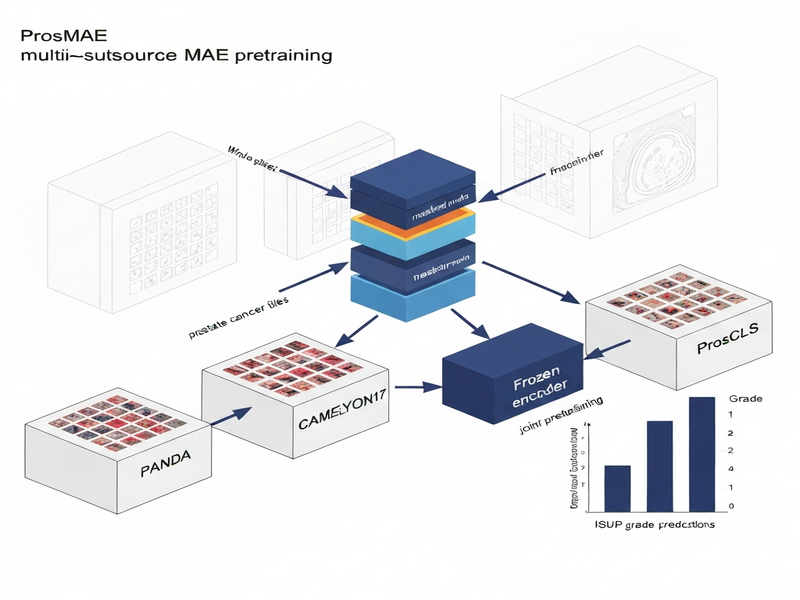
After pre‑training, the encoder is frozen and a simple linear head (ProsCLS) is attached to perform International Society of Urological Pathology (ISUP) grade classification. The approach outperforms a vanilla MAE baseline, achieving a higher mean validation quadratic weighted kappa (QWK) on a disjoint PANDA split.
Key Advantages
- Diverse Data Exposure: Training on three distinct datasets improves the encoder’s ability to generalize across stain variations and scanner differences.
- Efficient Transfer Learning: Freezing the encoder and using a linear probe reduces computational cost while maintaining high accuracy.
- Scalable Architecture: The MAE framework can be extended to incorporate additional histopathology sources as they become available.
Implications for Clinical AI
By delivering a robust, pre‑trained representation, ProsMAE paves the way for more reliable AI‑assisted prostate cancer grading, potentially accelerating diagnostic workflows and reducing inter‑observer variability.
Read the full paper on arXiv and explore related resources on our site:
Andrii Bidochko
CTO UBOS
Andrii Bidochko is an AI entrepreneur and researcher focused on AI agents, reinforcement learning, and autonomous systems. He writes about the technologies shaping the future of machine intelligence, from frontier models and agent architectures to real-world AI applications.