

- Updated: July 23, 2026
- 7 min read
Prompt-Driven Exploration
Direct Answer
Prompt‑Driven Exploration (PDE) introduces a new way for reinforcement‑learning agents to discover useful behaviors by iteratively refining natural‑language prompts with the help of a vision‑language model. By treating prompts as the exploration knob, PDE can generate global policy changes that traditional action‑space noise cannot, dramatically improving sample efficiency on tasks that start with zero reward.
Background: Why This Problem Is Hard
Reinforcement learning (RL) agents improve by sampling actions that lead to higher returns. When a policy is weak—meaning it rarely receives any reward—standard exploration techniques such as epsilon‑greedy or Gaussian action noise only produce slight variations around the same failing trajectory. This “local jitter” rarely pushes the agent into qualitatively new regions of the state space, leaving the learning process stuck.
Several practical bottlenecks illustrate the difficulty:
- Sparse rewards: Many real‑world problems (robotic manipulation, long‑horizon planning) provide feedback only after a long sequence of steps, making it hard to gauge which actions were useful.
- High‑dimensional action spaces: In vision‑language‑action (VLA) settings, the agent must coordinate perception, language understanding, and motor commands, amplifying the exploration challenge.
- Global policy shifts needed: Escaping a poor local optimum often requires a coordinated change across many timesteps—something that simple stochastic perturbations cannot achieve.
Existing approaches try to address these issues with intrinsic motivation, curiosity bonuses, or hierarchical policies. While they add useful signals, they still rely on the underlying action distribution to generate new rollouts. Consequently, they inherit the same limitation: exploration remains confined to the vicinity of the current policy.
What the Researchers Propose
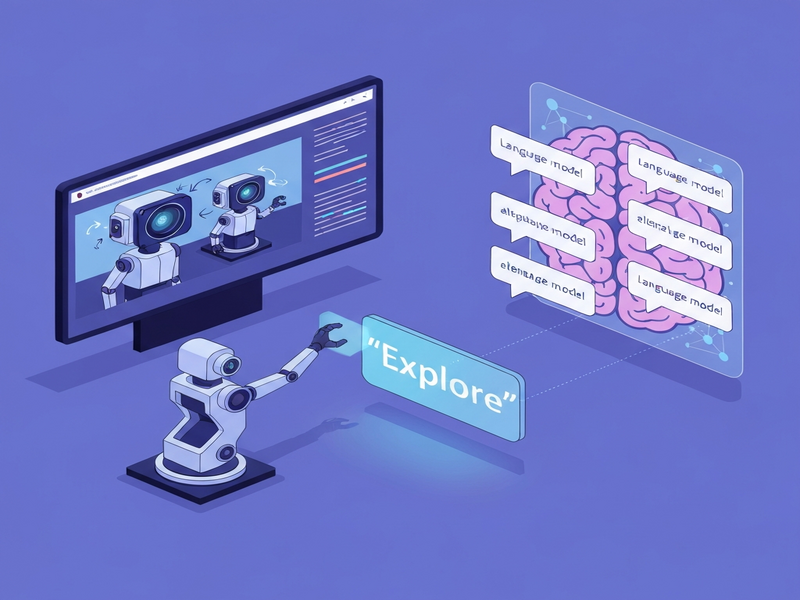
The authors propose a framework called Prompt‑Driven Exploration (PDE) that lifts the exploration problem from the action level to the prompt level. The key insight is that large language models (LLMs) and vision‑language‑action (VLA) models can condition an agent’s behavior on a natural‑language instruction. Changing the instruction can instantly reshape the entire rollout, producing a global policy perturbation.
PDE consists of three interacting components:
- Policy conditioned on a prompt: The RL agent receives a textual prompt that guides its decision‑making throughout an episode.
- Vision‑Language Model (VLM) reviewer: After each rollout, a VLM watches the resulting video, interprets how the agent responded to the prompt, and diagnoses shortcomings.
- Prompt updater: Using the VLM’s diagnosis, the system rewrites the prompt to encourage better behavior in the next episode.
In effect, the VLM maintains an implicit distribution over “useful” prompts and performs posterior sampling—an established exploration principle—by drawing new prompts from this evolving distribution.
How It Works in Practice
The PDE loop can be visualized as a four‑stage pipeline:
- Initialize: Start with a generic prompt (e.g., “pick up the red block”) and a randomly initialized policy.
- Execute: The policy runs in the environment, producing a video of its actions guided by the current prompt.
- Analyze: A pre‑trained VLM ingests the video, extracts a textual description of what happened, and compares it against the intended goal expressed in the prompt.
- Rewrite: Based on the discrepancy, the VLM generates a revised prompt that emphasizes missing sub‑tasks or corrects misunderstandings (e.g., “first grasp the red block, then lift it above the table”).
This cycle repeats, each time feeding the RL optimizer with a fresh prompt that nudges the policy toward previously unexplored behaviors. The crucial difference from conventional exploration is that the “noise” is injected at the semantic level, allowing the agent to leap to entirely new strategies rather than merely jittering around a single trajectory.
To illustrate the workflow, consider a robotic arm tasked with stacking objects:
- The initial prompt “stack the cubes” yields a failed attempt where the arm repeatedly knocks the cubes over.
- The VLM watches the video, notes that the arm never aligns the cubes before lowering them, and rewrites the prompt to “align the cubes before stacking them.”
- The next rollout follows the new instruction, leading the arm to first adjust its grip, thereby exploring a previously unseen sub‑policy.
Because each prompt is a high‑level, human‑readable artifact, developers can also manually intervene, inspect, or constrain the prompt space, adding a layer of interpretability rarely available in pure action‑noise methods.
Evaluation & Results
The authors benchmarked PDE on two families of tasks:
- Manipulation suite: Simulated robotic environments where agents must pick, place, and stack objects under sparse reward signals.
- Reasoning challenges: Grid‑world puzzles that require multi‑step logical planning, again with rewards only at episode completion.
Key findings include:
- Zero‑reward start success: PDE enabled agents to achieve non‑trivial scores on tasks where baseline RL (with epsilon‑greedy or curiosity) never received a single reward after millions of steps.
- Sample‑efficiency boost: Across all benchmarks, PDE reduced the number of environment interactions needed to reach a target success rate by 2‑3× compared with state‑of‑the‑art exploration methods.
- Robustness to prompt noise: Even when the VLM introduced imperfect rewrites, the policy still converged, demonstrating that PDE tolerates noisy language feedback.
These results were validated using standard RL metrics (success rate, episode return) and qualitative video analysis, confirming that the agent’s behavior changed in a globally coherent way after each prompt update.
Why This Matters for AI Systems and Agents
Prompt‑Driven Exploration reshapes how engineers think about exploration in complex, high‑dimensional domains. Its implications span several practical dimensions:
- Accelerated prototyping: By leveraging natural‑language prompts, developers can steer agents toward promising behaviors without hand‑crafting reward shaping functions.
- Interpretability and debugging: Since prompts are human‑readable, teams can trace why an agent behaved a certain way by inspecting the prompt history, simplifying root‑cause analysis.
- Modular system design: PDE cleanly separates perception (VLM), policy learning, and instruction generation, aligning with modern micro‑service architectures for AI agents.
- Integration with existing platforms: The prompt‑centric workflow can be wrapped inside orchestration tools such as the Workflow automation studio, enabling non‑technical users to define high‑level goals and let the system explore autonomously.
- Enterprise‑grade deployments: Companies building autonomous assistants or robotic fleets can embed PDE into their pipelines via the Enterprise AI platform by UBOS, gaining a scalable exploration mechanism that does not rely on dense reward engineering.
In short, PDE offers a pragmatic bridge between the expressive power of large language models and the rigorous learning dynamics of reinforcement learning, opening a path toward more adaptable, sample‑efficient agents in production environments.
What Comes Next
While PDE marks a significant step forward, several open challenges remain:
- Prompt space regularization: Unconstrained rewriting can drift into ambiguous or contradictory instructions. Future work could incorporate constraint solvers or human‑in‑the‑loop verification.
- Multi‑modal feedback loops: Extending the VLM reviewer to incorporate audio, tactile, or proprioceptive signals could enrich the diagnostic process for embodied agents.
- Scalability to real‑world robotics: Translating video‑based VLM analysis from simulation to physical robots will require robust perception pipelines and domain‑adaptation techniques.
- Prompt diversity strategies: Sampling diverse prompts while avoiding redundancy is an open research question; techniques from Bayesian optimization or information‑theoretic exploration may prove useful.
Addressing these topics will likely involve collaborations across natural‑language processing, computer vision, and control theory. Practitioners interested in experimenting with PDE can start by integrating it with the UBOS solutions for SMBs, which provide a low‑friction environment for deploying custom RL loops and VLM services.
References & Further Reading
For a complete technical description, see the original pre‑print:
Prompt‑Driven Exploration paper
Additional resources on related technologies:
Andrii Bidochko
CTO UBOS
Andrii Bidochko is an AI entrepreneur and researcher focused on AI agents, reinforcement learning, and autonomous systems. He writes about the technologies shaping the future of machine intelligence, from frontier models and agent architectures to real-world AI applications.