

- Updated: June 13, 2026
- 7 min read
Prompt Codebooks: Discrete Compositional Optimization for Language Model Instruction Refinement
Direct Answer
Prompt Codebooks (PCO) introduce a compositional, discrete‑learning framework that treats prompt engineering as the selection and assembly of reusable “instinct” units rather than a monolithic string edit. By routing each input through a learned codebook of natural‑language building blocks, PCO delivers per‑instance prompt customization, dramatically boosting performance on complex reasoning tasks while shrinking prompt length.
Background: Why This Problem Is Hard
Large language models (LLMs) have become the backbone of AI‑driven agents, from customer‑service bots to autonomous research assistants. The effectiveness of these agents hinges on the quality of the prompts that steer the model’s behavior. Traditional automatic prompt optimization (APO) methods treat a prompt as a single, immutable text blob and apply global edits—adding, deleting, or re‑ordering tokens—based on aggregate performance metrics.
Such instance‑blind approaches suffer from three fundamental limitations:
- Brittle updates: A change that helps one subset of queries can degrade another, because the same prompt is forced on every input.
- Lack of composability: Learned improvements cannot be reused across tasks; each new task requires a fresh optimization run.
- Prompt bloat: Global edits often inflate the prompt, pushing token limits and increasing latency.
In real‑world deployments—think multi‑step planning agents or knowledge‑intensive retrieval‑augmented generation—these shortcomings translate into unstable behavior, higher costs, and longer development cycles. The industry therefore needs a prompt‑engineering paradigm that is both modular and adaptive.
What the Researchers Propose
The authors of the Prompt Codebooks paper propose a novel framework called Prompt Codebooks (PCO). At its core, PCO reframes prompt construction as a discrete compositional optimization problem:
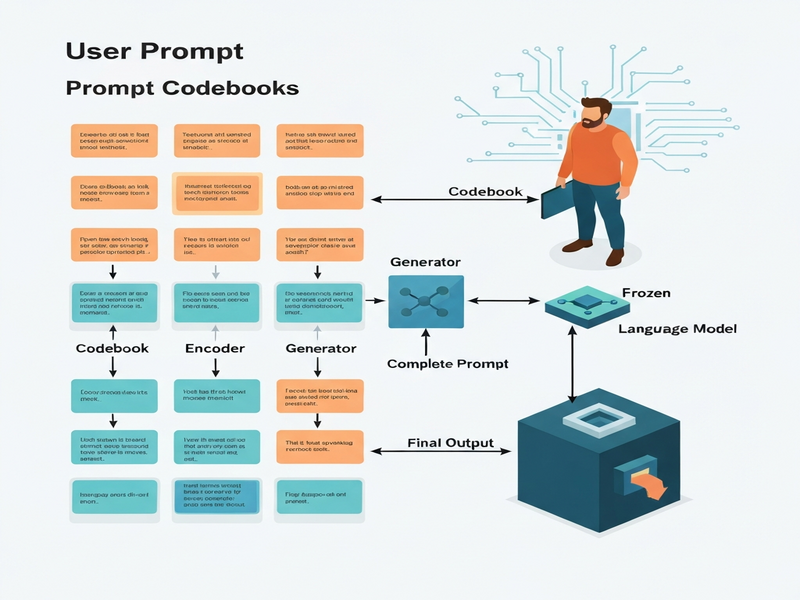
- Codebook of instincts: A finite vocabulary of short, natural‑language instruction snippets (the “instincts”) that capture atomic behaviors such as “list relevant facts,” “compare two entities,” or “explain the reasoning step.”
- Encoder (router): An LLM‑based module that examines the user query and selects a small subset (e.g., K = 16) of instincts most likely to help the downstream model.
- Generator: A lightweight language model that stitches the chosen instincts together into a coherent prompt, preserving grammatical flow and logical ordering.
- Critic: A structured evaluator that scores the generated prompt, decomposes the score into per‑instinct gradients, and feeds these signals back to jointly train the encoder, generator, and codebook.
This architecture enables per‑instance routing: each input can receive a unique combination of instincts, something impossible for monolithic APO methods. Moreover, because instincts are reusable, improvements learned on one task can be transferred to others, fostering a shared “prompt knowledge base.”
How It Works in Practice
The PCO workflow can be visualized as a three‑stage pipeline:
- Routing (Encoder): When a user query arrives, the encoder encodes the query into a latent representation and scores every instinct in the codebook. The top‑K instincts are selected as the candidate set.
- Composition (Generator): The generator receives the ordered list of selected instincts and produces a single prompt string. It ensures that the assembled prompt respects natural language flow, adds connective phrasing, and respects token limits.
- Evaluation (Critic): The composed prompt is fed to the frozen target LLM (e.g., Qwen3‑8B or LLaMA‑3.1‑8B) along with the original query. The critic compares the model’s output against a ground‑truth or task‑specific metric, then back‑propagates a structured loss that attributes credit or blame to each instinct.
Training proceeds under a min‑max objective: the encoder‑generator pair tries to maximize the critic’s reward, while the critic learns to provide accurate, fine‑grained feedback. Because the codebook entries are discrete and human‑readable, engineers can inspect, edit, or augment them without retraining the entire system.
What sets PCO apart from prior work is the combination of three properties:
- Discrete compositionality: Instincts are atomic and reusable, enabling systematic prompt construction.
- Instance‑level adaptation: Each query receives a tailor‑made prompt, eliminating the “one‑size‑fits‑all” weakness.
- Parameter‑efficient scaling: The frozen target model remains unchanged; only the lightweight encoder, generator, and codebook are trained, keeping compute costs low.
Evaluation & Results
The researchers benchmarked PCO on six diverse tasks, ranging from multi‑hop question answering (HotpotQA) to logical reasoning (GSM‑8K) and code generation. All experiments used the same frozen LLM back‑ends (Qwen3‑8B and LLaMA‑3.1‑8B) to isolate the effect of prompt optimization.
Key findings include:
- Performance lift: Across the board, PCO outperformed zero‑shot baselines by up to +30.36 points on task‑specific metrics, demonstrating that compositional prompts can unlock latent model capabilities.
- Competitive edge: Against the strongest prior APO method (GEPA), PCO achieved a +3.34 improvement on HotpotQA and a +1.11 aggregate gain across all benchmarks.
- Prompt efficiency: Using only 16 instincts per query, PCO reduced the final prompt length by up to 14.1× compared with MIPROv2 and 3.0× versus GEPA, staying comfortably within token limits.
- Generalization: Instincts learned on one dataset transferred to unseen tasks with minimal fine‑tuning, confirming the reusable nature of the codebook.
These results matter because they show that a modest, discrete prompt vocabulary can rival or surpass heavyweight, globally edited prompts while consuming far fewer tokens—a critical factor for cost‑sensitive production environments.
Why This Matters for AI Systems and Agents
For developers building AI agents, PCO offers a practical pathway to more reliable, adaptable, and efficient prompting:
- Modular prompt libraries: Instincts can be curated as a shared asset across teams, reducing duplication of effort and accelerating onboarding.
- Dynamic orchestration: Agents can query the encoder in real time to fetch the most relevant instincts, enabling on‑the‑fly adaptation to user intent or context shifts.
- Cost savings: Shorter prompts translate directly into lower inference token usage, which is especially valuable when scaling to millions of requests.
- Explainability: Because each instinct is a human‑readable snippet, engineers can trace why a particular behavior emerged, aiding debugging and compliance.
These advantages align closely with the capabilities of the UBOS platform overview, which emphasizes reusable AI components and low‑code orchestration. By integrating Prompt Codebooks into UBOS’s Workflow automation studio, teams can construct agent pipelines that automatically select the optimal prompt composition for each incoming request.
Moreover, the modular nature of instincts dovetails with AI marketing agents, where different campaign goals (e.g., brand awareness vs. conversion) require subtly different prompting strategies. Prompt Codebooks make it trivial to swap or augment instincts without redeploying the entire model.
What Comes Next
While Prompt Codebooks mark a significant step forward, several open challenges remain:
- Scalability of the codebook: As the number of instincts grows, efficient retrieval becomes critical. Future work could explore hierarchical or memory‑augmented encoders.
- Cross‑modal instincts: Extending the concept to multimodal prompts (e.g., vision‑language or audio‑language) would broaden applicability to agents that process images, video, or speech.
- Human‑in‑the‑loop curation: Providing UI tools for domain experts to author, validate, and rank instincts could accelerate adoption in regulated industries.
- Robustness to adversarial inputs: Investigating how per‑instance routing behaves under noisy or malicious queries is essential for secure deployments.
Addressing these directions could unlock new use cases such as personalized tutoring bots that dynamically assemble pedagogical instincts, or enterprise assistants that tailor compliance‑focused prompts per department.
Organizations interested in experimenting with compositional prompting can start by leveraging the OpenAI ChatGPT integration to prototype instinct libraries, then migrate to in‑house LLMs using UBOS’s Enterprise AI platform by UBOS for production‑grade scaling.
Conclusion
Prompt Codebooks reimagine automatic prompt optimization as a discrete, compositional process, delivering per‑instance adaptability, token efficiency, and reusable prompt knowledge. The framework’s encoder‑generator‑critic loop learns to select and assemble a small set of natural‑language instincts, achieving state‑of‑the‑art performance on a suite of reasoning benchmarks while dramatically shrinking prompt size. For AI practitioners building agents, orchestration pipelines, or enterprise AI services, PCO offers a modular, explainable, and cost‑effective alternative to monolithic prompt tuning.
As the AI ecosystem continues to gravitate toward modular, low‑code platforms, the principles behind Prompt Codebooks are poised to become a foundational building block for next‑generation, adaptable LLM‑driven agents.
References
- Nath, J., Kumar, N., & Lall, B. (2026). Prompt Codebooks: Discrete Compositional Optimization for Language Model Instruction Refinement. arXiv preprint arXiv:2605.28360.
- Related work on automatic prompt optimization: GEPA, MIPROv2, and other gradient‑based methods.
Andrii Bidochko
CTO UBOS
Andrii Bidochko is an AI entrepreneur and researcher focused on AI agents, reinforcement learning, and autonomous systems. He writes about the technologies shaping the future of machine intelligence, from frontier models and agent architectures to real-world AI applications.