

- Updated: June 17, 2026
- 7 min read
Prominence-Stratified Failure Modes in Retrieval-Augmented Commercial Recommendation: A 37,000-Run Audit
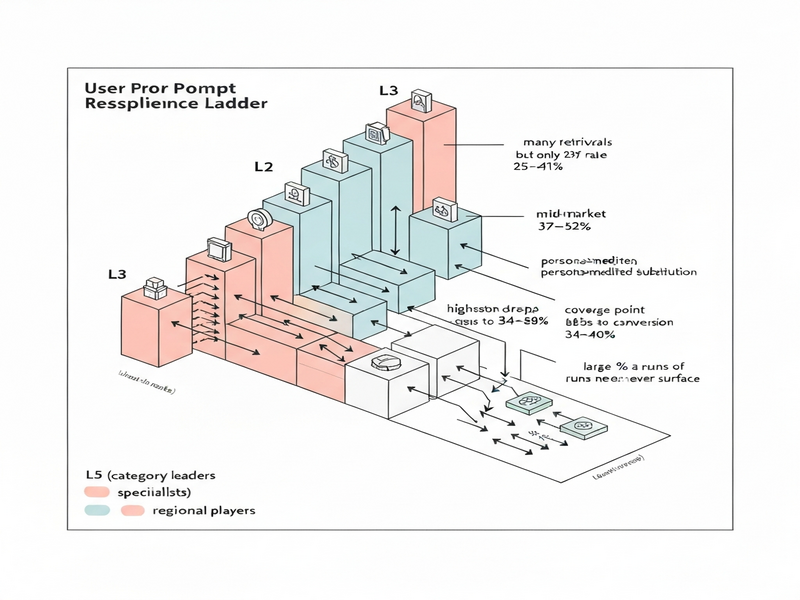
Direct Answer
The paper introduces a massive audit of 37,000 production runs of retrieval‑augmented commercial recommendation models, revealing that brand visibility and conversion rates vary dramatically across a five‑tier “prominence ladder.” It matters because the findings expose systematic failure modes that can cripple mid‑market and niche brands in AI‑driven recommendation engines, reshaping how marketers allocate resources and how engineers design retrieval pipelines.
Background: Why This Problem Is Hard
AI assistants such as ChatGPT, Claude, and emerging enterprise agents have evolved from pure question‑answering tools into de‑facto recommendation engines. When a user asks, “What’s a good laptop for graphic design?” the model does not return a list of links; it nominates specific brands. This shift creates a new marketing frontier where discoverability is no longer about SEO rankings but about being *named* by the model.
Traditional search‑engine optimization (SEO) tactics—keyword targeting, backlink building, schema markup—address visibility in a ranked list of URLs. In contrast, retrieval‑augmented recommendation (RAR) pipelines fuse a dense vector retriever with a generative LLM that selects a handful of brand names to embed in its answer. The challenges are threefold:
- Opaque Retrieval Layers: Vector similarity scores are not directly interpretable, making it hard to predict which brands will surface.
- Persona‑Mediated Substitution: LLMs often replace a retrieved brand with a more “familiar” or “authoritative” alternative based on the conversational persona, sidelining equally relevant but less prominent options.
- Prominence Bias: The model’s training data reflects real‑world brand awareness, which can amplify the dominance of market leaders while marginalizing regional or specialist players.
Existing evaluations of RAR systems typically focus on relevance metrics (e.g., nDCG, recall) or user satisfaction surveys. They rarely stratify performance by brand prominence, leaving marketers blind to systematic blind spots that can cost market share.
What the Researchers Propose
The authors construct a “prominence‑stratified audit framework” that layers three analytical components on top of a production‑grade RAR system:
- Reference Catalog Construction: A curated list of 533 brands across 19 commercial sectors, classified into five tiers (L1–L5) using external authority lists (e.g., industry reports, market research). Tier L1 represents category leaders; L5 captures regional or niche players.
- Prompt Corpus Generation: 215 commercially‑framed prompts that mimic real user queries (e.g., “Best CRM for small businesses”). The prompts are designed to trigger brand retrieval across the entire catalog.
- Run‑Level Auditing Engine: An automated pipeline that executes each prompt against four model configurations (two Anthropic, two OpenAI) and records every retrieved brand, its position in the recommendation slot, and whether it wins the slot (i.e., is actually named).
By intersecting the retrieved brands with the prominence ladder, the framework isolates “failure modes” specific to each tier—whether a brand is never retrieved, retrieved but never selected, or retrieved and selected at a low conversion rate.
How It Works in Practice
The audit workflow can be visualized as a three‑stage pipeline:
- Retrieval Phase: The prompt is encoded into a dense vector and fed to a vector database (e.g., Chroma DB). The top‑k nearest brand documents are returned, forming a candidate set.
- Generation Phase: The LLM receives the prompt plus the retrieved candidates as context. It then generates a natural‑language answer, optionally inserting brand names into the response.
- Selection & Scoring Phase: Post‑processing scripts parse the answer to extract brand mentions, map them back to the catalog, and assign a “win” flag if the brand occupies a recommendation slot (e.g., first‑place suggestion).
What distinguishes this approach from prior audits is the explicit mapping of each brand to a prominence tier before analysis. This stratification enables the researchers to ask tier‑specific questions such as, “What proportion of L4 specialists ever appear in any run?” rather than aggregating across the entire catalog.
Additionally, the study evaluates four distinct model configurations—two from Anthropic (Claude‑2, Claude‑Instant) and two from OpenAI (GPT‑4‑Turbo, GPT‑3.5‑Turbo). By holding the prompt set and catalog constant, the authors isolate the impact of model architecture and training data on brand visibility.
Evaluation & Results
The audit spans 37,000 runs, covering every combination of prompt, model, and sector. The key findings are organized by prominence tier:
L1 – Category Leaders
- Appeared in nearly 100% of relevant retrievals across all models.
- Converted to a recommendation slot only 25–41% of the time, indicating that visibility is not the limiting factor; differentiation is.
- When they did win, they commanded the highest absolute click‑through potential due to brand familiarity.
L2 – Challenger Brands
- Achieved the highest conversion rates of any tier, ranging from 37–52%.
- Anthropic models exhibited a “persona‑mediated substitution” effect, often replacing L2 brands with L1 leaders in the final answer.
- OpenAI models retained more L2 mentions, suggesting differences in persona handling.
L3 – Mid‑Market Brands
- Coverage dropped to 88% of relevant retrievals, marking the inflection point where many brands never entered the candidate set.
- Conversion rates settled between 34–40%, lower than L2 but higher than L4/L5.
- Persona effects peaked here; the model’s internal bias toward “known” brands amplified the loss of L3 candidates.
L4 – Specialists & Niche Players
- Only 48–52% of runs ever surfaced an L4 brand, indicating catastrophic invisibility for many niche offerings.
- When retrieved, conversion rates fell below 20%, reflecting both low visibility and low confidence from the model.
L5 – Regional or Emerging Brands
- Nearly half of the runs (48–52%) never retrieved an L5 brand at all.
- Even when retrieved, the win rate was under 10%, effectively rendering these brands invisible in AI‑driven recommendations.
Across all tiers, the audit uncovered that no single model configuration “solved” the visibility problem. Instead, each model exhibited a distinct trade‑off between retrieval breadth and persona‑driven substitution.
Why This Matters for AI Systems and Agents
For practitioners building AI‑powered recommendation agents, the study delivers three actionable insights:
- Design Retrieval Pipelines with Tier Awareness: Embedding a prominence‑aware re‑ranking step can ensure that mid‑market and niche brands are not systematically filtered out before generation.
- Persona Calibration is Critical: The LLM’s conversational persona can override retrieval signals. Fine‑tuning or prompting strategies that explicitly ask the model to “consider all options” can mitigate substitution bias.
- Evaluation Must Go Beyond Aggregate Metrics: Traditional relevance scores mask tier‑specific failures. Incorporating prominence‑stratified metrics into continuous monitoring dashboards will surface blind spots early.
These implications ripple through the entire AI agent stack—from data ingestion to user‑facing dialogue. Companies that rely on AI recommendation engines for e‑commerce, travel, or SaaS marketplaces can leverage the findings to:
- Allocate marketing spend more efficiently, focusing on “differentiation” for L1 brands and “visibility boosting” for L4/L5 players.
- Implement AI marketing agents that dynamically adjust prompts based on brand tier, ensuring equitable exposure.
- Integrate the audit’s methodology into their UBOS platform overview for automated monitoring of recommendation health.
What Comes Next
While the audit is comprehensive, several limitations open avenues for future research:
- Dynamic Catalogs: Brands evolve—new entrants appear, others exit. A live updating catalog with automated tier reassignment would keep the audit relevant over time.
- Cross‑Modal Retrieval: Incorporating images, reviews, and structured product data could enrich the candidate set and reduce reliance on textual prominence alone.
- User‑Feedback Loops: Real‑world click‑through and conversion data could be fed back into the retrieval model to personalize brand exposure per user segment.
Potential applications extend beyond commercial recommendation. For example, policy‑focused agents could use a similar ladder to ensure that minority‑owned businesses receive fair representation in public‑service suggestions.
Organizations interested in operationalizing these insights can explore the UBOS partner program for co‑development opportunities, or adopt the Enterprise AI platform by UBOS to embed prominence‑aware retrieval into existing workflows. Startups looking to differentiate early can leverage the UBOS for startups resources to prototype tier‑balanced recommendation pipelines.
For a deeper dive into the methodology and raw data, consult the original pre‑print: Prominence-Stratified Failure Modes in Retrieval-Augmented Commercial Recommendation.
Andrii Bidochko
CTO UBOS
Andrii Bidochko is an AI entrepreneur and researcher focused on AI agents, reinforcement learning, and autonomous systems. He writes about the technologies shaping the future of machine intelligence, from frontier models and agent architectures to real-world AI applications.