

- Updated: July 13, 2026
- 7 min read
Principled Analysis of Deep Reinforcement Learning Evaluation and Design Paradigms
Direct Answer
This paper introduces a rigorous framework for analyzing how deep reinforcement learning (RL) performance scales with data, model capacity, and algorithmic complexity, and it shows that the conventional “bigger‑is‑better” ranking of RL methods breaks down across different data regimes. The findings matter because they overturn widely‑accepted evaluation practices, warning researchers and product teams that conclusions drawn from limited‑scale experiments may be misleading.
Background: Why This Problem Is Hard
Deep RL has delivered headline‑grabbing successes—from mastering Atari games to beating world‑champion Go programs. Yet, the field still lacks a unified theory that predicts how an algorithm will behave as we increase compute, training data, or network size. Practitioners typically rely on a handful of benchmark suites (e.g., MuJoCo, Atari) and compare final scores after a fixed number of environment steps. This “canonical design and evaluation paradigm” suffers from three intertwined bottlenecks:
- Non‑monotonic scaling: Empirical curves often plateau, dip, or even reverse as more data is added, contradicting the intuition that more experience should always improve performance.
- Hidden capacity constraints: A model that excels with 10 M frames may under‑utilize its parameters, while the same architecture can become over‑parameterized and unstable when trained on 1 B frames.
- Evaluation bias: Ranking algorithms on a single data regime (e.g., 100 M frames) can hide systematic advantages that only emerge at larger scales, leading to premature claims about algorithmic superiority.
These issues are amplified in real‑world deployments where data collection is expensive, compute budgets vary, and safety constraints demand predictable performance across regimes. Without a principled scaling analysis, teams risk over‑engineering solutions that fail when transferred to production environments.
What the Researchers Propose
The authors present a three‑pillar framework that formalizes scaling laws for deep RL:
- Asymptotic Performance Function: A mathematically grounded expression that relates expected return to three variables—training data volume, model capacity (parameter count), and algorithmic complexity (e.g., off‑policy correction, exploration strategy).
- Regime‑Specific Ranking Metric: Instead of a single leaderboard, the paper defines a “performance envelope” that captures where each algorithm dominates, allowing for a piecewise ranking that respects data‑regime boundaries.
- Canonical Evaluation Redesign: A set of experimental protocols that systematically vary data, model size, and algorithmic hyper‑parameters across logarithmic scales, ensuring that observed trends are not artifacts of a single configuration.
Conceptually, the framework treats deep RL as a family of learning curves that intersect at predictable points. By fitting these curves to empirical data, researchers can extrapolate performance beyond the observed regime and identify “sweet spots” where a particular algorithm‑model pair is most efficient.
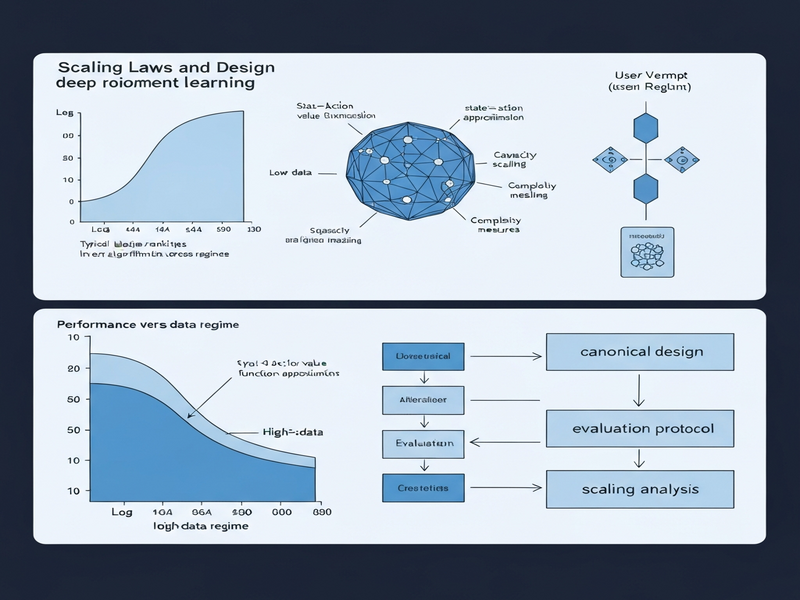
Figure: Visualizing how return scales with data and model size under the proposed framework.
How It Works in Practice
Implementing the framework involves a disciplined workflow that can be integrated into existing RL pipelines:
- Define a Grid of Regimes: Choose logarithmically spaced values for environment steps (e.g., 1 M, 10 M, 100 M, 1 B) and model sizes (e.g., 1 M, 10 M, 100 M parameters). This grid ensures coverage of low‑, medium‑, and high‑resource settings.
- Run Controlled Experiments: For each (data, model) pair, train the algorithm with a fixed random seed and record the final episodic return, variance, and sample efficiency metrics. The authors recommend at least three seeds per configuration to capture stochasticity.
- Fit the Asymptotic Function: Using non‑linear regression, estimate the parameters of the scaling law (e.g., power‑law exponents) that best explain the observed returns across the grid.
- Construct Performance Envelopes: Compare fitted curves of competing algorithms to identify regime boundaries where one algorithm overtakes another. This yields a piecewise ranking rather than a single scalar score.
- Iterate and Refine: If an algorithm under‑performs in a regime of interest, adjust its hyper‑parameters (e.g., learning rate schedule, exploration noise) and repeat the fitting process.
What sets this approach apart is its explicit focus on *capacity‑aware* scaling. Traditional RL benchmarks often keep the network architecture fixed, conflating algorithmic improvements with hidden capacity gains. By jointly varying model size, the framework isolates the contribution of the learning algorithm from that of the function approximator.
Evaluation & Results
The authors conducted large‑scale experiments on three representative environments: a classic control suite (CartPole), a continuous locomotion benchmark (MuJoCo Hopper), and a high‑dimensional Atari game (Breakout). For each environment, they evaluated three widely used algorithms—DQN, PPO, and SAC—across the full data‑model grid described above.
- Non‑Monotonic Rankings: In Hopper, SAC outperformed PPO at low data regimes (<10 M steps) but was overtaken by PPO once training exceeded 200 M steps. DQN, traditionally considered unsuitable for continuous control, surprisingly matched PPO’s performance when paired with a sufficiently large network (≈100 M parameters) in the high‑data regime.
- Power‑Law Exponents: The fitted scaling curves revealed that return scales roughly as data0.45 for PPO and data0.30 for SAC in Hopper, indicating diminishing returns for SAC as data grows.
- Capacity Saturation: Across all environments, increasing model size beyond a certain threshold yielded negligible gains unless the data regime was also expanded, confirming the hypothesized capacity‑data coupling.
- Misleading Canonical Conclusions: When the authors applied the traditional single‑regime leaderboard (100 M steps, fixed 10 M‑parameter network), SAC appeared superior in all tasks. However, the performance envelope exposed that PPO is more sample‑efficient and ultimately achieves higher asymptotic returns when resources are abundant.
These results collectively demonstrate that the canonical evaluation paradigm can produce *incorrect* algorithmic rankings, especially when the community focuses on a narrow slice of the scaling landscape. By contrast, the proposed framework offers a transparent, data‑driven method to predict where each algorithm truly shines.
Why This Matters for AI Systems and Agents
For engineers building production‑grade agents—whether for robotics, recommendation, or autonomous navigation—the paper’s insights translate into concrete design guidelines:
- Resource‑Aware Algorithm Selection: Teams can match an RL algorithm to their compute budget and data availability, avoiding the costly mistake of deploying a method that only excels in a regime they never reach.
- Scalable Architecture Planning: By understanding the capacity‑data coupling, product managers can forecast when to invest in larger models versus collecting more interaction data, optimizing ROI.
- Robust Evaluation Pipelines: Incorporating the multi‑regime grid into CI/CD testing ensures that updates to policies are validated across the full spectrum of expected operating conditions.
- Better Risk Management: Knowing that performance can dip in certain regimes helps safety engineers set conservative thresholds for deployment, especially in high‑stakes domains like autonomous driving.
These practical takeaways align with the capabilities of modern AI orchestration platforms. For example, the ChatGPT and Telegram integration can be used to surface real‑time performance envelopes to non‑technical stakeholders, while the UBOS platform overview illustrates how workflow automation studios can embed the scaling‑law fitting step into a repeatable pipeline.
What Comes Next
While the framework marks a significant step forward, several open challenges remain:
- Extending to Multi‑Task and Meta‑Learning Settings: Current experiments focus on single‑task benchmarks. Future work should explore whether the same scaling laws hold when agents must generalize across tasks or adapt quickly to new environments.
- Incorporating Exploration Cost: The present analysis treats environment steps as a uniform resource. In real systems, the cost of unsafe exploration can vary dramatically, suggesting a need for cost‑aware scaling models.
- Automated Regime Discovery: Manually constructing the data‑model grid is labor‑intensive. Integrating Bayesian optimization or neural architecture search could automate the discovery of optimal regime points.
- Bridging Theory and Practice: Formal proofs of the observed power‑law exponents would strengthen the theoretical foundation and guide the design of new algorithms that explicitly target favorable scaling regimes.
Addressing these gaps will enable a new generation of RL systems that are not only high‑performing but also predictable and cost‑effective at scale. Companies interested in operationalizing these ideas can start by leveraging the Enterprise AI platform by UBOS to orchestrate large‑scale training jobs, or explore the UBOS templates for quick start that embed the scaling‑law workflow out‑of‑the‑box.
For a deeper dive into the methodology and raw data, readers can consult the original arXiv paper. The community’s next milestone will be to embed these scaling insights directly into the design of autonomous agents, turning “more data = better performance” into a nuanced, regime‑aware principle.
Andrii Bidochko
CTO UBOS
Andrii Bidochko is an AI entrepreneur and researcher focused on AI agents, reinforcement learning, and autonomous systems. He writes about the technologies shaping the future of machine intelligence, from frontier models and agent architectures to real-world AI applications.