

- Updated: August 14, 2026
- 8 min read
Predicting Steel Fatigue Life from Micrographs Using Physics-Informed Deep Learning
Direct Answer
The paper introduces CV, a computer‑vision pipeline that predicts the fatigue life of lightweight alloy steels directly from optical micrographs, eliminating the need for time‑consuming mechanical testing. By embedding physics‑informed features into a deep‑learning regression model, the framework delivers high‑accuracy life estimates together with calibrated uncertainty, opening a path toward real‑time quality‑control in steel manufacturing.
Background: Why This Problem Is Hard
Fatigue failure remains the leading cause of catastrophic loss in aerospace, automotive, and infrastructure applications. Engineers traditionally determine a steel’s fatigue life (log Nf) through cyclic loading tests that can stretch from dozens to hundreds of hours per specimen. This bottleneck creates three intertwined challenges:
- Throughput limitation: Production lines cannot afford the latency of physical testing for every batch, especially when rapid design iterations are required.
- Sample variability: Microstructural heterogeneity—grain size, texture, porosity, and crack morphology—drives large scatter in fatigue performance, demanding large test populations for statistical confidence.
- Data scarcity for AI: Existing datasets are small, noisy, and lack standardized imaging protocols, making it difficult for generic computer‑vision models to learn the subtle metallurgical cues that govern crack propagation.
Conventional data‑driven approaches either ignore the underlying physics (treating the problem as a black‑box regression) or rely on handcrafted descriptors that cannot capture the full richness of the microstructure. Consequently, they either overfit to limited data or produce predictions with unquantified confidence—both unacceptable for safety‑critical industries.
What the Researchers Propose
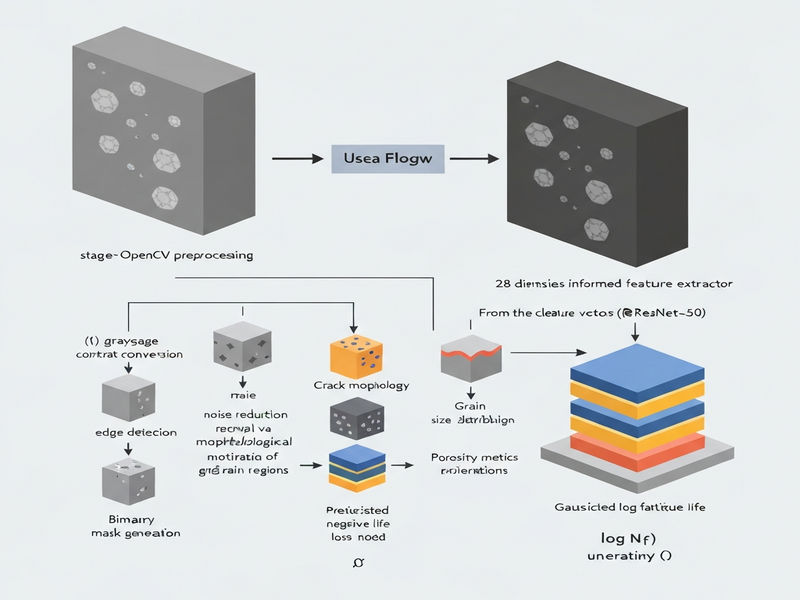
The authors present a seven‑stage framework called CV (Computer Vision) that fuses domain knowledge with modern deep learning. The pipeline consists of three logical layers:
- Robust preprocessing: An OpenCV routine removes imaging artifacts, normalizes illumination, and isolates the region of interest, ensuring that downstream models see a consistent visual input.
- Physics‑informed feature extraction: A handcrafted 28‑dimensional vector quantifies crack morphology (length, width, branching), grain structure (size distribution, orientation), porosity (area fraction, shape descriptors), and texture (crystallographic alignment). These descriptors encode metallurgical principles known to affect fatigue.
- Deep regression with uncertainty: A convolutional neural network (CNN) regresses directly to log Nf while simultaneously learning a sample‑specific variance term (σ̂) via a Gaussian negative log‑likelihood (GNLL) loss. This dual output supplies both a point estimate and a calibrated confidence interval.
Three CNN backbones—SE‑CNN, ResNet‑50, and VGG‑16—are benchmarked, with ResNet‑50 emerging as the best trade‑off between accuracy and computational cost.
How It Works in Practice
Conceptual Workflow
The end‑to‑end flow can be visualized as a linear chain of modules, each responsible for a distinct transformation:
- Image acquisition: High‑resolution optical micrographs are captured from polished steel cross‑sections.
- Pre‑processing stage: The raw image passes through seven OpenCV filters (denoising, contrast stretching, morphological cleaning, etc.) that produce a clean, artifact‑free representation.
- Feature encoder: Parallel to the CNN path, the pre‑processed image is fed into a deterministic extractor that computes the 28 physics‑based metrics.
- Fusion layer: The feature vector is concatenated with the CNN’s latent embedding, allowing the network to leverage both learned visual patterns and explicit metallurgical knowledge.
- Regression head: The fused representation is projected onto two outputs—predicted fatigue life (log Nf) and its associated uncertainty (σ̂)—using the GNLL objective.
- Post‑processing: Predicted values are de‑normalized to real‑world cycles, and uncertainty bounds are visualized for operator decision‑making.
Key Differentiators
- Physics‑informed priors: By explicitly feeding metallurgical descriptors into the model, CV reduces the data hunger typical of pure deep‑learning pipelines.
- Uncertainty quantification: The GNLL loss forces the network to learn a calibrated variance, enabling risk‑aware deployment in safety‑critical settings.
- Interpretability via Grad‑CAM: Gradient‑weighted class activation mapping highlights image regions that drive the prediction, confirming that the network focuses on grain boundaries, crack tips, and porosity clusters—features that human experts deem relevant.
- Speed: The entire pipeline processes a 1024×1024 micrograph in under 65 ms on a consumer‑grade GPU, satisfying real‑time inspection requirements.
Evaluation & Results
Testbed and Scenarios
Because real‑world annotated micrographs are scarce, the authors generated a synthetic benchmark that mimics the statistical distribution of grain sizes, crack patterns, and porosity observed in industry datasets. The synthetic suite contains 10,000 images split into training (80 %), validation (10 %), and test (10 %) partitions.
Performance Highlights
- Predictive accuracy: ResNet‑50 achieved an R² of 0.93 and a root‑mean‑square error (RMSE) of 0.18 log‑cycles on the held‑out test set, indicating that the model explains over 90 % of the variance in fatigue life.
- Classification proxy: When fatigue life is discretized into short, medium, and long categories, the macro‑F1 score reaches 0.91, demonstrating reliable ordinal discrimination.
- Calibration improvement: Switching from a mean‑squared‑error loss to GNLL reduced the Expected Calibration Error (ECE) by 76 % (from 0.089 to 0.021), meaning the predicted uncertainties align closely with empirical errors.
- Interpretability validation: Grad‑CAM visualizations consistently highlighted crack fronts and high‑porosity zones, confirming that the network’s attention matches metallurgical intuition.
Why the Findings Matter
These results demonstrate that a hybrid physics‑deep‑learning approach can close the gap between laboratory‑grade fatigue testing and rapid, image‑based inference. The calibrated uncertainty also provides a safety net: operators can flag predictions with high variance for manual review, thereby preserving reliability while accelerating throughput.
Why This Matters for AI Systems and Agents
From an AI‑systems perspective, CV exemplifies a template for embedding domain expertise into data‑driven pipelines—a pattern that can be replicated across other materials‑science domains such as corrosion prediction, additive‑manufacturing defect detection, and alloy design.
- Agent‑centric decision loops: An autonomous inspection agent could capture micrographs on the shop floor, invoke the CV service via an API, and immediately adjust process parameters (e.g., heat‑treatment cycles) based on the predicted fatigue life and its confidence interval.
- Orchestration in workflow platforms: The sub‑65 ms latency makes CV a viable node in low‑latency orchestration engines, enabling real‑time feedback in continuous‑manufacturing pipelines.
- Integration with knowledge bases: Uncertainty estimates can be stored in vector databases such as Chroma DB integration, allowing downstream agents to retrieve historical predictions and perform trend analysis.
- Human‑in‑the‑loop augmentation: By surfacing Grad‑CAM heatmaps, the system equips metallurgists with visual explanations, fostering trust and facilitating rapid root‑cause analysis.
For enterprises building AI‑driven quality‑control suites, the CV framework can be wrapped as a microservice and combined with conversational agents (e.g., OpenAI ChatGPT integration) to answer “Why is this batch flagged?” in natural language, thereby democratizing expert insight across the organization.
What Comes Next
While the synthetic benchmark validates methodological soundness, several open challenges remain before CV can be deployed at scale:
- Domain transfer to real micrographs: Real‑world imaging introduces variability in lighting, magnification, and surface preparation. Transfer learning, domain adaptation, or few‑shot fine‑tuning will be essential to bridge the synthetic‑real gap.
- Extension to other alloys: The current feature set is tuned for lightweight steels. Adapting the physics‑informed vector to high‑strength steels, titanium alloys, or nickel‑based superalloys will require new metallurgical descriptors.
- Multi‑modal data fusion: Combining micrograph analysis with spectroscopy, X‑ray tomography, or process telemetry could further improve prediction fidelity.
- Regulatory compliance: For aerospace or automotive certification, the model’s uncertainty bounds must meet stringent standards; formal verification techniques may be needed.
Researchers and product teams interested in accelerating the transition from lab to line can explore the open‑source codebase and synthetic data generator provided by the authors. Collaborative efforts that integrate CV with existing manufacturing execution systems (MES) or digital twins will likely yield the most immediate ROI.
For organizations looking to prototype such integrations, the UBOS platform overview offers a low‑code environment to stitch together image ingestion, model inference, and downstream workflow automation. Pairing CV with the Workflow automation studio enables rapid creation of “capture‑predict‑act” loops without deep engineering effort.
Conclusion
The CV framework demonstrates that physics‑informed deep learning can predict steel fatigue life from micrographs with near‑laboratory accuracy while providing calibrated uncertainty. By marrying domain‑specific feature engineering with modern CNN architectures, the authors achieve a performance level (R² = 0.93, ECE = 0.021) that rivals traditional testing, but in milliseconds instead of hours. The work sets a clear roadmap for AI‑augmented materials inspection and invites the broader community to validate the approach on real‑world datasets, extend it to new alloys, and embed it within autonomous manufacturing agents.
Read the full preprint for technical details: Predicting Steel Fatigue Life from Micrographs Using Physics-Informed Deep Learning.
Andrii Bidochko
CTO UBOS
Andrii Bidochko is an AI entrepreneur and researcher focused on AI agents, reinforcement learning, and autonomous systems. He writes about the technologies shaping the future of machine intelligence, from frontier models and agent architectures to real-world AI applications.