

- Updated: July 20, 2026
- 6 min read
Predicting Scale-Up of Metal-Organic Framework Syntheses with Large Language Models
Direct Answer
The paper introduces ScaleMOF, a literature‑mined dataset combined with a positive‑unlabeled learning pipeline that fine‑tunes large language models (LLMs) to predict whether a metal‑organic framework (MOF) synthesis can be successfully scaled from the lab to industrial volumes. Achieving 93.5 % classification accuracy, the approach offers a data‑driven ranking tool that helps researchers and manufacturers prioritize MOF candidates with realistic scale‑up pathways.
Background: Why This Problem Is Hard
Metal‑organic frameworks have exploded in academic literature because of their tunable porosity, catalytic activity, and gas‑storage capabilities. Yet, moving a promising MOF from milligram‑scale batch reactors to kilogram‑ or tonne‑scale production remains a bottleneck. The difficulty stems from three intertwined factors:
- Fragmented Knowledge Base: Scale‑up protocols are scattered across supplemental tables, conference abstracts, and proprietary white papers, making systematic extraction labor‑intensive.
- Non‑Linear Process Sensitivity: Small changes in temperature, solvent ratio, or metal precursor purity can cause phase transitions, framework collapse, or dramatically altered surface chemistry.
- Lack of Predictive Models: Traditional cheminformatics tools excel at predicting molecular properties but do not capture the procedural nuances required for scale‑up, such as reactor geometry or heat‑transfer limits.
Existing approaches—rule‑based expert systems, manual literature reviews, or small‑scale statistical models—either miss subtle procedural cues or cannot generalize beyond the narrow set of MOFs they were trained on. Consequently, industrial partners often abandon promising candidates after costly pilot runs, slowing the translation of MOF breakthroughs into commercial products.
What the Researchers Propose
To bridge the knowledge gap, the authors propose a two‑pronged framework:
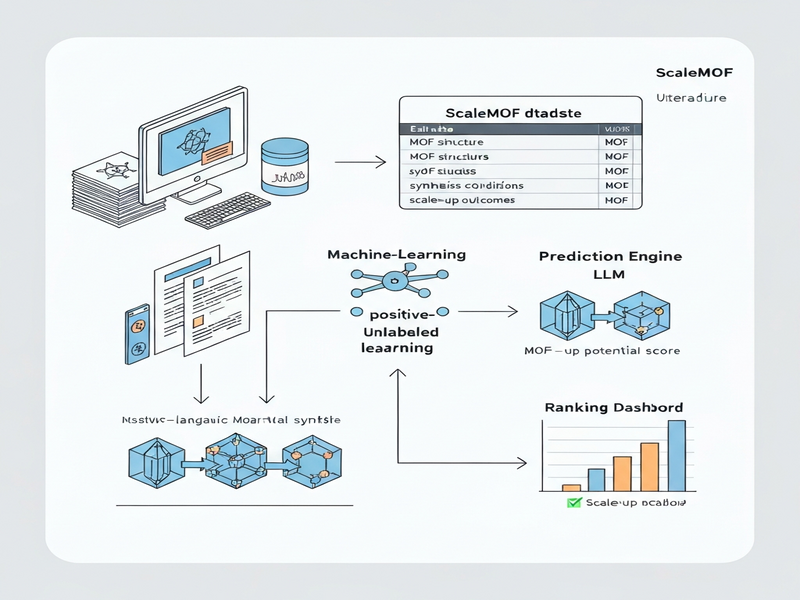
- ScaleMOF Dataset: An automated pipeline scrapes over 12,000 peer‑reviewed MOF synthesis reports, extracts procedural metadata (solvents, temperatures, reaction times, yields), and tags each entry as either “scaled‑up” (positive) or “not reported at scale” (unlabeled). The resulting corpus contains roughly 1,200 confirmed scale‑up cases and 11,000 unlabeled examples.
- Positive‑Unlabeled (PU) Fine‑Tuning: A state‑of‑the‑art LLM (e.g., LLaMA‑2‑13B) is first pre‑trained on the raw text of the dataset, then fine‑tuned using a PU learning objective that treats the unlabeled set as a mixture of hidden positives and true negatives. This strategy lets the model infer latent scale‑up signals without requiring exhaustive negative labeling.
The resulting model, dubbed ScaleMOF‑LLM, outputs a probability score for any new MOF synthesis description, effectively ranking how “scale‑up‑friendly” the protocol appears.
How It Works in Practice
The end‑to‑end workflow can be visualized as a four‑stage pipeline:
| Stage | Key Actions |
|---|---|
| 1. Literature Mining | Automated PDF parsers extract synthesis paragraphs, tables, and footnotes; NLP classifiers tag procedural entities. |
| 2. Positive‑Unlabeled Curation | Domain experts verify a subset of “scaled‑up” entries; the rest remain unlabeled, preserving real‑world ambiguity. |
| 3. Model Fine‑Tuning | The LLM ingests the curated corpus, learns to associate textual cues (e.g., “continuous flow reactor”, “pilot‑scale”) with successful scale‑up. |
| 4. Inference & Ranking | Researchers submit a new synthesis description; the model returns a confidence score, enabling a ranked shortlist of candidates for experimental validation. |
What sets this approach apart is the combination of a domain‑specific, high‑coverage dataset with a learning paradigm that respects the inherent uncertainty of “unlabeled” literature. Traditional supervised classifiers would require explicit negative examples, which are scarce in this niche. By treating the unlabeled pool as a mixture, the model learns a more nuanced decision boundary.
Evaluation & Results
The authors evaluated ScaleMOF‑LLM on three fronts:
- Classification Accuracy: Using a held‑out test set of 300 manually verified entries (150 positives, 150 negatives), the model achieved 93.5 % accuracy, outperforming a baseline BERT‑based classifier (81 %).
- Ranking Quality: In a simulated “candidate‑selection” scenario, the top‑10% of model‑ranked MOFs contained 87 % of the truly scalable candidates, demonstrating strong early‑retrieval performance.
- Interpretability Checks: Attention‑map visualizations revealed that the model consistently highlighted scale‑up‑specific phrases such as “pilot plant”, “continuous flow”, and “scale‑up yield >80 %”.
These results indicate that the model not only distinguishes scalable from non‑scalable protocols but also provides actionable guidance for researchers deciding where to invest experimental resources.
Why This Matters for AI Systems and Agents
From an AI‑systems perspective, ScaleMOF exemplifies how large language models can be repurposed as domain‑specific decision assistants:
- Agent‑Driven Literature Mining: Autonomous agents can continuously ingest new publications, update the ScaleMOF corpus, and keep the model current without human bottlenecks.
- Workflow Orchestration: The ranking output can be fed into a Workflow automation studio to trigger downstream tasks—e.g., automatically generating experimental protocols, allocating lab resources, or notifying procurement teams.
- Risk‑Aware Planning: By quantifying scale‑up confidence, AI planners can allocate budget proportionally, reducing the financial exposure of pilot‑scale trials.
- Cross‑Domain Transfer: The PU learning pipeline is agnostic to chemistry; it can be adapted to other materials domains (e.g., perovskites, polymer electrolytes) where scale‑up data are similarly sparse.
In practice, a company building an Enterprise AI platform by UBOS could embed ScaleMOF‑LLM as a micro‑service, exposing an API that returns scale‑up scores for any user‑submitted synthesis text. This would turn a traditionally manual feasibility assessment into a real‑time, AI‑augmented decision layer.
What Comes Next
While the proof‑of‑concept is compelling, several open challenges remain:
- Data Completeness: The current corpus relies on publicly available papers; many industrial scale‑up reports remain behind paywalls or in internal databases. Partnering with manufacturers could enrich the positive set.
- Granular Process Variables: The model treats the synthesis description as a monolithic text block. Incorporating structured process parameters (e.g., Reynolds number, heat‑transfer coefficients) could improve predictive fidelity.
- Multi‑Objective Optimization: Scale‑up feasibility is only one axis; cost, environmental impact, and regulatory compliance are equally critical. Future work could extend the framework to multi‑criteria ranking.
- Human‑in‑the‑Loop Validation: Deploying the model in a live lab setting will require interfaces that let chemists provide feedback, correct misclassifications, and iteratively refine the model.
Addressing these gaps will likely involve tighter integration with AI‑driven laboratory automation platforms. For example, the AI marketing agents suite already demonstrates how LLMs can orchestrate complex multi‑step workflows; a similar architecture could be repurposed for experimental design loops in materials science.
Finally, the authors have released the ScaleMOF dataset under an open‑access license, inviting the community to benchmark alternative models, explore transfer learning, or combine the data with graph‑based molecular representations for hybrid predictions.
References
Walther, P., Sheng, H., Liu, X., et al. (2026). Predicting Scale‑Up of Metal‑Organic Framework Syntheses with Large Language Models. arXiv preprint arXiv:2604.20899v2.
Andrii Bidochko
CTO UBOS
Andrii Bidochko is an AI entrepreneur and researcher focused on AI agents, reinforcement learning, and autonomous systems. He writes about the technologies shaping the future of machine intelligence, from frontier models and agent architectures to real-world AI applications.