

- Updated: July 1, 2026
- 6 min read
Post-Training Recipe, More Than Model Family, Shapes Multi-Agent LLM Conversational Behavior
Direct Answer
The paper Post‑Training Recipe, More Than Model Family, Shapes Multi‑Agent LLM Conversational Behavior demonstrates that the fine‑tuning and post‑training procedures applied to a language model have a larger impact on its interaction style in multi‑LLM panels than the model’s family label. This matters because system architects can achieve richer, more controllable agent diversity by selecting models based on their training recipes rather than merely mixing different model families.
Background: Why This Problem Is Hard
Multi‑agent conversational systems—where several large language models (LLMs) deliberate, critique, or collaborate—are emerging as the backbone of advanced AI assistants, autonomous research bots, and enterprise decision‑support platforms. The core promise of such systems is behavioral diversity: each agent should bring a distinct reasoning style, risk tolerance, or domain bias, allowing the collective to outperform any single model.
Historically, practitioners have relied on the model family (e.g., Llama, GPT, Claude) as a proxy for diversity. Offline studies showed that when models are asked to rate each other’s outputs in isolation, they tend to favor peers from the same family, suggesting that family‑level differences are the primary source of variance. However, real‑world deployments involve continuous, turn‑based dialogue where models react to each other’s statements, not just static outputs. In this interactive regime, the assumption that family alone predicts diversity has never been rigorously validated.
Compounding the difficulty, LLMs undergo extensive post‑training modifications—instruction fine‑tuning, reinforcement learning from human feedback (RLHF), distillation, and domain‑specific data augmentation. These “recipes” can reshape a model’s confidence calibration, propensity to hedge, or willingness to challenge a partner. Because such changes are often proprietary and undocumented, system designers lack a reliable taxonomy for selecting complementary agents.
What the Researchers Propose
The authors introduce a behavior‑centric framework that treats the post‑training recipe as a first‑class axis for composing multi‑LLM panels. Rather than grouping models solely by family, they categorize each checkpoint by the specific sequence of fine‑tuning steps, data mixes, and runtime constraints applied after the base pre‑training phase.
Key components of the framework include:
- Recipe Metadata Layer: A structured record of every post‑training operation (e.g., “reasoning‑distilled”, “RLHF‑v2”, “instruction‑augmented”).
- Diversity Metric Suite: A set of validated conversational probes—hedging, repair, challenge—that quantify how a model behaves when paired with another.
- Panel Construction Engine: An algorithm that selects checkpoints to maximize metric variance while respecting compute budgets and latency constraints.
By foregrounding the recipe, the framework enables designers to predict and engineer interaction patterns that were previously hidden behind the opaque “family” label.
How It Works in Practice
The practical workflow can be broken down into three stages:
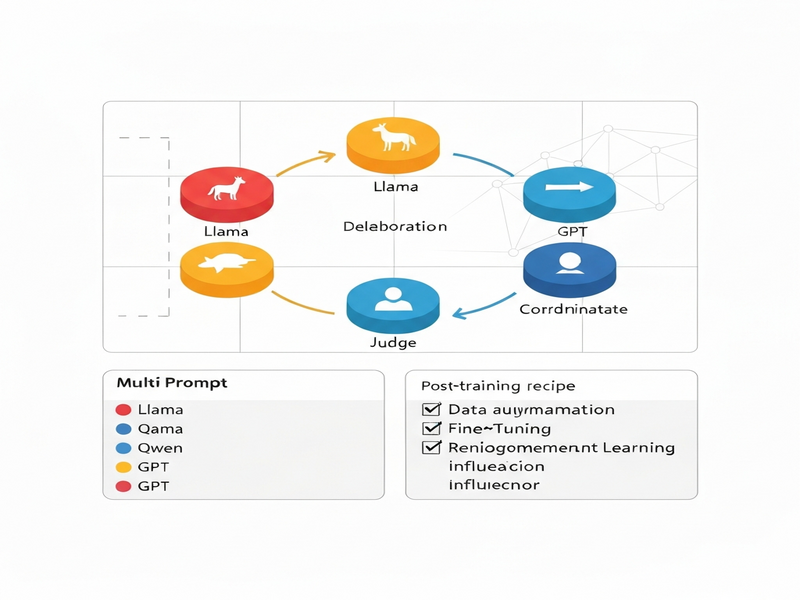
- Recipe Cataloguing: Researchers ingest a large corpus of checkpoints (over 11 Llama checkpoints and 940 k conversational chains) and annotate each with its post‑training steps. This creates a searchable index where “Llama‑7B‑distilled‑reasoning” and “Llama‑7B‑RLHF‑v1” are distinct entries.
- Interactive Pairwise Probing: Using a controlled chat environment, each model is paired with every other model in the index. The system runs a series of prompts designed to surface hedging (expressing uncertainty), repair (correcting a partner’s mistake), and challenge (disagreeing with a partner). The responses are fed to surface‑cue detectors that output a normalized score per metric.
- Panel Optimization: With the metric matrix in hand, a greedy or integer‑programming optimizer selects a subset of models that maximizes the spread across the three metrics while staying within latency budgets. The resulting panel is then deployed in a live multi‑agent system.
What sets this approach apart is the explicit separation of post‑training dynamics from the underlying architecture. Two checkpoints from the same family can behave as divergently as checkpoints from different families if their recipes differ enough.
Evaluation & Results
The authors evaluated the framework on two massive corpora:
- A 940,000‑chain dataset spanning 11 checkpoints across multiple families, each chain representing a full multi‑turn dialogue.
- A 1.6 M‑chain factorial experiment using only Llama base models but varying the post‑training recipe for each participant.
Key findings include:
- Recipe‑Driven Hedging Shift: A reasoning‑distilled Llama checkpoint altered its hedging score by 18 % depending on which same‑base partner it responded to—exceeding the maximum cross‑family hedging gap observed in the broader dataset.
- Cross‑Family vs. Same‑Base Variance: In controlled subsets, the variance introduced by differing recipes within the same base model outperformed the variance between entirely different families for the hedging metric.
- Robustness Checks: Experiments with Qwen, closed‑API models, and runtime latency variations confirmed that the recipe effect persisted beyond a single ecosystem.
- Exploratory Repair & Challenge: While surface‑cue detectors for repair and challenge were less mature, preliminary signals suggested similar recipe‑driven divergences.
Collectively, these results validate the hypothesis that post‑training recipes are a dominant factor shaping conversational behavior in interactive multi‑LLM settings.
Why This Matters for AI Systems and Agents
For practitioners building AI assistants, autonomous agents, or decision‑support panels, the study offers a concrete lever to engineer diversity without incurring the cost of acquiring entirely new model families. By selecting checkpoints with complementary recipes, developers can:
- Increase Robustness: Diverse hedging tendencies reduce the risk of collective over‑confidence, leading to safer recommendations.
- Enhance Creativity: Contrasting challenge styles foster richer brainstorming sessions, useful in product ideation or research assistance.
- Optimize Resource Allocation: Since all models share the same base architecture, they can run on a unified hardware stack, simplifying scaling and monitoring.
- Facilitate Fine‑Grained Evaluation: The metric suite provides actionable diagnostics that can be integrated into continuous‑integration pipelines.
These capabilities align directly with the needs of enterprise‑grade platforms that orchestrate multiple agents. For example, the UBOS platform overview highlights a modular agent orchestration layer that can ingest recipe metadata to auto‑compose panels, while the AI marketing agents product can benefit from hedging diversity to balance bold campaign suggestions with cautious risk assessments.
What Comes Next
Despite the compelling evidence, the research leaves several avenues open:
- Metric Expansion: Current detectors for repair and challenge are nascent. Developing more reliable classifiers will sharpen the granularity of diversity measurement.
- Dynamic Recipe Adaptation: Future systems could adjust a model’s post‑training parameters on‑the‑fly based on real‑time performance, effectively creating “self‑tuning” agents.
- Cross‑Domain Validation: Extending experiments to domains such as legal reasoning, medical triage, or financial forecasting will test the generality of recipe‑driven effects.
- Tooling Integration: Embedding the recipe catalog into existing workflow automation solutions can streamline panel creation for non‑research teams.
Practically, developers can start experimenting by leveraging the Workflow automation studio to script recipe‑aware panel generation, or by connecting to the OpenAI ChatGPT integration to compare proprietary recipes against open‑source checkpoints.
In the longer term, we anticipate a shift in industry best practices: model families will become a baseline, while post‑training recipes will serve as the primary design knob for multi‑agent orchestration. This paradigm promises more predictable, controllable, and ethically aligned AI collaborations.
Andrii Bidochko
CTO UBOS
Andrii Bidochko is an AI entrepreneur and researcher focused on AI agents, reinforcement learning, and autonomous systems. He writes about the technologies shaping the future of machine intelligence, from frontier models and agent architectures to real-world AI applications.