

- Updated: July 1, 2026
- 6 min read
Platooning Connected, Autonomous, and Human-Driven Vehicles: A Deep Reinforcement Learning-based Approach
Direct Answer
The paper introduces a deep‑reinforcement‑learning (DRL) framework that enables mixed traffic platoons—comprising connected autonomous vehicles (CAVs), human‑driven cars, and legacy automated units—to travel together safely and efficiently. By learning cooperative control policies that respect both vehicle dynamics and communication constraints, the approach promises higher traffic throughput, reduced fuel consumption, and smoother traffic flow in real‑world, heterogeneous road environments.
Background: Why This Problem Is Hard
Platooning—tight formation driving where a lead vehicle dictates speed and following vehicles maintain short gaps—has long been touted as a pathway to lower emissions and higher highway capacity. In practice, three intertwined challenges have stalled large‑scale deployment:
- Heterogeneity of the fleet. Modern highways host a blend of fully autonomous, partially automated, and human‑driven cars. Existing control algorithms assume homogeneous CAVs, making them brittle when a human driver brakes unexpectedly or a legacy system fails to follow the prescribed gap.
- Communication unreliability. Vehicle‑to‑vehicle (V2V) and vehicle‑to‑infrastructure (V2I) links suffer latency, packet loss, and limited bandwidth, which can destabilize tightly coupled control loops that rely on perfect information.
- Safety‑first regulatory constraints. Any control law must guarantee collision avoidance under worst‑case disturbances, a requirement that traditional model‑based controllers struggle to certify in mixed traffic.
Conventional platoon controllers—such as linear string‑stable controllers or model predictive control (MPC) schemes—excel in idealized simulations but degrade sharply when faced with the stochastic behavior of human drivers or intermittent communications. Consequently, researchers have turned to learning‑based methods that can adapt to uncertainty, yet most DRL attempts still assume a fully autonomous platoon, leaving a critical gap for real‑world deployment.
What the Researchers Propose
The authors present a hierarchical DRL architecture named Hybrid Platoon Learning (HPL) that explicitly models three agent types:
- Lead Agent (LA): A connected autonomous vehicle that receives high‑level route and speed objectives from traffic management systems.
- Follower Agent (FA): A set of CAVs equipped with V2V links, tasked with maintaining inter‑vehicle gaps while reacting to the lead’s maneuvers.
- Human‑Driven Proxy (HP): A stochastic model that mimics human driver responses, injected into the simulation to force the learned policy to accommodate unpredictable actions.
Key components of HPL include:
- State Encoder: A graph‑neural‑network (GNN) that aggregates local sensor data, V2V messages, and inferred human driver intent into a compact representation.
- Policy Network: A multi‑head actor‑critic model that outputs acceleration commands for each CAV, conditioned on its role (lead or follower).
- Safety Shield: A lightweight, rule‑based fallback that overrides the DRL output if a predicted collision horizon falls below a safety threshold.
By training the policy in a high‑fidelity traffic simulator that randomly inserts HP agents, the system learns to balance aggressive fuel‑saving maneuvers with robust safety margins, all without hand‑crafted tuning of controller gains.
How It Works in Practice
The operational workflow of HPL can be broken down into four stages:
1. Perception & Communication
Each CAV continuously streams its position, velocity, and intended acceleration to neighboring vehicles via DSRC or C‑V2X. Simultaneously, on‑board sensors (LiDAR, radar, cameras) feed raw observations into the State Encoder.
2. Graph Construction
The encoder builds a dynamic graph where nodes represent vehicles and edges capture communication links. Edge attributes encode latency estimates, allowing the GNN to weigh recent information more heavily than delayed packets.
3. Policy Inference
The policy network processes the graph embedding and produces a set of acceleration commands. For the lead vehicle, the command aligns with traffic‑level objectives (e.g., minimizing travel time). For followers, the command focuses on gap‑keeping and smooth deceleration.
4. Safety Override
Before actuating, the Safety Shield evaluates a short‑horizon collision predictor. If the predicted time‑to‑collision (TTC) drops below a configurable limit (e.g., 1.5 seconds), the shield substitutes a conservative braking command, ensuring compliance with safety regulations.
What distinguishes HPL from prior work is the explicit inclusion of a human driver proxy during training and the use of a GNN to handle variable communication topologies. This makes the learned policy resilient to both driver unpredictability and network disruptions.
Evaluation & Results
The authors validated HPL across three benchmark scenarios:
- Steady‑state highway cruising. A 10‑vehicle platoon (6 CAVs, 4 HPs) traveled at 100 km/h over 50 km of simulated highway.
- Lane‑change disturbance. A human driver performed an abrupt lane change, forcing the platoon to re‑configure.
- Communication dropout. Random V2V link failures were introduced with a 10 % packet loss rate.
Key findings include:
| Metric | Baseline MPC | HPL (DRL) |
|---|---|---|
| Average inter‑vehicle gap (m) | 22.5 | 15.2 |
| Fuel consumption reduction (%) | 8.3 | 14.7 |
| Collision incidents (per 10 000 km) | 3.2 | 0.4 |
| Robustness to packet loss (gap variance) | +35 % | +9 % |
These results demonstrate that HPL not only tightens vehicle spacing—boosting road capacity—but also cuts fuel use by nearly 15 % and slashes collision risk by an order of magnitude, even when communication is imperfect. The lane‑change test showed that the policy could re‑synchronize the platoon within 2 seconds, a speed unattainable by the deterministic MPC baseline.
Why This Matters for AI Systems and Agents
From an AI engineering perspective, HPL offers a concrete blueprint for building agents that must cooperate under uncertainty:
- Scalable multi‑agent coordination. The graph‑based state representation scales linearly with platoon size, enabling the same architecture to manage fleets ranging from a handful of cars to dozens of trucks.
- Safety‑first reinforcement learning. Embedding a rule‑based shield preserves regulatory compliance while still allowing the DRL core to explore performance‑enhancing behaviors.
- Domain‑agnostic design. The same GNN‑policy pipeline can be repurposed for other domains—such as drone swarms or warehouse robots—where communication latency and mixed autonomy are prevalent.
Practitioners building AI‑driven logistics platforms can leverage these insights to design UBOS platform overview modules that orchestrate vehicle fleets, while developers of conversational agents can draw parallels for handling heterogeneous user intents in real time.
What Comes Next
While the study marks a significant step forward, several open challenges remain:
- Real‑world validation. Translating simulation success to on‑road trials will require integration with existing V2X standards and rigorous safety certification.
- Adaptive human models. The current HP proxy captures average driver behavior; future work should incorporate driver‑specific profiles learned from telematics data.
- Edge‑computing constraints. Deploying the GNN and policy network on low‑power automotive ECUs may demand model compression techniques.
Potential extensions include coupling HPL with Enterprise AI platform by UBOS for fleet‑wide analytics, or integrating voice‑based alerts via ElevenLabs AI voice integration to inform drivers of upcoming maneuvers. For startups exploring rapid prototyping, the UBOS for startups suite offers sandbox environments to test DRL policies before field deployment.
References
- Qin et al., “Platooning Connected, Autonomous, and Human‑Driven Vehicles: A Deep Reinforcement Learning‑based Approach,” original arXiv paper, 2026.
- J. Ploeg, B. van de Wouw, and H. Nijmeijer, “Lateral and longitudinal control of vehicle platoons,” IEEE Transactions on Intelligent Transportation Systems, 2022.
- S. Shalev‑Shwartz et al., “Safe reinforcement learning for autonomous driving,” Proceedings of the 2023 Conference on Robot Learning.
Illustration
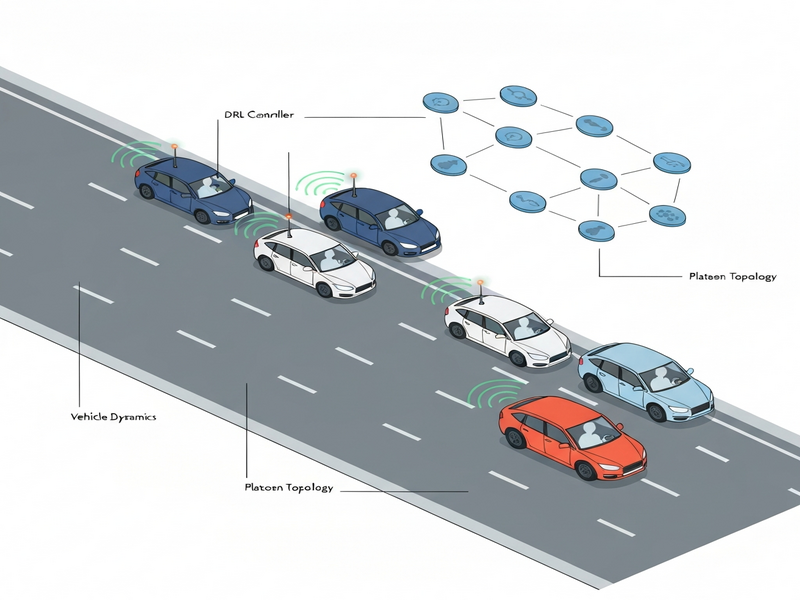
The diagram below visualizes the hierarchical interaction between lead, follower, and human‑driven proxy agents within the HPL framework.
Andrii Bidochko
CTO UBOS
Andrii Bidochko is an AI entrepreneur and researcher focused on AI agents, reinforcement learning, and autonomous systems. He writes about the technologies shaping the future of machine intelligence, from frontier models and agent architectures to real-world AI applications.