

- Updated: June 29, 2026
- 7 min read
Plans Don’t Persist: Why Context Management Is Load Bearing for LLM Agents
Direct Answer
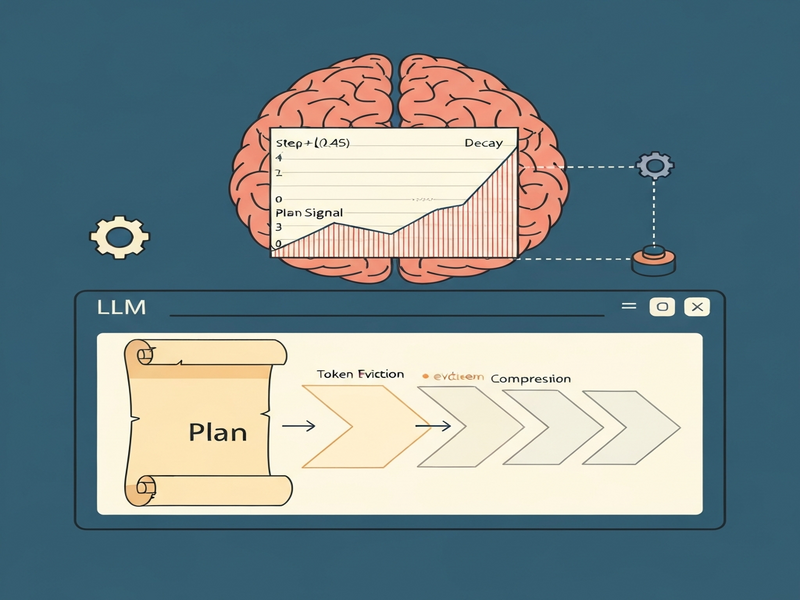
The paper Plans Don’t Persist: Why Context Management Is Load Bearing for LLM Agents shows that large‑language‑model (LLM) agents do not retain their high‑level plans as internal state; instead they rely on the plan staying in the prompt context. When the plan is evicted by a context‑compression routine, the agent’s hidden state quickly forgets the plan, causing a sharp drop in performance on long‑horizon tasks.
Background: Why This Problem Is Hard
LLM agents are increasingly used for multi‑step reasoning, autonomous tool use, and interactive simulations. Unlike single‑turn chat, these agents must remember goals, sub‑tasks, and constraints across dozens or hundreds of inference steps. The underlying transformer architecture, however, has a fixed token window (often 4‑8 k tokens). To keep operating beyond that window, systems employ context management—compressing, summarizing, or discarding older tokens.
Existing pipelines assume that once a piece of information is removed from the prompt, the model has already internalized it in its hidden state. This assumption works for transient facts (e.g., “the user said X”) but breaks down for plans—structured sequences of actions generated early in a trajectory and referenced repeatedly later. Because plans are large, they are among the first candidates for eviction, creating a “stress case” for context management.
Current mitigation strategies—such as periodic summarization or embedding plans into a vector store—lack rigorous measurement. Without a diagnostic that isolates plan retention, developers cannot tell whether a drop in success is due to poor planning logic or simply because the plan vanished from the prompt.
What the Researchers Propose
Mehta and Datta introduce a two‑part framework designed to expose and quantify plan persistence in LLM agents:
- Replay Pairing Diagnostic: Run the exact same trajectory twice—once with the original plan kept in the context (the “full” run) and once with the plan removed from the context (the “stripped” run). By comparing the cosine distance between hidden states at each step, the method measures how much the model’s internal representation depends on the plan’s presence.
- Layer‑wise Probing: Train a lightweight classifier (a “probe”) on hidden states from a specific transformer layer (L32 in Llama‑3.1‑70B) to predict whether the current step follows a plan‑containing or plan‑stripped trajectory. The probe acts as a diagnostic that flags when plan information has decayed.
The framework also identifies a confounding factor they call the reasoning‑trace confound. When agents generate explicit “<think>” blocks, those blocks re‑derive plan content, unintentionally leaking plan information into the stripped run. The authors fix this by strictly stripping all prior <think> blocks, ensuring a clean comparison.
How It Works in Practice
The workflow can be visualized as a four‑stage pipeline:
- Plan Generation: The agent receives a high‑level goal and produces a textual plan (e.g., “1. locate the key, 2. unlock the door, 3. retrieve the artifact”). This plan is appended to the prompt context.
- Execution Loop: For each environment step, the agent receives the latest observation, appends it to the context, and generates an action. The context grows until it reaches the model’s token limit.
- Context Management: When the token window is exceeded, a compression policy evicts older tokens—often the earliest plan sentences.
- Replay Pairing & Probing: The same execution trace is replayed with the plan removed after eviction. Hidden‑state vectors from layer L32 are extracted for both runs, and the cosine distance is computed. A trained probe then classifies each step as “plan‑present” or “plan‑absent.”
What makes this approach distinct is the strict isolation of plan information. By controlling for reasoning traces and using a layer‑specific probe, the authors can attribute performance drops directly to plan loss rather than to other sources of noise.
Evaluation & Results
The authors evaluate on two fronts:
Plan‑Decay Measurement
- On Llama‑3.1‑70B, the cosine distance spikes to 0.453 one step after the plan appears, indicating a strong plan signal.
- After a single action‑observation step, the signal collapses by a factor of 4.1, showing rapid decay.
- In the HotpotQA benchmark, the decay is even steeper—12.4× reduction after one step.
Reasoning‑Trace Confound Fix
When the strict stripping procedure is applied, the step‑+1 signal recovers by 163 % on in‑sample data and 153 % on held‑out data, while non‑reasoning models (plain Llama) see only a modest 4.8 % change. This demonstrates that the confound was inflating apparent plan retention.
Probe Transferability
- A probe trained on Llama‑3.1 transfers to DeepSeek‑R1‑Distill‑Llama‑70B with AUROC 0.748 (p = 6e‑4), confirming that plan‑related hidden‑state patterns are not model‑specific.
- R1‑specific probes achieve perfect AUROC = 1.000, suggesting that DeepSeek encodes plan information along a different hidden‑state direction.
Compression Stress Test
In the ALFWorld environment (a simulated household task suite), naïvely evicting the plan reduces success rate by 34.7 percentage points. A “probe‑gated re‑surfacing” strategy—where the probe signals when the plan signal is fading and the system re‑injects the plan—recovers the lost performance, confirming the practical cost of plan loss.
Why This Matters for AI Systems and Agents
Understanding plan decay reshapes how engineers design long‑horizon agents:
- Reliability: Agents that silently forget their own plans can produce erratic or unsafe actions, especially in critical domains like robotics or finance.
- Prompt Engineering: Simply appending a plan to the prompt is insufficient; developers must implement safeguards—such as periodic re‑prompting or external memory stores—to keep the plan alive.
- Evaluation Standards: Benchmarks that ignore context‑management policies may overestimate an agent’s true capability. The replay‑pairing diagnostic offers a reproducible way to audit plan persistence.
- System Architecture: The findings encourage hybrid designs where a lightweight planner module maintains a persistent plan representation (e.g., in a vector database) and feeds it back into the prompt as needed.
For organizations building enterprise‑grade AI assistants, these insights translate into concrete product decisions. For example, the UBOS platform overview already supports modular workflow orchestration, allowing a dedicated planning service to store and re‑inject plans on demand, thereby mitigating the decay problem identified in this research.
What Comes Next
While the paper establishes that plans are not inherently persistent, several open challenges remain:
- Memory‑Augmented Architectures: Future work could explore transformer variants with built‑in external memory slots that explicitly encode plans, reducing reliance on prompt length.
- Adaptive Compression Policies: Instead of static token eviction, agents could learn to prioritize plan tokens based on probe‑derived importance scores.
- Cross‑Model Generalization: Extending the probe methodology to multimodal agents (vision‑language) will test whether plan decay behaves similarly when visual context is involved.
- User‑Facing Tooling: Providing developers with out‑of‑the‑box diagnostics—similar to the replay‑pairing tool—could become a standard feature in AI development platforms.
Addressing these directions will likely involve tighter integration between LLM back‑ends and dedicated planning modules. Companies that embed such capabilities into their AI stacks can differentiate themselves by offering agents that truly “remember” their objectives over long horizons. The AI marketing agents product line, for instance, is experimenting with persistent campaign plans that survive context compression, directly applying the paper’s recommendations.
Conclusion
The study by Mehta and Datta provides the first systematic evidence that LLM agents treat plans as transient context rather than durable internal state. Their replay‑pairing diagnostic and layer‑wise probing reveal rapid plan decay, a reasoning‑trace confound, and the practical performance penalty of naïve context eviction. For practitioners, the takeaway is clear: robust long‑horizon agents must incorporate explicit plan‑preservation mechanisms, whether through external memory, adaptive compression, or periodic re‑prompting. As the field moves toward more autonomous AI systems, ensuring that high‑level intent survives the token window will be a cornerstone of reliable, trustworthy agents.
Andrii Bidochko
CTO UBOS
Andrii Bidochko is an AI entrepreneur and researcher focused on AI agents, reinforcement learning, and autonomous systems. He writes about the technologies shaping the future of machine intelligence, from frontier models and agent architectures to real-world AI applications.