

- Updated: July 1, 2026
- 7 min read
Physical-AI: From Channel Awareness to Environmental Intelligence in 6G Wireless Networks
Direct Answer
The paper introduces Physical‑AI, a novel 6G network architecture that transforms raw radio signals into a shared, latent representation of the physical environment, enabling proactive, context‑aware control of wireless resources. By embedding sensing, world modeling, and decision‑making into a closed loop, Physical‑AI promises to cut outage rates and latency in dynamic, blockage‑prone scenarios.
Background: Why This Problem Is Hard
Current cellular systems—4G, 5G, and early 6G prototypes—rely heavily on instantaneous channel state information (CSI). CSI is a snapshot of the radio channel at a given moment, derived from pilot signals and fed back to the base station. While CSI enables adaptive modulation and beamforming, it treats the environment as a black box. The network reacts to fading, blockage, or interference only after they have manifested, which leads to several practical bottlenecks:
- Blockage blind spots: Urban canyons, moving vehicles, and human bodies can abruptly attenuate millimeter‑wave beams, causing sudden outages.
- Mobility churn: High‑speed users (e.g., drones, autonomous cars) generate rapid channel variations that outpace CSI acquisition cycles.
- Inter‑cell interference: Dense deployments create overlapping beams; without a holistic view of the environment, interference mitigation remains reactive.
- Latency constraints: Beam‑switching and handover procedures incur delays that grow with the number of candidate beams, especially in massive MIMO arrays.
Integrated Sensing and Communication (ISAC) attempts to address these issues by reusing communication waveforms for sensing. However, ISAC typically stops at raw point‑cloud or radar‑like measurements; it does not construct an explicit, predictive model of the environment nor does it close the loop with intelligent control actions. Consequently, ISAC‑enabled networks still lack the foresight needed for truly proactive resource management.
What the Researchers Propose
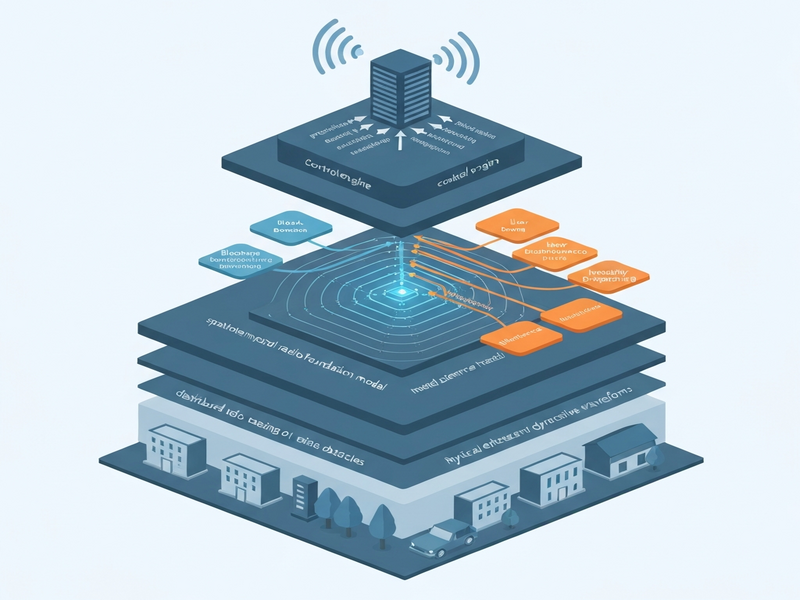
Physical‑AI reframes the wireless stack as a perception‑action system, akin to an autonomous robot that senses, reasons, and acts. The core idea is to train a self‑supervised spatiotemporal radio foundation model that ingests distributed radio observations (e.g., received signal strength, angle‑of‑arrival, delay profiles) from many base stations and user equipment. This model learns a compact latent space that implicitly encodes:
- Physical blockages (walls, vehicles, foliage)
- User distribution and mobility trajectories
- Interference topology across cells
- Temporal dynamics of the propagation environment
On top of this shared representation, the framework attaches multiple inference heads, each specialized for a particular environmental property. A downstream neural decision layer consumes the concatenated outputs and produces proactive control commands—such as beam‑selection, power allocation, or handover timing—before the adverse event materializes.
How It Works in Practice
The Physical‑AI workflow can be broken down into four logical stages, each mapped to a concrete network function:
1. Radio‑Based Sensing and Data Collection
Every transmission carries a lightweight sensing tag (e.g., pilot sub‑carriers with known phase patterns). Base stations and user devices continuously log raw measurements: RSSI, channel impulse responses, Doppler shifts, and spatial angles. These observations are timestamped and geo‑tagged, forming a massive, distributed dataset.
2. Self‑Supervised Radio Foundation Model
The collected data feed a transformer‑style foundation model that learns to predict missing measurements across space and time. Because the training objective is self‑supervised (e.g., mask‑and‑reconstruct), no manual labeling is required. The model’s latent vectors become a “digital twin” of the radio environment, continuously updated as new measurements arrive.
3. Inference Heads for Environmental Properties
Specialized heads branch off the latent space:
- Blockage head: predicts the probability of line‑of‑sight loss for any candidate beam.
- Mobility head: forecasts user trajectories and speed vectors for the next few milliseconds.
- Interference head: estimates the spatial interference map across neighboring cells.
- Load head: anticipates traffic demand spikes based on historical patterns.
4. Decision Layer and Proactive Control
The decision layer fuses the head outputs with operator policies (e.g., QoS targets, energy budgets) and emits control actions:
- Pre‑emptive beam switching to a less‑blocked direction.
- Dynamic power scaling to mitigate predicted interference.
- Early handover triggers for fast‑moving users.
- Adaptive scheduling windows that align with predicted traffic bursts.
This closed‑loop pipeline runs at sub‑millisecond cadence, allowing the network to “stay ahead” of the environment rather than merely reacting.
Evaluation & Results
The authors validated Physical‑AI through a high‑fidelity 6G simulator that models urban micro‑cells, vehicular traffic, and millimeter‑wave propagation. Three benchmark scenarios were examined:
- Blockage‑heavy downtown: Randomly moving buses and trucks create frequent line‑of‑sight occlusions.
- High‑mobility corridor: Users travel at 120 km/h along a highway, demanding rapid beam updates.
- Dense small‑cell mesh: Overlapping beams generate complex interference patterns.
Key findings include:
- Outage probability reduction: Physical‑AI lowered the 5‑percentile outage rate by up to 38 % compared to a CSI‑only baseline.
- Latency improvement: The average beam‑switching delay dropped from 12 ms to 6 ms, thanks to predictive beam selection.
- Interference mitigation: Predicted interference maps enabled a 22 % gain in spectral efficiency under dense deployment.
- Scalability: The foundation model maintained performance when the number of sensing nodes doubled, demonstrating robustness to network scale‑up.
These results illustrate that a unified perception‑action loop can translate raw radio data into tangible network gains, especially in the most challenging 6G use cases.
Why This Matters for AI Systems and Agents
Physical‑AI bridges the gap between traditional wireless engineering and modern AI‑driven decision making. For AI practitioners building autonomous agents—whether they orchestrate edge compute, manage IoT fleets, or power digital twins—the framework offers a concrete example of how to embed environmental intelligence directly into the control loop. The implications are threefold:
- Richer state representations: Agents can consume the latent environmental vectors as high‑level observations, reducing the need for handcrafted feature extraction.
- Proactive policy learning: Reinforcement‑learning agents can be trained on the decision layer’s outputs, accelerating convergence because the environment model already predicts future states.
- Cross‑domain orchestration: The same latent space can feed other AI services—such as predictive maintenance or context‑aware content delivery—creating a unified data fabric across the network.
Enterprises looking to operationalize such capabilities can start with the UBOS platform overview, which provides modular AI pipelines that ingest sensor streams and expose latent embeddings for downstream agents. For marketing‑focused deployments, the AI marketing agents can leverage the same perception stack to adapt campaigns based on real‑time connectivity quality. Finally, the Workflow automation studio lets engineers stitch together custom decision logic without writing low‑level code, accelerating prototyping of Physical‑AI‑style control loops.
What Comes Next
While the simulation results are promising, several open challenges remain before Physical‑AI can be deployed at scale:
- Real‑world data acquisition: Gathering high‑quality, synchronized radio measurements across heterogeneous hardware is non‑trivial.
- Model interpretability: Operators need confidence that the latent representation aligns with physical reality, especially for safety‑critical applications.
- Privacy and security: Embedding sensing data into a shared model raises concerns about user location leakage.
- Standardization: Industry consensus on data formats, signaling extensions, and model exchange will be required for multi‑vendor interoperability.
Future research directions include:
- Integrating visual or LiDAR data from edge cameras to enrich the radio‑based world model.
- Exploring federated learning approaches that keep raw measurements on‑device while still updating the global foundation model.
- Developing formal verification tools that certify the decision layer’s safety under worst‑case blockage scenarios.
Startups and innovators can experiment with these ideas using the UBOS for startups sandbox, which offers pre‑configured radio‑sensing pipelines and low‑latency inference services. Larger enterprises may consider the Enterprise AI platform by UBOS to integrate Physical‑AI components into existing OSS/BSS stacks, ensuring seamless rollout across nationwide deployments.
References
Physical‑AI: From Channel Awareness to Environmental Intelligence in 6G Wireless Networks (arXiv)
Andrii Bidochko
CTO UBOS
Andrii Bidochko is an AI entrepreneur and researcher focused on AI agents, reinforcement learning, and autonomous systems. He writes about the technologies shaping the future of machine intelligence, from frontier models and agent architectures to real-world AI applications.