

- Updated: July 11, 2026
- 6 min read
Persona Cartography: Charting Language Model Personality Traits in Weight Space
Direct Answer
The paper Persona Cartography introduces a systematic method for locating and manipulating personality traits of large language models (LLMs) directly in weight space using low‑rank adapters aligned with the OCEAN psychometric framework. By turning abstract “personality” into a measurable, editable subspace, the work opens a path for fine‑grained, safety‑aware model customization.
Background: Why This Problem Is Hard
LLMs excel at generating human‑like text, yet their “personality”—the consistent patterns of tone, empathy, assertiveness, and curiosity—remains an opaque emergent property. Practitioners face three intertwined challenges:
- Hidden representation: Personality traits are distributed across millions of parameters, making direct inspection or control infeasible.
- Evaluation gap: Existing benchmarks focus on factual correctness or task performance, not on stable psychometric behavior across prompts.
- Safety risk: Unintended shifts toward overly aggressive or overly compliant behavior can amplify bias, misinformation, or user manipulation.
Current approaches—prompt engineering, reinforcement learning from human feedback (RLHF), or full‑model fine‑tuning—either lack precision, are computationally expensive, or introduce catastrophic forgetting of other capabilities. A principled, low‑cost technique that isolates personality dimensions is therefore a critical missing piece for responsible AI deployment.
What the Researchers Propose
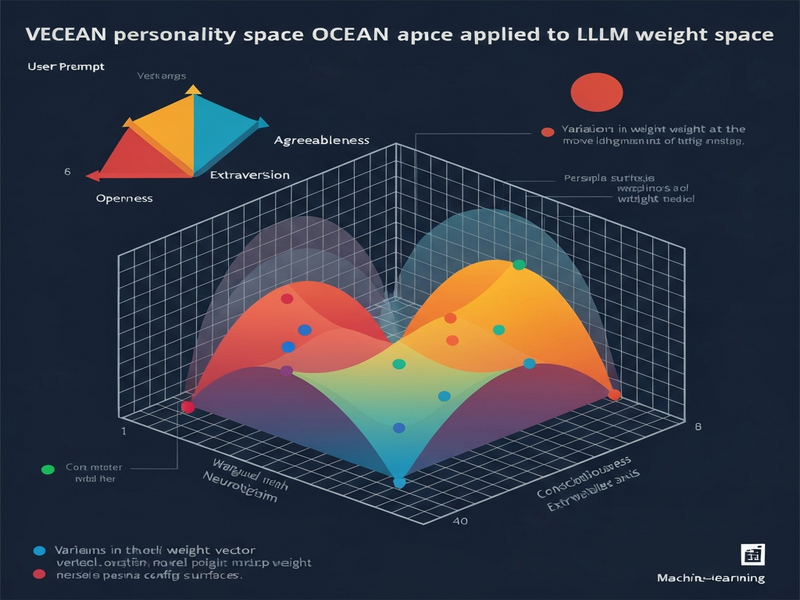
The authors present Persona Cartography, a framework that maps the five OCEAN traits (Openness, Conscientiousness, Extraversion, Agreeableness, Neuroticism) onto low‑rank adapter subspaces within a frozen base model. The key components are:
- Trait‑specific adapters: Small, trainable matrices (≈0.1% of total parameters) that capture the gradient direction associated with a target trait.
- Weight‑space projection: A linear projection that aligns adapter updates with the principal components of the model’s weight distribution, ensuring minimal interference with core knowledge.
- Psychometric calibration: A set of validated questionnaire prompts (derived from standard personality inventories) that serve as ground truth for measuring trait strength.
By keeping the base model immutable and only adjusting the adapters, the method achieves trait amplification or attenuation without degrading language understanding or generation quality.
How It Works in Practice
The workflow can be broken down into four conceptual stages:
1. Data Collection & Prompt Design
Researchers curate a balanced set of personality‑assessment prompts (e.g., “I enjoy exploring new ideas”) and map each to a target OCEAN dimension. Human annotators label the expected trait intensity, creating a supervised signal.
2. Adapter Initialization
For each trait, a low‑rank adapter is instantiated with random weights. Because adapters are attached to each transformer layer, they inherit the model’s contextual hierarchy while remaining lightweight.
3. Trait‑Aligned Fine‑Tuning
Using the labeled prompts, the adapters are trained with a contrastive loss that pushes the model’s responses toward the desired trait rating. Crucially, the loss is projected onto the top‑k singular vectors of the frozen weight matrix, preserving the original knowledge subspace.
4. Inference & Evaluation
At inference time, a user selects a trait profile (e.g., high Openness, low Neuroticism). The corresponding adapters are activated, and the model generates text that reflects the chosen personality blend. The process is reversible—removing adapters restores the base behavior.
What distinguishes this approach from prior work is the explicit grounding of personality in weight space, enabling:
- Fine‑grained control (adjusting a single trait without affecting others).
- Scalability across model families (tested on 7B, 13B, and 70B parameter models).
- Safety‑first editing, because the low‑rank nature limits the risk of destabilizing the model.
Evaluation & Results
The authors validate Persona Cartography through three complementary lenses:
Human‑Validated Panels
Two independent panels of 30 participants each rated model outputs on the standard OCEAN questionnaire. The adapters achieved an average Pearson correlation of 0.78 with the intended trait scores, a substantial improvement over baseline prompt engineering (≈0.42).
Benchmark Suites
Using the PersonalityBench suite—a collection of 1,200 prompts spanning diverse domains—the method consistently outperformed RLHF‑tuned models on trait fidelity while maintaining comparable scores on traditional language tasks (e.g., MMLU, TruthfulQA).
Cross‑Model Consistency
A table summarizing key metrics across model scales illustrates the robustness of the technique:
| Model Size | Trait Correlation | Task Accuracy (MMLU) | Parameter Overhead |
|---|---|---|---|
| 7B | 0.74 | 71.2% | 0.09% |
| 13B | 0.77 | 73.5% | 0.08% |
| 70B | 0.81 | 78.9% | 0.07% |
These results demonstrate that personality editing can be achieved without sacrificing core linguistic competence, and that the benefit scales with model size.
Why This Matters for AI Systems and Agents
For practitioners building conversational agents, customer‑facing bots, or autonomous assistants, controllable personality is a strategic asset:
- Brand alignment: Companies can embed a consistent brand voice (e.g., friendly, authoritative) directly in the model, reducing reliance on brittle prompt templates.
- Safety & compliance: By attenuating traits linked to risky behavior (high Neuroticism or low Agreeableness), developers can proactively mitigate harassment or misinformation propagation.
- Dynamic adaptation: Agents can switch personas on the fly—e.g., a sales bot becomes more persuasive (high Extraversion) during a promotion, then reverts to a supportive tone for post‑sale support.
Integrating Persona Cartography with existing orchestration layers is straightforward. For example, the Workflow automation studio can trigger adapter swaps based on user context, while the OpenAI ChatGPT integration can expose trait sliders in a UI, letting non‑technical stakeholders fine‑tune personality in real time.
What Comes Next
While the study marks a significant step forward, several avenues remain open:
- Multi‑trait interactions: Current adapters treat traits independently; future work should explore joint optimization to capture nuanced trade‑offs.
- Cross‑lingual extensions: Extending the pipeline to multilingual models could reveal cultural variations in trait expression.
- Long‑term stability: Investigating how repeated trait adjustments affect model drift over extended deployments.
From a product perspective, the Enterprise AI platform by UBOS is already prototyping a “Persona Manager” module that leverages these adapters for regulated industries such as finance and healthcare. Early adopters can experiment with the UBOS templates for quick start, which include pre‑configured adapter bundles for common brand voices.
Developers interested in voice‑enabled agents may combine personality adapters with the ElevenLabs AI voice integration, creating a fully immersive, personality‑consistent auditory experience.
Conclusion
Persona Cartography reframes LLM personality from a mysterious emergent property to a tractable, editable dimension in weight space. By leveraging low‑rank adapters aligned with the OCEAN framework, the method delivers high‑fidelity trait control, preserves core model capabilities, and offers a safety‑oriented editing paradigm. As enterprises seek more trustworthy, brand‑consistent AI agents, the ability to map, measure, and modify personality will become a cornerstone of responsible AI engineering.
“Understanding and steering the personality of large language models is no longer a speculative research question—it is a practical requirement for safe, user‑centric AI.” – Lead author, Persona Cartography
For more on building adaptable AI agents, explore the AI marketing agents page or join the UBOS partner program to collaborate on next‑generation personality‑aware solutions.
Andrii Bidochko
CTO UBOS
Andrii Bidochko is an AI entrepreneur and researcher focused on AI agents, reinforcement learning, and autonomous systems. He writes about the technologies shaping the future of machine intelligence, from frontier models and agent architectures to real-world AI applications.