

- Updated: June 21, 2026
- 7 min read
Performance and Explainability Requirements of Evolutionary Algorithms in Real-World Physics-Informed Optimization
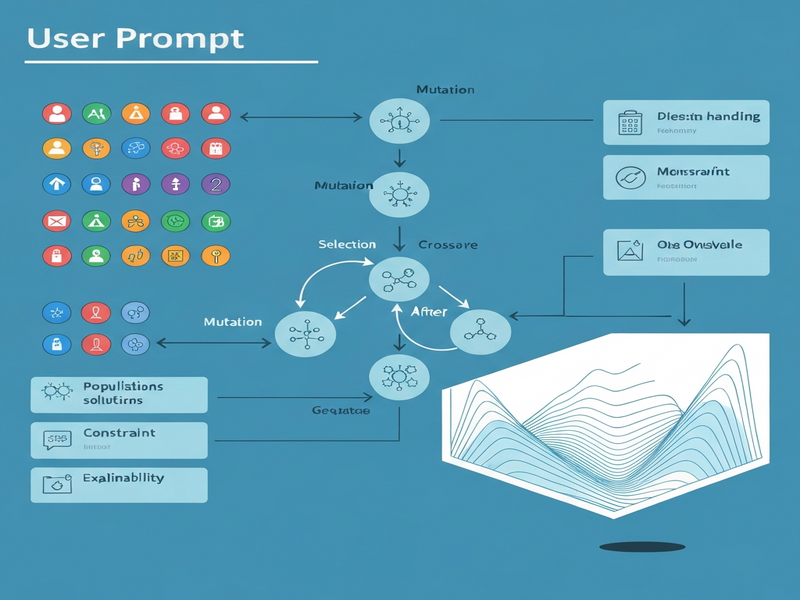
Evolutionary algorithms (EAs) can meet real‑world physics‑informed optimization demands when they are engineered for high computational performance **and** transparent, explainable decision pathways.
1. Introduction
Researchers and engineers increasingly rely on physics‑informed optimization to solve problems where domain laws (e.g., conservation of energy, fluid dynamics) must be respected. Traditional gradient‑based solvers excel on smooth, differentiable landscapes, but many physical systems present discontinuities, multi‑modalities, or stochastic constraints that render classic methods ineffective. Evolutionary algorithms—genetic algorithms, differential evolution, particle swarm optimization, and their hybrids—offer a population‑based, derivative‑free alternative that can explore rugged search spaces.
However, the adoption of EAs in safety‑critical or high‑stakes environments (aerospace design, nuclear reactor control, climate‑model calibration) hinges on two non‑negotiable criteria:
- Performance: deterministic runtime, scalability on modern hardware, and reproducibility.
- Explainability: the ability to trace why a particular genotype was selected, how physical constraints were satisfied, and what trade‑offs were made.
In this guide we dissect those requirements, map them to the expectations of domain experts, and highlight emerging techniques that bridge the gap between raw computational intelligence and trustworthy AI.
2. Importance of Performance and Explainability
Performance and explainability are not merely nice‑to‑have attributes; they are strategic levers that determine whether an EA solution can be deployed in production.
2.1 Performance as a Business Enabler
High‑performance EAs reduce time‑to‑solution, enabling rapid prototyping and iterative design cycles. In a Enterprise AI platform by UBOS, for instance, parallel evaluation of candidate solutions across a Kubernetes cluster can shrink a 48‑hour simulation to under an hour, directly impacting ROI.
Key performance metrics include:
- Computational throughput (evaluations per second)
- Memory footprint per individual
- Scalability on GPU/TPU accelerators
- Deterministic reproducibility across runs
2.2 Explainability as Trust Builder
Explainability satisfies regulatory compliance (e.g., ISO 26262 for automotive) and builds stakeholder confidence. When an EA proposes a new wing shape for a jet, engineers must understand which aerodynamic constraints drove the selection and how the algorithm balanced lift versus drag.
Explainable EA frameworks typically provide:
- Feature importance heatmaps for genotype‑phenotype mappings
- Evolutionary trace logs that can be replayed step‑by‑step
- Constraint‑violation dashboards that highlight physics‑law breaches
- Post‑hoc surrogate models (e.g., Gaussian processes) that approximate the fitness landscape for human inspection
3. Real‑World Physics‑Based Optimization Problems
Below are representative domains where physics‑informed EAs have demonstrated impact:
| Domain | Typical Objective | Key Physical Constraints |
|---|---|---|
| Aerospace structural design | Minimize weight while maximizing stiffness | Stress limits, buckling criteria, material anisotropy |
| Renewable energy grid layout | Maximize energy capture, minimize losses | Power flow equations, voltage stability |
| Computational fluid dynamics (CFD) shape optimization | Reduce drag coefficient | Navier‑Stokes continuity, turbulence models |
| Materials discovery | Maximize band‑gap, minimize synthesis cost | Thermodynamic stability, crystal symmetry |
These problems share a common pattern: a high‑dimensional design space, expensive simulation‑based fitness evaluation, and hard constraints derived from physics.
4. Requirements from Domain Experts
Domain experts—physicists, mechanical engineers, climate scientists—express their needs in three distinct categories:
4.1 Accuracy & Fidelity
Solutions must respect governing equations to within tolerances that are scientifically meaningful (e.g., <0.5 % error on pressure fields). This often forces the EA to embed a physics‑based penalty function or to use surrogate models that are themselves physics‑aware.
4.2 Transparency & Auditability
Experts demand a clear audit trail. They want to answer questions such as:
- Which individuals contributed most to fitness improvement?
- How did constraint handling evolve over generations?
- What would happen if a specific physical law were relaxed?
Tools like the Workflow automation studio can automatically capture these logs and present them in a dashboard.
4.3 Integration & Extensibility
Most research groups already use simulation packages (ANSYS, OpenFOAM, COMSOL). An EA framework must expose clean APIs, support containerized execution, and allow plug‑ins for custom physics modules. The UBOS platform overview showcases a modular architecture that satisfies these integration demands.
5. Existing Approaches to Improve Performance and Explainability
Several research streams address the dual challenge of speed and interpretability.
5.1 Parallel & Distributed Evolutionary Computing
Modern EAs exploit data‑parallelism by evaluating individuals concurrently on CPU clusters or GPU farms. Frameworks such as Enterprise AI platform by UBOS provide auto‑scaling pods that spin up on demand, reducing wall‑clock time dramatically.
5.2 Surrogate‑Assisted Evolution
Surrogates (Gaussian processes, neural networks, or physics‑informed neural networks) approximate expensive simulations. The EA queries the surrogate for most candidates and falls back to the high‑fidelity model only when uncertainty exceeds a threshold. This hybrid approach cuts evaluation cost by 70‑90 % while preserving solution quality.
5.3 Constraint‑Handling Techniques
Penalty functions, repair operators, and feasibility‑preserving crossover are classic methods. Recent advances embed constraints directly into the genotype via physics‑informed encoding, guaranteeing that every decoded individual satisfies conservation laws by construction.
5.4 Explainable Evolutionary Analytics
Explainability tools fall into two families:
- Post‑hoc visualizations: lineage trees, heatmaps of gene contributions, and Pareto front plots.
- Model‑based explanations: SHAP values for surrogate models, symbolic regression to extract closed‑form approximations of the fitness function.
For example, the UBOS templates for quick start include a pre‑built dashboard that visualizes evolutionary traces alongside constraint violation metrics.
6. Gap Analysis and Future Directions
Despite progress, several gaps hinder widespread adoption of physics‑informed EAs in industry.
6.1 Limited Standardization of Explainability Metrics
There is no consensus on how to quantify “explainability” for evolutionary processes. Researchers often report ad‑hoc visualizations, making cross‑study comparison difficult. A community‑driven benchmark suite—similar to UBOS portfolio examples that showcase reproducible pipelines—could accelerate progress.
6.2 Scalability Bottlenecks in High‑Fidelity Simulations
Even with surrogate assistance, certain domains (e.g., multiphase flow) still require full CFD runs for validation. Emerging hardware such as quantum‑accelerated solvers or specialized AI chips may alleviate this, but integration pathways remain under‑explored.
6.3 Human‑in‑the‑Loop Evolution
Current pipelines are largely automated, yet domain experts often wish to intervene—biasing the search toward regions of known feasibility or injecting new physics insights mid‑run. Interactive UI components, perhaps built with the Web app editor on UBOS, could enable real‑time steering.
6.4 Trustworthy AI Governance
Regulatory frameworks (e.g., EU AI Act) are beginning to require documented model provenance. Evolutionary algorithms must therefore produce immutable logs, cryptographic signatures, and versioned datasets. Integrating with a UBOS partner program that offers compliance‑ready modules could be a game‑changer.
6.5 Cross‑Domain Knowledge Transfer
Meta‑learning techniques that transfer evolutionary strategies across domains are nascent. A promising direction is to train a meta‑optimizer on a suite of physics‑based benchmarks and then fine‑tune it for a specific industrial case, reducing the number of generations needed for convergence.
7. Conclusion
Performance and explainability are two sides of the same coin for physics‑informed evolutionary optimization. By leveraging parallel computing, surrogate models, and transparent analytics, researchers can meet the stringent demands of real‑world engineering while preserving the scientific rigor required by domain experts.
Future work should focus on standardizing explainability metrics, building interactive human‑in‑the‑loop tools, and aligning EA pipelines with emerging AI governance standards. Platforms like UBOS homepage already provide the modular infrastructure needed to prototype these next‑generation solutions.
Ready to accelerate your physics‑informed optimization projects? Explore the AI marketing agents for automated reporting, or start with a ready‑made AI SEO Analyzer template to showcase your results.
For a deeper dive into the academic foundations, see the original arXiv paper: Performance and Explainability Requirements of Evolutionary Algorithms in Real‑World Physics‑Informed Optimization.
Andrii Bidochko
CTO UBOS
Andrii Bidochko is an AI entrepreneur and researcher focused on AI agents, reinforcement learning, and autonomous systems. He writes about the technologies shaping the future of machine intelligence, from frontier models and agent architectures to real-world AI applications.