

- Updated: July 4, 2026
- 6 min read
PeerCheck: Enhancing LLM-Generated Academic Reviews Towards Human-Level Quality
Direct Answer
The paper introduces PeerCheck, a systematic framework that studies how large language models (LLMs) differ from human reviewers and applies prompt engineering and retrieval‑augmented generation (RAG) to push LLM‑generated academic reviews toward human‑level quality. This matters because it offers a concrete pathway to scale peer review without sacrificing rigor, opening the door for AI‑assisted scholarly evaluation in an era of exploding submission volumes.
Background: Why This Problem Is Hard
Academic conferences and journals receive thousands of submissions each month, yet the pool of qualified reviewers grows only slowly. Traditional peer review suffers from three intertwined bottlenecks:
- Capacity strain: Reviewers are overburdened, leading to delayed decisions and superficial feedback.
- Consistency gaps: Human judgments vary widely in depth, tone, and focus, creating fairness concerns.
- Expertise mismatch: Emerging sub‑fields often lack enough senior experts to evaluate cutting‑edge methods.
Recent attempts to enlist LLMs as “review assistants” have shown promise, but early prototypes tend to echo textbook definitions, miss methodological nuance, and occasionally hallucinate citations. Existing approaches typically rely on a single prompt or a naïve “generate‑then‑edit” pipeline, which fails to capture the multi‑step reasoning that human reviewers apply when dissecting theory, experiments, and broader impact.
What the Researchers Propose
PeerCheck is built around two research questions:
- RQ1: What systematic differences exist between human‑written reviews and those produced by various LLMs?
- RQ2: Which techniques—prompt engineering, chain‑of‑thought (CoT) reasoning, or retrieval‑augmented generation—can narrow the quality gap?
To answer these, the authors assemble a curated dataset of 1,200 real peer reviews across computer‑science venues and generate parallel reviews using multiple LLM families (e.g., GPT‑4, Claude, LLaMA). The framework then applies three enhancement modules:
- Prompt Engineering Layer: Tailors the initial instruction set to emphasize methodological critique, experimental reproducibility, and ethical considerations.
- Chain‑of‑Thought (CoT) Module: Forces the model to articulate step‑by‑step reasoning before producing the final verdict, mirroring how reviewers outline strengths, weaknesses, and suggestions.
- Retrieval‑Augmented Generation (RAG) Engine: Pulls relevant prior work, datasets, and code snippets from a domain‑specific knowledge base, then injects them into the generation context.
How It Works in Practice
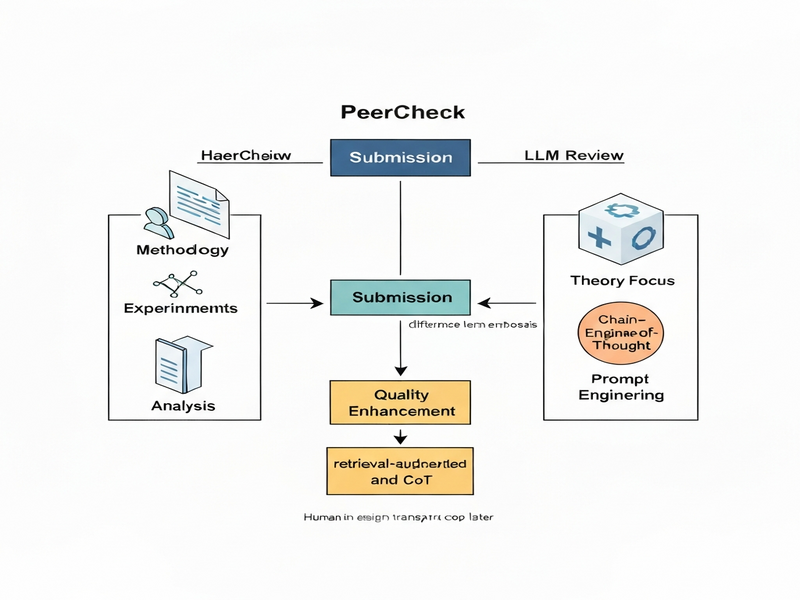
The PeerCheck workflow can be visualized as a four‑stage pipeline:
- Input Ingestion: The submitted manuscript (PDF or LaTeX source) is parsed into structured sections (abstract, methodology, results, etc.).
- Context Retrieval: A lightweight search over a curated scholarly index returns the top‑k most relevant prior papers, datasets, and benchmark results. This step is optional and configurable per reviewer preference.
- Reasoning Prompt: The system constructs a multi‑part prompt that first asks the LLM to list key contributions, then to enumerate methodological strengths and weaknesses, and finally to synthesize a recommendation. The CoT scaffold is embedded directly in the prompt.
- Review Generation & Post‑Processing: The LLM produces a draft review, which is then passed through a consistency checker (e.g., factuality verifier) and a style normalizer to align with venue‑specific guidelines.
What distinguishes PeerCheck from earlier “LLM‑review bots” is the explicit separation of retrieval, reasoning, and synthesis, allowing each component to be tuned independently. Moreover, the framework logs intermediate reasoning traces, enabling auditors to inspect why a model highlighted a particular flaw—a crucial step for transparency.
Evaluation & Results
To gauge effectiveness, the authors conducted a double‑blind study involving 30 senior researchers who rated 200 LLM‑generated reviews on four dimensions: technical depth, methodological relevance, clarity, and overall usefulness. The baseline (plain prompt) achieved an average score of 2.8/5. Introducing CoT raised the average to 3.9/5, a statistically significant improvement (p < 0.01). When RAG was added, results diverged:
- For GPT‑4, RAG boosted methodological relevance by 0.6 points, confirming the “knowledge‑infused” hypothesis.
- For Claude, RAG unexpectedly lowered clarity, illustrating the “RAG paradox” where irrelevant retrieved snippets confuse the model.
Beyond numeric scores, qualitative analysis revealed that CoT‑enhanced reviews more frequently cited concrete experimental design flaws (e.g., missing ablation studies) and offered actionable suggestions—behaviors traditionally associated with expert human reviewers.
Why This Matters for AI Systems and Agents
For AI practitioners building autonomous agents, PeerCheck offers a reusable pattern: retrieve → reason → generate → verify. This pattern can be transplanted to other domains such as code review, policy analysis, or compliance auditing. By exposing the reasoning trace, developers can embed a “self‑explain” capability into agents, improving trustworthiness and facilitating human‑in‑the‑loop oversight.
From an operational standpoint, institutions can integrate PeerCheck into existing editorial management platforms to pre‑screen submissions, flag potential methodological gaps, and allocate human reviewer effort more efficiently. The framework’s modularity also aligns with the UBOS platform overview, where retrieval services, prompt libraries, and verification modules can be orchestrated through a low‑code workflow engine.
Furthermore, the ability to generate high‑quality, human‑like reviews opens new business models for AI‑driven scholarly services, such as “AI‑assisted revision assistants” that help authors address reviewer comments before resubmission. These assistants can be built on top of the same CoT and RAG primitives demonstrated by PeerCheck.
What Comes Next
While PeerCheck marks a significant step forward, several limitations remain:
- Domain Generalization: The current knowledge base focuses on computer‑science venues; extending to biomedical or social‑science domains will require specialized retrieval pipelines.
- Hallucination Control: Even with RAG, occasional fabricated citations persisted, indicating a need for tighter grounding mechanisms.
- Ethical Guardrails: Automating review raises concerns about bias amplification and accountability, demanding transparent audit trails.
Future research directions include:
- Integrating Chroma DB integration for scalable vector search across millions of papers.
- Exploring multimodal retrieval (e.g., code snippets, figures) to enrich the evidence base.
- Coupling PeerCheck with Enterprise AI platform by UBOS to provide end‑to‑end orchestration, from submission ingestion to reviewer assignment.
- Developing a “reviewer persona” module that can emulate different conference cultures (e.g., strict vs. lenient) via prompt conditioning.
Addressing these challenges will not only improve the fidelity of AI‑generated reviews but also lay the groundwork for a broader ecosystem of AI‑augmented scholarly communication tools.
Conclusion
PeerCheck demonstrates that LLMs, when guided by structured reasoning and domain‑specific retrieval, can produce academic reviews that approach human expertise. The framework’s modular design, transparent reasoning traces, and empirical validation make it a practical blueprint for anyone looking to embed AI‑assisted evaluation into research workflows. As submission volumes continue to climb, tools like PeerCheck will become essential allies in preserving the rigor and fairness of peer review.
For a deeper dive into the methodology and data, consult the original PeerCheck paper.
Andrii Bidochko
CTO UBOS
Andrii Bidochko is an AI entrepreneur and researcher focused on AI agents, reinforcement learning, and autonomous systems. He writes about the technologies shaping the future of machine intelligence, from frontier models and agent architectures to real-world AI applications.