

- Updated: June 30, 2026
- 8 min read
Paraphrasing Attack Resilience of Various AI-Generated Text Detection Methods
Direct Answer
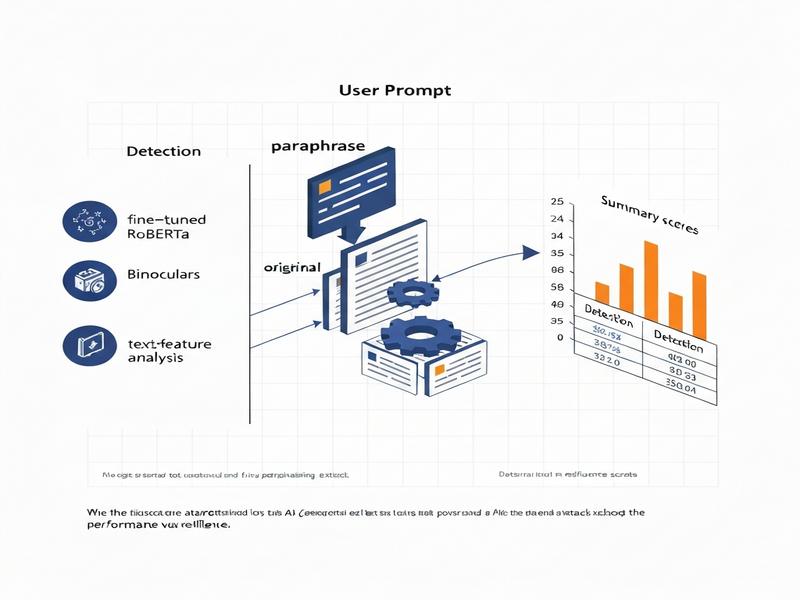
The paper Paraphrasing Attack Resilience of Various AI‑Generated Text Detection Methods evaluates how well three leading AI‑text detectors—fine‑tuned RoBERTa, Binoculars, and a handcrafted feature‑analysis pipeline—survive paraphrasing attacks, and it shows that ensembles that include Binoculars achieve the highest raw detection scores but suffer the steepest performance drops when the input is paraphrased. This matters because it reveals a hidden trade‑off between detection accuracy and robustness, forcing practitioners to rethink which tool‑chain best protects against sophisticated plagiarism and misinformation.
Background: Why This Problem Is Hard
Large language models (LLMs) such as GPT‑4, Claude, and LLaMA can now generate fluent, human‑like prose at scale. While this unlocks productivity gains, it also creates three intertwined risks:
- Plagiarism at scale: Students, journalists, and marketers can submit AI‑written drafts as original work.
- Misinformation amplification: Bad actors can flood forums with fabricated narratives that appear authentic.
- Regulatory pressure: Governments and platforms increasingly demand verifiable provenance for published text.
Detecting machine‑generated text is not a simple classification problem. Early detectors relied on surface‑level cues—repetitive n‑grams, unusual token distributions, or statistical anomalies. Modern approaches, however, train deep classifiers (e.g., RoBERTa) on massive corpora of synthetic and human text, or they combine multiple signals (Binoculars) to improve precision.
What makes the problem especially brittle is the rise of paraphrasing attacks. By feeding AI‑generated output through a paraphraser (either another LLM or a rule‑based rewriter), an adversary can preserve the semantic content while dramatically altering lexical patterns. Most detectors, which depend on those lexical fingerprints, see the paraphrased version as fresh, human‑written text. Existing literature has documented this vulnerability in isolation, but no systematic study has compared how different detectors—and their ensembles—behave under a controlled paraphrasing threat model. That gap is precisely what Shportko and Verbitsky aim to fill.
What the Researchers Propose
Rather than introducing a brand‑new detector, the authors construct a comparative framework that measures “paraphrase resilience” across three representative detection pipelines:
- Fine‑tuned RoBERTa: A transformer classifier pre‑trained on large corpora and subsequently fine‑tuned on a balanced mix of human and AI‑generated sentences.
- Binoculars: An open‑source system that fuses multiple shallow classifiers (e.g., perplexity, token‑frequency, syntactic depth) into a single confidence score.
- Feature‑analysis pipeline: A handcrafted set of linguistic and statistical features (readability indices, POS‑tag distributions, etc.) fed into a gradient‑boosted model.
To probe robustness, the authors generate a paraphrased counterpart for every test sample using a state‑of‑the‑art LLM instructed to “rewrite the paragraph while preserving meaning.” They then evaluate each detector on three axes:
- Baseline accuracy on untouched AI‑generated text.
- Post‑paraphrase accuracy after the attack.
- Resilience ratio (post‑attack / baseline), which quantifies how much performance degrades.
Beyond individual detectors, the study also builds Random Forest ensembles that combine the three scores in various configurations (e.g., RoBERTa + Binoculars, all three together). This allows the authors to test whether diversity of signals can mitigate the attack’s impact.
How It Works in Practice
The experimental workflow can be broken down into four logical stages, each of which could be replicated in an enterprise AI‑governance pipeline:
1. Corpus Construction
Researchers collect a balanced dataset of 10 k human sentences (sourced from news articles, Wikipedia, and literary excerpts) and 10 k AI‑generated sentences (produced by prompting GPT‑4, Claude, and LLaMA with identical topics). This ensures that detectors see a realistic distribution of styles and topics.
2. Paraphrase Generation
A separate LLM, prompted with “Rewrite the following paragraph in your own words while keeping the meaning identical,” creates a paraphrased version of every AI‑generated sentence. The process is deterministic (temperature = 0) to keep the attack reproducible.
3. Detection Scoring
Each of the three detectors processes both the original and paraphrased texts, outputting a probability that the input is machine‑generated. For Binoculars, the system aggregates five shallow classifiers; for the feature pipeline, a LightGBM model consumes 27 handcrafted metrics.
4. Ensemble Fusion
The three probability scores become feature vectors for a Random Forest classifier. Different subsets of detectors are fed to the forest, yielding four ensemble variants: (i) RoBERTa‑only, (ii) Binoculars‑only, (iii) Feature‑only, (iv) All‑three combined.
What distinguishes this approach from prior work is the explicit “attack‑first” mindset: the paraphrasing step is not an afterthought but a core part of the evaluation loop. By keeping the paraphrase generator constant, the authors isolate detector weakness rather than conflating it with variability in the attack itself.
Evaluation & Results
The authors report three families of findings that together paint a nuanced picture of the detection landscape.
Baseline Performance (No Attack)
- Binoculars achieved the highest raw F1‑score (≈ 0.92), thanks to its multi‑signal architecture.
- RoBERTa followed closely (≈ 0.89), reflecting the power of deep contextual embeddings.
- Feature‑analysis lagged behind (≈ 0.81) but still outperformed naïve n‑gram baselines.
Post‑Paraphrase Performance
- All detectors suffered a drop, but the magnitude varied dramatically.
- Binoculars fell to an F1 of ≈ 0.58—a 37 % relative loss.
- RoBERTa retained more of its strength, ending at ≈ 0.71 (≈ 20 % loss).
- Feature‑analysis was the most resilient, ending at ≈ 0.73 (≈ 10 % loss), despite its lower baseline.
Ensemble Outcomes
When the three detectors were fused via Random Forest, the “All‑three” ensemble reached a baseline F1 of ≈ 0.94—slightly better than any single method. However, after paraphrasing, its score collapsed to ≈ 0.60, mirroring Binoculars’ vulnerability. The “RoBERTa + Feature” ensemble, by contrast, kept a steadier post‑attack F1 of ≈ 0.78, suggesting that excluding the most brittle component (Binoculars) can improve resilience without sacrificing too much accuracy.
These results collectively demonstrate a performance‑vs‑resilience dichotomy: the most accurate detectors are also the most fragile under paraphrase attacks, while simpler, feature‑based models trade raw precision for robustness.
Why This Matters for AI Systems and Agents
For organizations that rely on AI‑generated content—whether for marketing copy, customer‑support drafts, or automated report generation—the findings have immediate operational implications.
- Policy enforcement: Companies that must flag AI‑written text (e.g., for compliance or academic honesty) cannot depend solely on high‑accuracy detectors; they need a layered approach that anticipates paraphrasing.
- Agent orchestration: When building multi‑agent pipelines where one LLM writes and another validates, the validation step should incorporate a resilient detector (e.g., the feature‑analysis model) to avoid false negatives.
- Workflow automation: Platforms like the Workflow automation studio can embed a “resilience check” stage that runs both a deep classifier and a lightweight feature‑based filter before publishing content.
- Product differentiation: AI‑content platforms that advertise “AI‑generated text detection” must disclose the limits of their technology, especially against paraphrasing, to maintain trust with enterprise customers.
- Security posture: Threat‑modeling teams should treat paraphrasing as a realistic attack vector, similar to adversarial examples in computer vision, and allocate resources to harden detection pipelines accordingly.
In short, the paper forces a shift from “detect‑once‑and‑done” to “detect‑and‑verify‑under‑adversarial‑conditions,” a mindset that aligns with best practices in AI governance.
What Comes Next
While the study offers a rigorous benchmark, several open challenges remain.
Limitations
- Single paraphrase engine: The authors used one LLM for rewriting. Real‑world attackers may employ diverse tools, including rule‑based synonym replacers, which could affect detector performance differently.
- Domain coverage: The test set focuses on general‑purpose prose. Technical documentation, code comments, or multilingual content may exhibit distinct vulnerability patterns.
- Ensemble complexity: Random Forest ensembles improve accuracy but increase latency and resource consumption, which may be prohibitive for real‑time moderation.
Future Research Directions
- Develop adversarial training pipelines that expose detectors to paraphrased examples during fine‑tuning, potentially closing the resilience gap.
- Explore semantic similarity metrics (e.g., sentence embeddings) as a complementary signal that is less sensitive to lexical changes.
- Integrate detection into Enterprise AI platform by UBOS as a micro‑service that can be called by any downstream agent, ensuring consistent policy enforcement across the organization.
- Investigate cross‑modal attacks where AI‑generated text is paired with synthetic images or audio, requiring multimodal detectors.
Potential Applications
Businesses can start by piloting a hybrid detection stack: a deep model for high‑precision screening, paired with a lightweight feature‑based filter for resilience. The UBOS templates for quick start already include pre‑configured pipelines that can be extended with custom detectors, making it easier to experiment without building infrastructure from scratch.
Moreover, the rise of “AI‑marketing agents” (AI marketing agents) underscores the need for built‑in provenance checks. Embedding a resilient detector directly into the agent’s output routine can automatically tag or quarantine content that appears paraphrased, preserving brand integrity.
Finally, as regulatory frameworks evolve, having a documented, benchmarked detection methodology will become a compliance requirement. The paper’s methodology—public datasets, reproducible paraphrase attacks, and transparent ensemble recipes—offers a template for auditors to verify that an organization’s detection stack meets industry standards.
Andrii Bidochko
CTO UBOS
Andrii Bidochko is an AI entrepreneur and researcher focused on AI agents, reinforcement learning, and autonomous systems. He writes about the technologies shaping the future of machine intelligence, from frontier models and agent architectures to real-world AI applications.