

- Updated: June 17, 2026
- 6 min read
Paraphrase Brittleness in Production Retrieval-Augmented Commercial Recommendation: Reproducibility Below the Rerun-Stability Baseline
Direct Answer
The paper “Paraphrase Brittleness in Production Retrieval‑Augmented Commercial Recommendation” reveals that tiny wording changes in a buyer’s query cause large, unpredictable swings in the brand recommendations generated by leading AI assistants. This instability undermines the reliability of “AI visibility” metrics that marketers currently use to track how often their brands appear in AI‑driven suggestions.
Background: Why This Problem Is Hard
Enterprises increasingly rely on large‑language‑model (LLM) agents that combine generative reasoning with retrieval‑augmented search over product catalogs. In theory, the underlying buying intent—whether a user wants a CRM for a SaaS startup or a simple “best CRM”—should dominate the recommendation outcome. In practice, however, the raw prompt string becomes the primary driver.
Two intertwined bottlenecks make this phenomenon especially troublesome:
- Semantic drift in retrieval pipelines. Retrieval‑augmented generation (RAG) first selects documents based on keyword overlap, then lets the LLM synthesize a response. Small lexical variations can shift the retrieved set dramatically, even when the semantic meaning stays constant.
- Lack of robust evaluation frameworks. Most commercial trackers evaluate a brand’s “AI visibility” by issuing a fixed list of handcrafted prompts and counting mentions. This approach assumes prompt‑level stability, an assumption the paper directly disproves.
Existing mitigation strategies—such as increasing the model’s reasoning steps or expanding the prompt pool—have shown limited effect, leaving product teams without a reliable way to gauge how their brands will surface in AI‑driven recommendation engines.
What the Researchers Propose
The authors introduce a systematic reproducibility study that quantifies “paraphrase brittleness” across two leading LLM providers (OpenAI and Anthropic). Their framework consists of three conceptual components:
- Intent‑anchored paraphrase generation. For each buying intent, they create two families of rephrasings: cosmetic (e.g., “best CRM” → “top CRM”) and constraint‑adding (e.g., “best CRM” → “best CRM for a SaaS startup”).
- Rerun‑stability baseline. They run the exact same prompt multiple times to capture the natural variance of the model when the input string is unchanged.
- Similarity measurement. Recommendation sets are compared using Jaccard similarity, providing a clear, interpretable metric of overlap.
By juxtaposing paraphrase‑induced variance against the rerun baseline, the study isolates the effect of wording from the stochastic nature of the model itself.
How It Works in Practice
The experimental workflow can be visualized as a three‑stage pipeline:
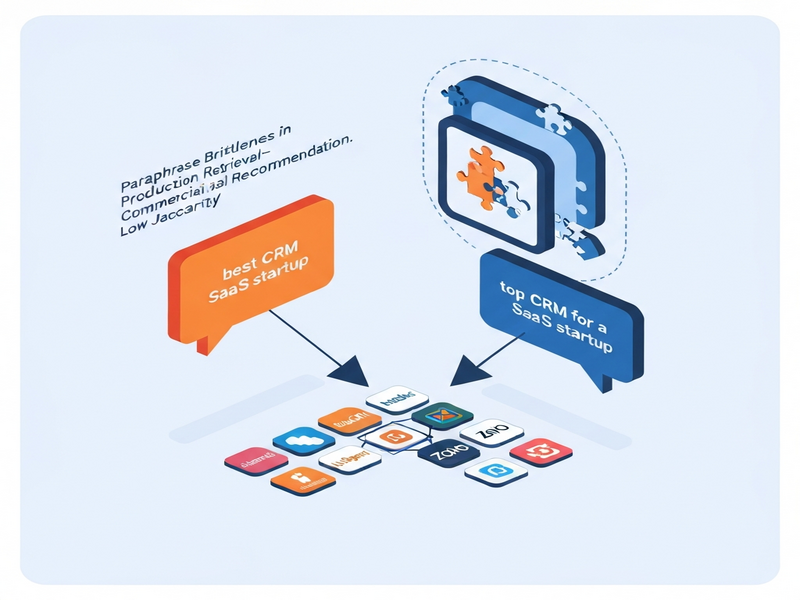
- Prompt Construction. A domain expert defines a core buying intent (e.g., “CRM for startups”). Automated paraphrase tools then generate two sets of variants: cosmetic and constraint‑adding.
- Model Invocation. Each variant is sent to the target LLM (OpenAI’s GPT‑4 or Anthropic’s Claude) using the same retrieval‑augmented pipeline that powers commercial recommendation assistants. The system also repeats the exact original prompt ten times to establish the rerun‑stability baseline.
- Result Aggregation & Analysis. The returned brand lists are normalized (deduplication, case folding) and compared pairwise. Jaccard similarity scores are aggregated across all intents, yielding confidence intervals for each paraphrase family.
What sets this approach apart is its focus on “intent‑preserving” paraphrases rather than random noise. By controlling for semantic equivalence, the researchers demonstrate that the observed brittleness is not a side‑effect of meaning drift but a structural weakness in the retrieval‑augmented recommendation stack.
Evaluation & Results
The study evaluated roughly 6,000 paraphrase runs and an equal number of same‑prompt reruns across both LLM providers. Key findings include:
- Cosmetic rewordings. Jaccard similarity averaged 0.288 (95 % CI [0.215, 0.361]), indicating that only about 29 % of recommended brands overlapped between two harmless rephrasings.
- Constraint‑adding rewordings. Overlap dropped further to an average of 0.135 (95 % CI [0.098, 0.175]), meaning less than one‑third of the original recommendation set survived the addition of a single qualifier.
- Rerun baseline. Identical prompts produced Jaccard scores between 0.50 and 0.61, confirming that the models themselves are relatively stable when the input string does not change.
- Reasoning depth. Increasing the model’s chain‑of‑thought steps altered similarity by less than ±0.05, suggesting that more “thinking” does not mitigate brittleness.
These results collectively demonstrate that the prompt string, not the buyer’s true intent, dominates the recommendation outcome. Consequently, any metric that counts brand mentions per static prompt set is fundamentally unstable.
Why This Matters for AI Systems and Agents
For product teams building AI‑driven recommendation agents, the paper’s insights trigger a reassessment of three core practices:
- Metric design. “AI visibility” scores that rely on a handful of handcrafted prompts will fluctuate wildly depending on which paraphrase happens to be used. This undermines confidence in dashboards that inform marketing spend.
- Prompt engineering pipelines. Simply expanding the prompt library does not solve the problem; the natural language space is orders of magnitude larger than any feasible benchmark set.
- System robustness. Retrieval components must be made less sensitive to lexical variation—e.g., by incorporating semantic embeddings, query expansion, or hybrid lexical‑semantic indexing.
Enterprises can mitigate risk by adopting more resilient evaluation frameworks, such as multi‑prompt sampling techniques from the academic literature, and by treating the recommendation engine as a stochastic service rather than a deterministic rule‑book.
Practical steps for AI product leaders include:
- Integrating AI marketing agents that dynamically rephrase user queries and aggregate results across multiple paraphrases before presenting a final list.
- Leveraging the UBOS platform overview to orchestrate retrieval pipelines with semantic‑aware vector stores, reducing reliance on exact keyword matches.
- Deploying the Workflow automation studio to schedule large‑scale paraphrase sampling and automatically flag intents with high brittleness scores.
What Comes Next
While the study provides a rigorous baseline, several open challenges remain:
- Scalable paraphrase generation. Current methods rely on manual or semi‑automated rephrasings. Future work should explore large‑scale, intent‑preserving paraphrase models that can cover the full distribution of natural buyer language.
- Semantic‑rich retrieval. Embedding‑based similarity search, hybrid lexical‑semantic indexes, and relevance feedback loops could dampen the impact of surface‑level wording changes.
- Alternative evaluation units. Rather than counting brand mentions per prompt, researchers might measure “brand exposure probability” across a probabilistic model of user phrasing, yielding a more stable metric.
- Cross‑domain validation. Extending the analysis beyond CRM recommendations to domains such as SaaS security, cloud infrastructure, or consumer electronics will test the generality of the brittleness phenomenon.
Addressing these gaps will require collaboration between LLM providers, retrieval engineers, and product teams. Companies that invest early in robust, paraphrase‑aware pipelines will gain a competitive edge in delivering consistent, trustworthy AI‑driven recommendations.
For startups looking to embed resilient recommendation engines, the UBOS for startups program offers pre‑built modules that combine vector search with adaptive prompt orchestration. Larger enterprises can explore the Enterprise AI platform by UBOS to scale these capabilities across multiple product lines and geographic markets.
Conclusion
The “paraphrase brittleness” uncovered by the researchers signals a fundamental mismatch between how commercial AI assistants retrieve information and how humans express intent. By quantifying the gap between paraphrase‑induced variance and natural model stochasticity, the paper forces a rethink of both metric design and system architecture. Organizations that adopt intent‑preserving evaluation, semantic‑aware retrieval, and multi‑prompt aggregation will be better positioned to deliver stable, trustworthy recommendations—turning AI from a novelty into a reliable business asset.
Andrii Bidochko
CTO UBOS
Andrii Bidochko is an AI entrepreneur and researcher focused on AI agents, reinforcement learning, and autonomous systems. He writes about the technologies shaping the future of machine intelligence, from frontier models and agent architectures to real-world AI applications.