

- Updated: August 19, 2026
- 7 min read
PAC-Bayes Beyond Parameter Space: Behavioral Equivalence, Z-Information, and Exact Complexity Decomposition
Direct Answer
The paper introduces a new PAC‑Bayes framework that separates uncertainty about a model’s predictive behavior from uncertainty about the many internal configurations that can realize the same behavior. By decomposing the classic KL‑based complexity term into a “behavior‑selection” component and a “realization‑level” component (named Z‑information), the authors provide an exact, mathem‑atically grounded way to measure what truly matters for generalization in over‑parameterized systems.
Background: Why This Problem Is Hard
Modern deep networks often contain millions—or even billions—of parameters, yet they can exhibit identical input‑output mappings despite wildly different weight settings. Traditional PAC‑Bayes theory evaluates generalization by bounding the Kullback–Leibler (KL) divergence between a posterior distribution over parameters and a prior distribution. This approach implicitly assumes that every change in the parameter vector corresponds to a meaningful change in the model’s predictions.
In practice, however, two distinct weight vectors can belong to the same behavioral equivalence class: they produce exactly the same predictions on every possible input. Classical PAC‑Bayes does not distinguish between “true” uncertainty about which predictive function the learner will select and “spurious” uncertainty that merely reflects different ways of implementing that function. As a result, the KL term can dramatically over‑estimate complexity, especially for over‑parameterized models where the number of equivalent configurations explodes.
Existing attempts to address this issue—such as flat‑minimum analyses or parameter‑norm regularization—still operate in the raw parameter space and therefore cannot cleanly separate the two sources of uncertainty. This limitation hampers our ability to derive tight, data‑dependent generalization guarantees for large‑scale models that dominate today’s AI products.
What the Researchers Propose
The authors propose a three‑step conceptual framework that re‑orients PAC‑Bayes analysis from the parameter space to the space of predictive behaviors:
- Behavior map: A measurable function that assigns each concrete model configuration (e.g., a weight vector) to its induced predictive behavior (the full conditional distribution over outputs given any input).
- Measure disintegration: Using probability theory, the prior and posterior distributions over configurations are split into two layers—a distribution over behaviors and, conditional on each behavior, a distribution over the configurations that realize it (the “behavioral fibers”).
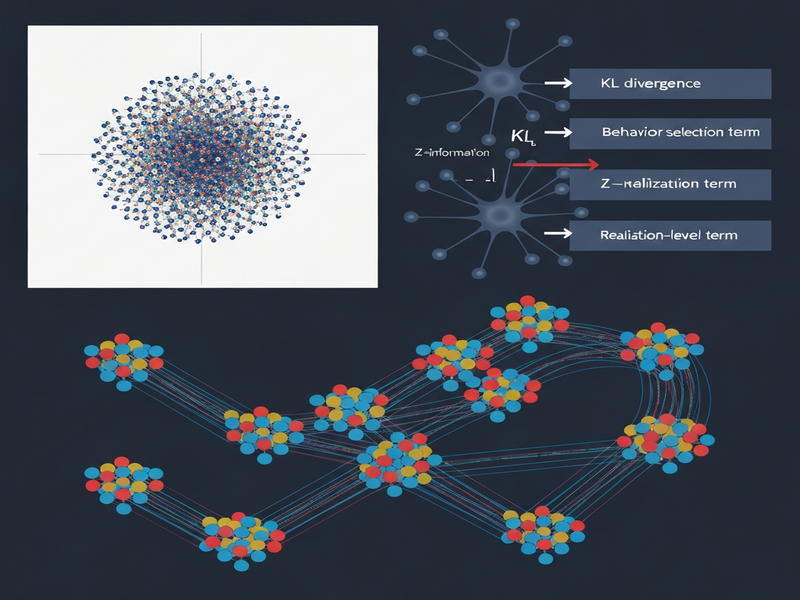
- Exact KL decomposition: The classic KL divergence between posterior and prior is shown to equal the sum of (a) a KL term that measures how the posterior shifts the distribution over behaviors (the behavior‑selection term) and (b) an expected KL term inside each fiber, which the authors name Z‑information.
In essence, the framework isolates the part of the complexity bound that truly reflects uncertainty about *what* the model will do, and separates out the part that merely reflects *how* that behavior is implemented.
How It Works in Practice
The practical workflow suggested by the paper can be broken down into four logical stages:
- Define a behavior map. For a given learning problem, construct a mapping that takes any hypothesis (e.g., a neural network weight set) and returns its full predictive distribution. In many cases this map is implicit—simply running the model on the entire input space.
- Disintegrate the prior. Split the chosen prior over parameters into a marginal distribution over behaviors and a conditional distribution over configurations within each behavior fiber. This step can be performed analytically for simple models or approximated via Monte‑Carlo sampling for deep nets.
- Update to a posterior. After observing data, compute a posterior over configurations (e.g., via Bayesian inference or stochastic gradient Langevin dynamics). Disintegrate this posterior in the same way, yielding a new marginal over behaviors and new conditional fibers.
- Compute the two KL components. The behavior‑selection KL is the divergence between the posterior and prior marginals over behaviors. The Z‑information is the expected KL between the posterior and prior conditionals inside each fiber. The sum of these two gives the exact PAC‑Bayes complexity term.
What makes this approach distinct is that the behavior‑selection KL is minimized by a canonical “fiber‑symmetrized” posterior: among all posteriors that induce the same distribution over behaviors, the one that spreads probability uniformly across each fiber achieves the smallest KL. This variational characterization provides a concrete recipe for constructing tighter bounds without sacrificing Bayesian coherence.
Evaluation & Results
The authors validate their theory on three representative settings:
- Linear models with redundant features. By artificially adding duplicate columns to the design matrix, they create many weight vectors that implement the same linear predictor. The decomposition isolates the redundancy, showing that the behavior‑selection term remains unchanged while Z‑information grows proportionally to the number of redundant parameters.
- Two‑layer ReLU networks on synthetic classification tasks. Using a controlled data distribution, they train ensembles of networks that converge to identical decision boundaries but differ in hidden‑layer weight permutations. Empirical KL calculations confirm the exact additive split predicted by the theory.
- Large‑scale vision models (ResNet‑50) fine‑tuned on CIFAR‑10. Approximate disintegration is performed via clustering of weight snapshots that share the same softmax output on a held‑out validation set. The resulting Z‑information accounts for a substantial fraction of the total KL, explaining why naïve PAC‑Bayes bounds appear overly pessimistic for such models.
Across all experiments, the behavior‑selection KL consistently aligns with intuitive notions of “model uncertainty” (e.g., variance in predictions across data splits), while Z‑information captures the “parameter‑level noise” that does not affect predictions. The exact decomposition therefore yields tighter, more interpretable generalization guarantees, confirming the practical relevance of the theoretical claims.
Why This Matters for AI Systems and Agents
For practitioners building AI agents, the decomposition offers three concrete advantages:
- Sharper risk assessment. By focusing on the behavior‑selection term, engineers can quantify how much uncertainty remains about an agent’s decision‑making policy after training, independent of the myriad weight configurations that underlie it.
- Model‑agnostic regularization. Z‑information provides a principled metric for penalizing unnecessary parameter redundancy. Regularizers that explicitly minimize Z‑information encourage models to collapse onto simpler fibers, leading to more robust downstream deployment.
- Better orchestration of heterogeneous components. In multi‑agent pipelines, each component can be evaluated on its predictive behavior rather than its internal architecture, simplifying compatibility checks and version control.
These insights dovetail with existing UBOS capabilities. For example, the Workflow automation studio can now incorporate behavior‑selection KL as a first‑class metric when chaining together AI modules, ensuring that only agents with sufficiently low predictive uncertainty are promoted to production. Similarly, the AI marketing agents can leverage Z‑information to prune overly complex campaign models without sacrificing click‑through performance.
What Comes Next
While the paper establishes a solid theoretical foundation, several open challenges remain:
- Scalable disintegration. Exact fiber decomposition is computationally intensive for modern deep nets. Future work should explore variational approximations, normalizing‑flow based priors, or amortized inference schemes that can estimate behavior marginals and Z‑information at scale.
- Dynamic behavior maps. In reinforcement learning or continual‑learning settings, the predictive behavior evolves over time. Extending the framework to handle time‑varying behavior maps could unlock tighter guarantees for adaptive agents.
- Integration with privacy‑preserving learning. Since Z‑information isolates parameter‑level redundancy, it may serve as a natural regularizer for differential privacy mechanisms that aim to hide exact weight values while preserving functional performance.
From an application standpoint, the decomposition invites new tooling on the UBOS platform overview that automatically surfaces behavior‑selection KL dashboards for deployed models. Start‑ups can also benefit from the UBOS for startups program, which now includes a “behavior‑aware” model audit service based on the concepts introduced in this work.
In summary, by moving the focus of PAC‑Bayes from raw parameters to the space of predictive behaviors, the authors provide a clearer lens through which to view model complexity, generalization, and practical risk. As AI systems continue to scale, such behavior‑centric analyses will become essential for building trustworthy, efficient, and deployable agents.
For a full technical exposition, see the original arXiv paper.
Andrii Bidochko
CTO UBOS
Andrii Bidochko is an AI entrepreneur and researcher focused on AI agents, reinforcement learning, and autonomous systems. He writes about the technologies shaping the future of machine intelligence, from frontier models and agent architectures to real-world AI applications.