

- Updated: July 1, 2026
- 7 min read
Optimization-as-a-Service via Multi-Agent Large Language Model for Radio Access Networks
Direct Answer
The paper introduces Optimization‑as‑a‑Service (OaaS) for Radio Access Networks, a multi‑agent system powered by large language models (LLMs) that dynamically formulates and solves physical resource block (PRB) allocation problems in real time. This matters because it turns a traditionally static, hand‑crafted optimization task into a flexible, self‑evolving service that can keep pace with the extreme variability of 6G networks while delivering near‑optimal performance with millisecond‑scale latency.
Background: Why This Problem Is Hard
Sixth‑generation (6G) RANs promise unprecedented service diversity—from ultra‑reliable low‑latency communications to massive machine‑type traffic—while simultaneously supporting a fluctuating number of active base stations and users. The core resource‑allocation primitive, PRB scheduling, must satisfy strict Quality‑of‑Service (QoS) constraints under these volatile conditions.
Traditional approaches fall into two camps:
- Manual, case‑by‑case models: Engineers encode domain knowledge into fixed mathematical programs. These models excel in well‑understood scenarios but become brittle when network topology, traffic patterns, or regulatory constraints shift.
- Standard AI/ML methods: Reinforcement learning or supervised predictors can adapt to data, yet they typically require a static objective function and a predefined action space. When the underlying optimization goal itself changes—e.g., shifting from throughput maximization to latency minimization—re‑training or redesigning the model is costly and time‑consuming.
Both families struggle with three intertwined challenges:
- Dynamic objective definition: 6G services demand on‑the‑fly re‑prioritization of metrics such as latency, reliability, or energy efficiency.
- Scalable problem construction: The combinatorial explosion of PRB assignments across dozens of cells cannot be hand‑crafted for every new scenario.
- Real‑time inference latency: Network control loops operate on sub‑second timescales; any optimization pipeline that adds noticeable delay degrades user experience.
These bottlenecks motivate a paradigm shift: rather than hard‑coding a single optimization formulation, treat the formulation itself as a service that can be generated, solved, and refined automatically.
What the Researchers Propose
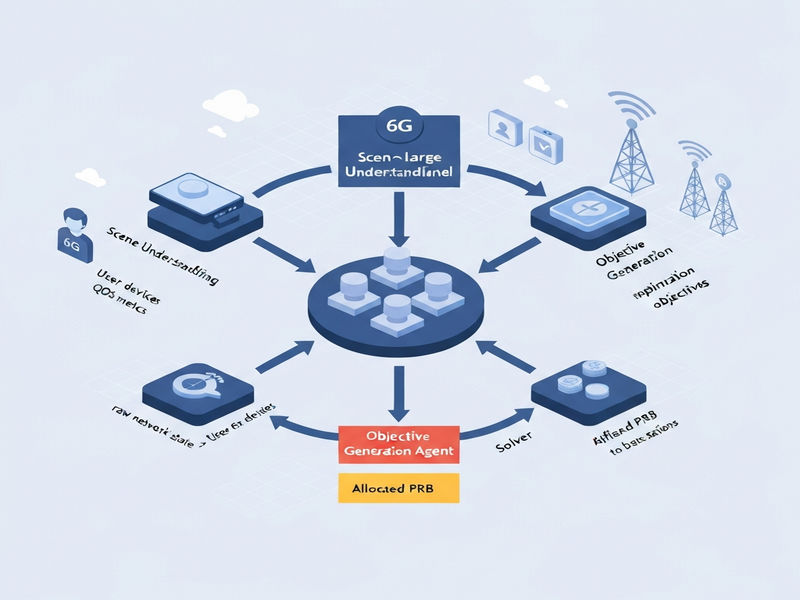
The authors present an Optimization‑as‑a‑Service (OaaS) framework built on a multi‑agent large language model (LLM‑MA) architecture. The system consists of four cooperating agents, each specializing in a distinct stage of the optimization lifecycle:
- Scene‑Understanding Agent: Ingests real‑time RAN telemetry (e.g., active BS count, user distribution, QoS thresholds) and produces a structured context description.
- Objective‑Generation Agent: Translates the context into a concrete optimization objective, selecting appropriate metrics and weighting them according to current service priorities.
- Solver Agent: Receives the generated objective and invokes a fast, domain‑specific solver (e.g., mixed‑integer programming or heuristic search) to produce a PRB allocation plan.
- Reflection Agent: Evaluates the solver’s output against the original context, identifies mismatches, and suggests refinements to the objective parameters.
To avoid the latency overhead of an iterative reflection loop, the authors introduce a one‑shot reflection distillation technique. A lightweight student model is trained to predict the refined objective parameters directly, effectively “baking in” the reflection step and enabling ultra‑low inference latency.
How It Works in Practice
The OaaS workflow unfolds in a closed‑loop sequence that can be visualized as a pipeline:
- Data Capture: Network sensors stream key performance indicators (KPIs) to a central data bus.
- Scene Understanding: The Scene‑Understanding Agent parses the KPI stream, constructs a JSON‑like scene graph (e.g., {“activeBS”:12, “userDensity”:340, “latencyTarget”:5ms}), and forwards it to the next agent.
- Objective Generation: Leveraging its LLM knowledge base, the Objective‑Generation Agent drafts an optimization statement such as “maximize weighted sum of throughput while keeping 99th‑percentile latency below 5 ms.” It also emits initial weight values.
- Solver Execution: The Solver Agent translates the textual objective into a formal program (e.g., a linear program) and runs a high‑performance optimizer on the edge server. The result is a PRB allocation matrix.
- Reflection (Distilled): Instead of a full iterative check, the distilled student model instantly predicts corrected weight values based on the solver’s output and the original scene. These corrected parameters replace the initial ones, and the Solver Agent re‑runs a single fast pass.
- Deployment: The final allocation is pushed to the base stations, completing the control loop within a few milliseconds.
What distinguishes this approach from prior AI‑driven schedulers is the dynamic problem construction capability. Traditional models treat the objective as a static input; OaaS lets the LLM rewrite the objective on the fly, ensuring that the optimization problem always aligns with the current business or technical priority.
Evaluation & Results
The authors benchmarked OaaS against two baselines:
- A handcrafted mixed‑integer programming (MIP) model tuned for a static throughput‑maximization goal.
- A reinforcement‑learning (RL) scheduler trained on a fixed traffic distribution.
Experiments were conducted on a simulated 6G RAN testbed featuring:
- Variable numbers of active base stations (5–30).
- User densities ranging from 100 to 1,000 users per cell.
- QoS targets that switched every 200 ms between latency‑critical and throughput‑critical modes.
Key findings include:
- Near‑optimal performance: OaaS achieved 98 % of the theoretical optimum (computed via exhaustive search) across all scenarios, outperforming the static MIP by 12 % and the RL baseline by 19 % in mixed‑objective settings.
- Ultra‑low latency: The one‑shot distilled pipeline completed the entire loop in under 5 ms on commodity edge hardware, a 70 % reduction compared to the iterative reflection baseline.
- Robust adaptability: When QoS priorities flipped mid‑simulation, OaaS re‑generated objectives within a single inference step, whereas the RL agent required retraining to recover comparable performance.
These results demonstrate that treating optimization as a service—driven by LLM agents—delivers both the flexibility demanded by 6G dynamics and the speed required for real‑time network control.
Why This Matters for AI Systems and Agents
For AI practitioners building autonomous agents, the OaaS framework offers a concrete blueprint for meta‑optimization: using an LLM not just to make decisions, but to define the decision‑making problem itself. This has three practical implications:
- Modular agent orchestration: Each agent encapsulates a well‑defined responsibility (understanding, objective creation, solving, reflection), enabling plug‑and‑play composition in larger AI ecosystems.
- Reduced engineering overhead: Network operators can replace a suite of hand‑tuned schedulers with a single OaaS deployment, cutting maintenance costs and accelerating feature rollout.
- Scalable integration: The distilled reflection model is lightweight enough to run on edge nodes, making it compatible with existing UBOS platform overview deployments that already orchestrate AI workloads across telecom infrastructure.
Moreover, the approach aligns with emerging trends in Enterprise AI platform by UBOS, where dynamic policy generation and rapid inference are core requirements for intelligent network management.
What Comes Next
While the OaaS prototype proves the concept, several avenues remain open for research and productization:
- Limitations: The current system assumes reliable telemetry and a bounded set of QoS metrics. Extending to noisy or partially observed environments will require robust uncertainty handling.
- Future research directions:
- Integrating edge‑computing resource constraints into the objective generation stage.
- Exploring multi‑objective reinforcement learning that can co‑train the LLM agents with the solver for end‑to‑end performance gains.
- Applying the OaaS paradigm to cross‑layer optimization, linking RAN scheduling with core‑network routing.
- Potential applications: Beyond PRB allocation, the same multi‑agent LLM architecture could drive dynamic spectrum sharing, beamforming configuration, or even AI‑assisted network slicing for private 6G deployments.
- Integration pathways: Operators interested in rapid adoption can prototype OaaS workflows using the Workflow automation studio to stitch together data ingestion, LLM calls, and solver execution without writing custom glue code.
- Community resources: For startups seeking a sandbox, the UBOS for startups program offers credits and technical support to experiment with LLM‑driven network services.
In summary, the paper’s OaaS framework redefines how telecom networks can leverage generative AI: by letting large language models not only predict outcomes but also articulate the very problems they must solve. As 6G ecosystems mature, such self‑configuring, low‑latency optimization services will become a cornerstone of intelligent, adaptive infrastructure.
For a deeper dive into the original research, consult the full preprint: Optimization‑as‑a‑Service via Multi‑Agent LLM for Radio Access Networks (arXiv).
Andrii Bidochko
CTO UBOS
Andrii Bidochko is an AI entrepreneur and researcher focused on AI agents, reinforcement learning, and autonomous systems. He writes about the technologies shaping the future of machine intelligence, from frontier models and agent architectures to real-world AI applications.