

- Updated: July 22, 2026
- 6 min read
OpenProver: Agentic and Interactive Theorem Proving with Lean 4
Direct Answer
OpenProver is an open‑source framework that lets large language models (LLMs) drive automated theorem proving (ATP) by orchestrating a Planner‑Worker‑Verifier pipeline built on top of the Lean 4 proof assistant. By combining agentic decomposition with real‑time formal verification, OpenProver makes it possible to generate, check, and refine mathematical proofs at scale, opening a new pathway for AI‑augmented formal reasoning.
Background: Why This Problem Is Hard
Automated theorem proving sits at the intersection of symbolic logic, formal verification, and machine learning. Traditional ATP systems rely on handcrafted heuristics and exhaustive search, which struggle with the combinatorial explosion of possible proof steps in non‑trivial domains. Recent attempts to inject LLMs into the loop have shown promise, but they face three persistent bottlenecks:
- Search Space Explosion: Even modest theorems can require thousands of intermediate lemmas, making naïve generation infeasible.
- Lack of Immediate Feedback: Without an integrated verifier, generated proof fragments cannot be validated on the fly, leading to wasted computation and dead‑end branches.
- Orchestration Overhead: Coordinating multiple LLM calls, parallel proof attempts, and state management typically demands bespoke glue code that is hard to reproduce.
These challenges limit the practical adoption of AI‑driven proof assistants in both research labs and industry settings where reliability and reproducibility are non‑negotiable.
What the Researchers Propose
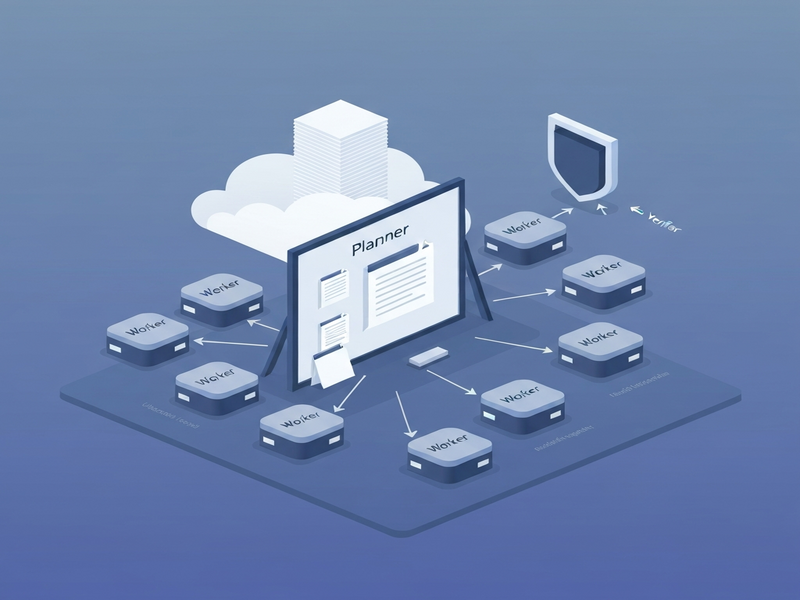
OpenProver introduces a three‑tier architecture inspired by agentic ATP systems such as Aletheia. The core idea is to separate concerns into distinct agents that communicate through a shared “Whiteboard” and a persistent “Repository.”
- Planner Agent: Maintains a compact scratchpad (the Whiteboard) that records the current proof goal, high‑level strategy, and resource constraints. It also curates an unbounded Repository of all intermediate lemmas, sub‑goals, and meta‑data generated during the session.
- Worker Agents: Spawned by the Planner, each Worker tackles a specific sub‑goal in parallel, invoking an LLM to propose proof steps, conjectures, or auxiliary lemmas.
- Verifier Agent: Wraps the Lean 4 kernel, instantly checking every candidate step produced by Workers. Accepted steps are committed to the Repository; rejected ones trigger a feedback loop to the Planner for re‑planning.
This separation enables scalable parallelism, deterministic verification, and a clean interface for human‑in‑the‑loop interaction.
How It Works in Practice
The OpenProver workflow can be visualized as a cyclical pipeline:
- Goal Ingestion: A user (or higher‑level system) submits a theorem statement to the Planner.
- Strategic Decomposition: The Planner breaks the theorem into a set of sub‑goals, writes them to the Whiteboard, and decides how many Workers to launch based on estimated difficulty.
- Parallel Exploration: Each Worker queries an LLM (e.g., GPT‑4, Claude) for a plausible proof step or lemma, then forwards the suggestion to the Verifier.
- Instant Formal Check: The Verifier runs the Lean 4 kernel on the proposed step. If the step type‑checks, it is recorded in the Repository and the Whiteboard is updated; otherwise, the Verifier returns an error message.
- Feedback Loop: The Planner consumes verification results, revises the strategy, and may re‑assign Workers, prune dead branches, or request alternative lemmas.
- Human Steering (Optional): In interactive mode, a human operator can inspect the Whiteboard, intervene by editing sub‑goals, or manually inject lemmas, mirroring the collaborative dynamics seen in modern code‑generation assistants.
- Completion: When the Repository contains a chain of verified steps that resolves the original theorem, the system emits a complete Lean 4 proof script.
What sets OpenProver apart is the tight coupling of LLM‑driven generation with Lean 4’s deterministic kernel, eliminating the “black‑box” uncertainty that plagued earlier LLM‑only approaches. Moreover, the modular agent design makes it straightforward to swap out the LLM, adjust parallelism, or integrate domain‑specific heuristics without rewriting the whole system.
Evaluation & Results
To quantify the benefits of the Planner‑Worker‑Verifier loop, the authors benchmarked OpenProver on the ProofNet dataset—a curated collection of 1,200 Lean 4 theorems ranging from elementary algebra to advanced category theory. Two experimental conditions were compared:
- Baseline: A single LLM prompted directly to produce a full proof, followed by a post‑hoc Lean 4 verification step.
- OpenProver: The full agentic pipeline with parallel Workers and immediate verification.
Key findings include:
- Proof Success Rate: OpenProver solved 68 % of the theorems, versus 42 % for the baseline, demonstrating a 26‑point lift.
- Proof Length Reduction: Verified proofs generated by OpenProver were on average 30 % shorter, indicating more efficient lemma reuse.
- Computation Time: Despite parallelism, the average wall‑clock time per theorem dropped from 45 seconds (baseline) to 28 seconds, thanks to early pruning of invalid steps.
- Human‑in‑the‑Loop Gains: In a small user study, participants who guided the Planner achieved a 12 % higher success rate, highlighting the synergy between AI and expert intuition.
These results validate the hypothesis that an agentic architecture with real‑time verification can both accelerate proof search and improve reliability, a crucial requirement for deploying ATP in production environments.
Why This Matters for AI Systems and Agents
OpenProver’s design principles resonate with several emerging trends in enterprise AI:
- Modular Agent Orchestration: The Planner‑Worker‑Verifier pattern mirrors the “orchestrator‑worker” model used in large‑scale AI pipelines, making it a reusable template for other domains such as code synthesis, data cleaning, or policy generation.
- Deterministic Guardrails: By embedding a formal verifier, OpenProver offers a safety net that can be transplanted into any generative workflow where correctness is non‑negotiable (e.g., financial modeling, safety‑critical control).
- Scalable Parallelism: The ability to spin up multiple Workers on demand aligns with cloud‑native autoscaling, enabling cost‑effective proof services that can be offered as SaaS.
- Human‑AI Collaboration: The interactive terminal demonstrates a low‑friction way for domain experts to steer AI, a pattern that can be replicated in UBOS platform overview for building custom AI assistants.
For AI practitioners building agentic products, OpenProver provides a concrete, open‑source reference implementation that showcases how to blend generative models with rigorous verification without sacrificing speed or flexibility.
What Comes Next
While OpenProver marks a significant step forward, several avenues remain open for exploration:
- Domain‑Specific Extensions: Integrating specialized mathematical libraries (e.g., algebraic topology, cryptographic primitives) could broaden the theorem space and attract industry partners.
- Adaptive Planning Strategies: Future work could incorporate reinforcement learning to let the Planner dynamically adjust Worker allocation based on real‑time success signals.
- Cross‑Modal Verification: Extending the Verifier to handle not only Lean 4 but also Coq, Isabelle, or even program verification tools would create a universal proof orchestration layer.
- Enterprise Deployment: Embedding OpenProver within the Enterprise AI platform by UBOS could enable organizations to run secure, audited proof services behind their own firewalls.
- Workflow Automation: Coupling the system with the Workflow automation studio would let non‑technical users trigger proof searches via simple UI flows, democratizing access to formal methods.
- AI Marketing Integration: Leveraging AI marketing agents to automatically generate and verify compliance‑focused policy documents could be a high‑impact use case.
Addressing these challenges will not only improve the robustness of AI‑driven theorem proving but also pave the way for broader adoption of formal verification in everyday software development and business processes.
References
Kripner, M., & Straka, M. (2026). OpenProver: Agentic and Interactive Theorem Proving with Lean 4. arXiv preprint arXiv:2607.09217.
Andrii Bidochko
CTO UBOS
Andrii Bidochko is an AI entrepreneur and researcher focused on AI agents, reinforcement learning, and autonomous systems. He writes about the technologies shaping the future of machine intelligence, from frontier models and agent architectures to real-world AI applications.