

- Updated: July 2, 2026
- 6 min read
NeuroShield: A Device-Agnostic Foundation Model for EEG Authentication
Direct Answer
NeuroShield is a device‑agnostic foundation model that learns to encode EEG recordings into identity‑specific embeddings, enabling reliable authentication across different headsets, channel layouts, and recording lengths. By decoupling the biometric model from hardware constraints, it paves the way for scalable, reusable brain‑based security in consumer and enterprise applications.
Background: Why This Problem Is Hard
Electroencephalography (EEG) offers a unique biometric signal—directly tied to neural activity—yet turning raw brain waves into a stable authentication factor has remained elusive. The difficulty stems from three intertwined sources of variability:
- Hardware heterogeneity: Commercial headsets differ in electrode count, placement, and sampling rates, producing recordings that are not directly comparable.
- Channel layout mismatch: Even within the same device family, manufacturers may offer models with 8, 14, or 32 channels, forcing developers to redesign feature extractors for each layout.
- Signal duration drift: Real‑world authentication sessions range from a few seconds to several minutes, while most research models are trained on a fixed window length.
Traditional EEG authentication pipelines address these issues by training a separate classifier per device or by manually aligning channels through interpolation. Such approaches fragment the research landscape, prevent knowledge transfer across datasets, and inflate development costs. In an era where biometric security must scale across IoT devices, wearables, and remote workstations, a unified model that tolerates hardware and temporal diversity is a critical missing piece.
What the Researchers Propose
The authors introduce NeuroShield, a reusable foundation model built on a dual‑stage transformer architecture. At a conceptual level, NeuroShield operates in two phases:
- Channel‑agnostic encoding: A first‑stage transformer ingests raw EEG segments, regardless of the number or order of channels, and produces a latent representation that abstracts away electrode‑specific details.
- Identity‑focused refinement: A second‑stage transformer refines the latent vector into a compact embedding optimized for discriminating between individual users.
Key design choices include:
- Positional embeddings that encode relative channel locations rather than absolute indices, allowing the model to generalize to unseen layouts.
- Variable‑length attention masks that let the network process recordings of any duration without padding artifacts.
- A contrastive pre‑training objective that pulls together embeddings from the same subject while pushing apart those from different subjects, fostering identity‑specific features.
How It Works in Practice
Deploying NeuroShield in a production environment follows a straightforward pipeline:
- Signal acquisition: An EEG device streams raw voltage traces to a preprocessing module that normalizes amplitude and applies a band‑pass filter (0.5–40 Hz).
- Channel mapping: The preprocessing step generates a channel‑position map based on the device’s electrode layout. This map is fed to the model’s positional encoder.
- Embedding generation: The dual‑stage transformer consumes the filtered signal and outputs a 256‑dimensional identity embedding.
- Authentication decision: During enrollment, multiple embeddings per user are stored in a secure vector database. At login, the live embedding is compared against the stored set using cosine similarity; a threshold determines acceptance.
What distinguishes NeuroShield from prior work is its ability to handle “out‑of‑distribution” hardware without retraining. Because the positional encoder learns a continuous representation of electrode geometry, a headset with a novel channel arrangement can be processed immediately, provided the layout metadata is supplied.
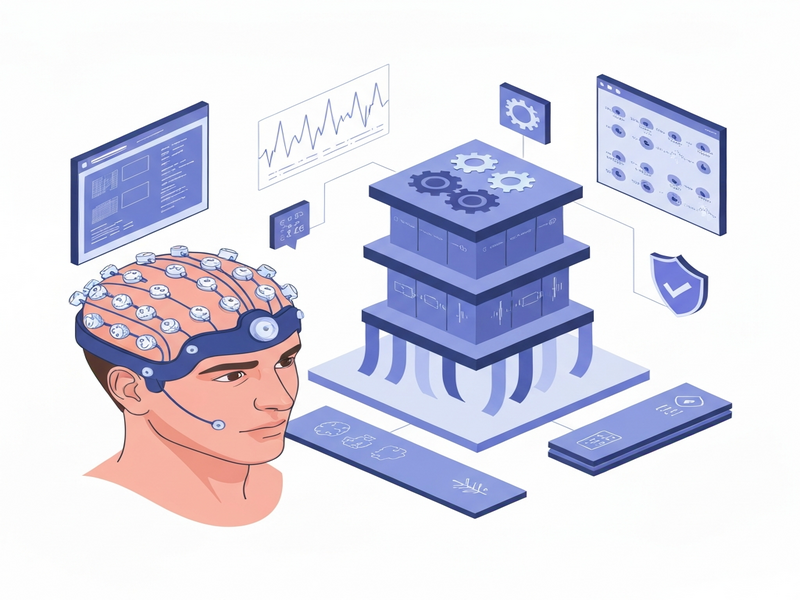
Evaluation & Results
The research team evaluated NeuroShield on a two‑stage benchmark:
- Pre‑training phase: The model was trained on three public EEG datasets encompassing 15,762 subjects and 28,116 sessions, covering a wide spectrum of devices and recording protocols.
- Transfer phase: Two unseen datasets—each featuring distinct headsets and longer recording windows—served as downstream tasks. The model was fine‑tuned on a small subset (5 % of the target data) before evaluation.
Key findings include:
- NeuroShield reduced the equal error rate (EER) by 0.44 to 8.06 percentage points compared with the strongest published baselines, demonstrating superior discrimination even with limited target data.
- The model maintained performance when presented with channel layouts never encountered during pre‑training, confirming its layout‑agnostic capability.
- When tested on longer signal segments than those used in training, NeuroShield’s embeddings continued to improve, indicating robustness to variable session lengths.
These results collectively validate the hypothesis that a foundation model, trained on heterogeneous EEG corpora, can serve as a universal identity encoder across devices and use‑cases.
Why This Matters for AI Systems and Agents
From a systems‑engineering perspective, NeuroShield introduces a plug‑and‑play biometric layer that can be integrated into any AI‑driven workflow requiring secure user verification. Consider the following scenarios:
- Secure access for autonomous agents: Robots or virtual assistants that operate in high‑risk environments can authenticate operators via EEG, eliminating reliance on passwords or facial recognition that may be spoofed.
- Personalized AI assistants: An AI concierge could verify a user’s identity before executing financial commands, leveraging the brain‑based token as a zero‑knowledge proof.
- Enterprise identity management: Companies adopting the Enterprise AI platform by UBOS can embed NeuroShield into their single‑sign‑on (SSO) stack, providing a biometric factor that works across laptops, AR glasses, and IoT wearables without device‑specific SDKs.
Because the model is device‑agnostic, developers no longer need to maintain separate authentication pipelines for each hardware vendor. This reduces engineering overhead, accelerates time‑to‑market, and opens the door for new business models—such as subscription‑based brain‑auth services—that can scale across heterogeneous device ecosystems.
What Comes Next
While NeuroShield marks a significant step forward, several avenues remain open for exploration:
- Continual learning: Incorporating online adaptation mechanisms could allow the model to refine user embeddings as neural patterns evolve over months or years.
- Privacy‑preserving deployment: Techniques like secure enclaves or homomorphic encryption could enable on‑device inference, ensuring raw EEG data never leaves the user’s hardware.
- Multimodal fusion: Combining EEG embeddings with other biometric signals (e.g., ECG, voice) could yield a more resilient multi‑factor authentication framework.
- Regulatory compliance: As brain‑based data enters mainstream security, standards bodies will need guidelines for consent, storage, and auditability.
Developers interested in rapid prototyping can leverage the Workflow automation studio to stitch NeuroShield’s inference API into existing pipelines, while the AI marketing agents showcase how biometric triggers can personalize outreach at scale. By open‑sourcing the model, the authors invite the community to extend these capabilities, fostering a collaborative ecosystem around brain‑based security.
For a deeper dive into the methodology and to reproduce the experiments, consult the original arXiv paper.
Andrii Bidochko
CTO UBOS
Andrii Bidochko is an AI entrepreneur and researcher focused on AI agents, reinforcement learning, and autonomous systems. He writes about the technologies shaping the future of machine intelligence, from frontier models and agent architectures to real-world AI applications.