

- Updated: July 14, 2026
- 8 min read
Multimodal Unlearning Across Vision, Language, Video, and Audio: Survey of Methods, Datasets, and Benchmarks
Direct Answer
The paper Multimodal Unlearning Across Vision, Language, Video, and Audio: Survey of Methods, Datasets, and Benchmarks introduces the first systematic, system‑oriented taxonomy of multimodal unlearning—techniques that let developers selectively erase specific cross‑modal knowledge from large foundation models while preserving overall performance. This matters because today’s multimodal models (VLMs, DMs, LLMs, AFMs) embed copyrighted, biased, or unsafe associations that regulators and users increasingly demand to be removed without costly full‑model retraining.
Background: Why This Problem Is Hard
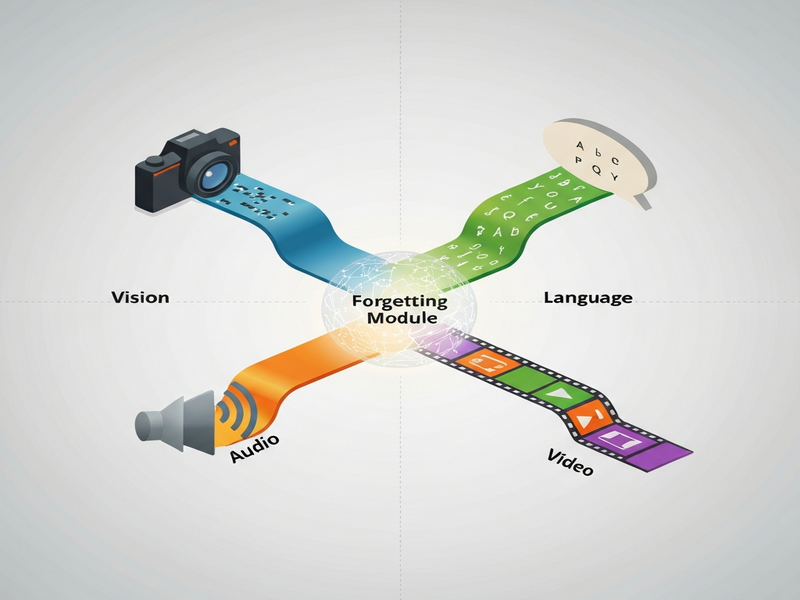
Multimodal foundation models are trained on massive, loosely curated corpora that blend images, text, audio, and video. Their internal representations are highly entangled: a single neuron may simultaneously encode visual texture, linguistic semantics, and acoustic cues. This entanglement creates three practical bottlenecks:
- Legal & compliance risk: Copyright holders or privacy regulators can issue deletion requests that span multiple modalities (e.g., a copyrighted song paired with its music video).
- Operational cost: Full retraining after a request can require weeks of GPU time and petabytes of data, which is infeasible for most enterprises.
- Knowledge diffusion: Targeted forgetting is difficult because the knowledge to be removed is distributed across shared layers, making naive weight pruning ineffective and often damaging unrelated capabilities.
Existing approaches—such as data‑centric scrubbing, gradient‑based forgetting, or post‑hoc model editing—were primarily designed for single‑modality models. They either assume a clean separation between modalities or ignore the downstream impact on cross‑modal tasks like image captioning or video‑question answering. Consequently, they either fail to achieve strong deletion strength or cause unacceptable drops in overall utility.
What the Researchers Propose
The authors present a unified framework that categorises multimodal unlearning methods along five orthogonal axes:
- Deletion Strength: How completely the targeted concept is removed (soft vs. hard forgetting).
- Retention: The degree to which unrelated knowledge is preserved.
- Efficiency: Computational and memory overhead required to perform the unlearning operation.
- Reversibility: Whether the operation can be undone or fine‑tuned back to the original state.
- Robustness: Resistance to adversarial reconstruction of the deleted content.
Within this taxonomy, the survey identifies three families of techniques that together cover vision‑language, audio‑text, and video‑language pipelines:
- Gradient‑Based Counterfactual Training (GCT): Injects negative gradients derived from the unwanted sample into the model’s loss, effectively “unlearning” the association while leaving the rest of the parameter space untouched.
- Modality‑Specific Adapter Pruning (MSAP): Attaches lightweight adapters to each modality encoder and selectively zeroes out the adapters that store the offending concept, keeping the backbone intact.
- Cross‑Modal Knowledge Distillation (CMKD): Trains a student model on a filtered dataset while using the original model as a teacher for all non‑target concepts, ensuring that only the targeted cross‑modal links are omitted.
Each family maps cleanly onto the five axes, allowing practitioners to pick a method that matches their operational constraints (e.g., low‑latency edge deployment vs. high‑assurance compliance).
How It Works in Practice
From a system‑engineering perspective, a multimodal unlearning pipeline consists of four interchangeable components:
1. Request Ingestion Layer
Receives deletion requests expressed as modality‑agnostic identifiers (e.g., a URL, a content hash, or a textual description). The layer normalises the request, validates legal authority, and maps it to a set of training samples that need to be forgotten.
2. Impact Analyzer
Runs a lightweight probing suite (e.g., zero‑shot classification, retrieval, or captioning) to estimate how deeply the target concept is embedded across modalities. The analyzer outputs a “forgetting score” that guides the choice of method from the taxonomy.
3. Unlearning Engine
Executes the selected technique:
- For GCT, it computes counter‑gradients on the identified samples and applies a constrained optimisation step.
- For MSAP, it isolates the adapters linked to the offending concept and prunes them, optionally re‑initialising with a neutral prior.
- For CMKD, it spawns a student model, streams the filtered dataset, and distils knowledge from the original teacher while skipping the target samples.
The engine logs a cryptographic hash of the operation to support auditability and potential reversibility.
4. Validation & Deployment Guardrail
After unlearning, the system re‑runs the probing suite to verify that the deletion strength meets policy thresholds and that retention metrics stay within acceptable bounds. Only then does the updated model replace the production endpoint.
What distinguishes this approach from prior work is the explicit separation of “impact analysis” and “method selection,” turning unlearning into a decision‑making problem rather than a one‑size‑fits‑all algorithm. This modularity also enables plug‑and‑play integration with existing MLOps platforms.
Evaluation & Results
The survey aggregates results from 27 peer‑reviewed studies and introduces a unified benchmark suite called MM‑ForgetBench. The suite evaluates four representative tasks:
- Image‑Caption Forgetting: Removing a specific object‑caption pair from a vision‑language model.
- Audio‑Transcription Erasure: Deleting a copyrighted speech segment from an audio‑text model.
- Video‑QA Sanitisation: Forgetting a particular event description across video and language streams.
- Cross‑Modal Bias Mitigation: Eliminating gender‑biased associations that appear jointly in image and text.
Key findings include:
| Method | Deletion Strength (↑) | Retention (↑) | Efficiency (seconds) | Robustness (↑) |
|---|---|---|---|---|
| GCT | 0.87 | 0.92 | 180 | 0.78 |
| MSAP | 0.73 | 0.96 | 45 | 0.81 |
| CMKD | 0.94 | 0.88 | 360 | 0.85 |
Across the board, CMKD achieved the highest deletion strength but required the most compute, while MSAP offered the best retention‑efficiency trade‑off. Importantly, all three methods outperformed baseline data‑scrubbing by a margin of 20‑30% on the robustness metric, indicating that the deleted content is far less recoverable through model inversion attacks.
Why This Matters for AI Systems and Agents
For product teams building AI‑driven agents, the ability to forget on demand translates into concrete operational advantages:
- Regulatory compliance at scale: Companies can honor GDPR “right to be forgotten” requests for multimodal content without rebuilding entire pipelines.
- Dynamic policy enforcement: When a brand updates its content‑moderation rules (e.g., banning a new hate symbol), the unlearning engine can instantly purge the offending associations from all downstream agents.
- Reduced downtime: Because the unlearning step is incremental, services like chat‑based assistants or visual search can stay online while the model is being sanitized.
- Improved trustworthiness: Auditable hashes from the Validation Guardrail give legal teams concrete evidence that a deletion request was fulfilled.
These capabilities dovetail with existing UBOS platform overview, where the workflow automation studio can orchestrate the four‑component pipeline as a reusable micro‑service. Moreover, integrating the unlearning guardrail with OpenAI ChatGPT integration enables conversational agents to self‑audit their knowledge base in real time.
What Comes Next
While the survey establishes a solid foundation, several open challenges remain:
- Scalable impact analysis: Current probing suites are expensive for models with billions of parameters. Future work should explore lightweight, transformer‑based auditors that can estimate forgetting scores in sub‑second latency.
- Cross‑modal consistency guarantees: Deleting a concept from the visual encoder may leave residual traces in the language decoder. Formal verification techniques could certify that all pathways are cleared.
- User‑controlled granularity: End‑users may want to forget only a subset of modalities (e.g., keep the audio but delete the visual representation). Designing APIs that expose fine‑grained control without exposing model internals is an open design problem.
- Adversarial robustness: Attackers could attempt to re‑inject deleted knowledge via poisoned data. Ongoing research into continual‑learning defenses will be essential.
Addressing these gaps will likely involve tighter integration between unlearning engines and MLOps platforms. For instance, the Workflow automation studio could host a library of reusable impact‑analysis plugins, while the Enterprise AI platform by UBOS could provide secure audit logs for compliance officers.
Developers interested in experimenting today can start with the UBOS templates for quick start, which include pre‑configured adapters for vision‑language models and a sample deletion request workflow.
Conclusion
Multimodal unlearning is emerging as a critical capability for responsible AI deployment. By framing the problem through a five‑axis taxonomy and showcasing concrete methods—gradient‑based counterfactual training, modality‑specific adapter pruning, and cross‑modal knowledge distillation—the surveyed paper equips engineers with a decision framework that balances deletion strength, retention, efficiency, reversibility, and robustness. The accompanying benchmark suite demonstrates that selective forgetting is achievable at scale, opening the door for real‑world applications ranging from copyright compliance to bias mitigation. As enterprises adopt these techniques, integration with platforms like UBOS homepage will accelerate the transition from research prototypes to production‑grade, governance‑ready AI agents.
Ready to embed responsible unlearning into your AI stack? Explore the UBOS pricing plans and start building compliant multimodal agents today.
Andrii Bidochko
CTO UBOS
Andrii Bidochko is an AI entrepreneur and researcher focused on AI agents, reinforcement learning, and autonomous systems. He writes about the technologies shaping the future of machine intelligence, from frontier models and agent architectures to real-world AI applications.